Recommended
Blog Post
Adressing “Root Causes” of Irregular Migration

Blog Post
EU “Partnerships”: A Euphemism for European Interests
On Monday, EU negotiators struck a deal to overhaul the Generalised Scheme of Preferences, under which poorer countries receive reduced or zero tariffs when exporting to the single market. The agreement, once formally adopted and applied, means the EU could suspend trade benefits for partner countries that do not cooperate on the return and readmission of failed asylum seekers.
This conditionality marks a significant shift in the EU’s approach, which is already being mirrored elsewhere. Negotiations for the EU’s next seven-year budget—for the 2028-2034 Multiannual Financial Framework (MFF)—are underway. Almost double the size of the external pot in the last MFF, the current proposal calls for €200 billion to be committed to a growing set of external priorities and for development aid to be tied—whether explicitly or implicitly—to cooperation on the return of failed asylum seekers. The EU will be focused on the MFF during the negotiations over the next few months, and managing migration will also be central to the Cypriot Presidency starting on January 1.
If Europe can expand returns in a legal, humane, and predictable way, this could increase credibility with domestic audiences; protect development budgets and trade access; and open space for discussions on legal migration pathways. In this blog, we explore how it can be done.
Returns are necessary, but hard to implement...
As the EU itself notes, returns and readmissions are essential elements of a comprehensive approach to migration. Returns fall into three broad categories: forced, voluntary, and self-funded. Of the 450,000 third-country nationals who are ordered to leave the EU each year, fewer than 25 percent are actually returned to a third country, with a reported mix of forced and voluntary returns. This gap feeds public perceptions that migration is “out of control”, undermining trust in migration management systems and limiting the space for evidence-based policymaking on legal migration pathways. So why are there so few returns?
There are a range of structural obstacles in both EU member states and in countries of origin. The country of origin might refuse to issue laissez-passer or other travel documents, or may be slow to engage in consular cooperation, especially when they have limited incentives to take people back. They may also contest the person’s nationality; verifying identity can be slow and technically difficult, as many migrants arrive without documents or come from contexts where civil registries are weak or records were destroyed.
On the EU side, return procedures and capacities differ widely across member states, including variations in how return orders are issued and recorded, as well as in the legal definitions of entry and return. In addition, the available data on irregular migration and returns is often incomplete, partly due to different national definitions of irregularity and the categories of third-country nationals included (or excluded) in the statistics. This limits the comparability of data, while making it harder to understand the trends and to thoroughly assess the return gap.
What needs to be improved
There will likely be an increased focus on supporting returns and readmissions within the new MFF. What can policymakers learn from current examples? Despite having a small number of irregular migrants in the EU, Ghana has been one of their more constructive partners on identification and voluntary readmission. This is largely because cooperation is tied to the Joint Agenda on Migration and Mobility, which also prioritises legal pathways, skills partnerships, and reintegration support. With other countries, forced returns are often at odds with domestic policies and, hence, there is less cooperation.
Where possible, the priority should be Assisted Voluntary Returns (AVR). AVR programmes have run over the last fifty years, vary in structure, and usually support the migrant to travel to their country of origin with administrative, logistical, and reintegration support. They are also cost-effective: evaluations of a UK AVR programme found the average cost was £1,000, compared to £15,000 for a forced return. For countries of origin, when carefully designed by European development and migration departments with reintegration support in mind, AVR can contribute to economic development through the return of skilled workers.
In terms of delivering an AVR programme, there are two dominant models. The first, preferred by the UK, France and Germany, sees AVR managed by one organisation (such as IOM in Germany and OFII in France), with support from the public sector and NGOs for communications and reintegration programming. The second, employed by Italy and Spain, sees AVR handled by multiple different organisations through competitive tender processes. Initial analysis has shown that the first model delivers higher rates of AVR.
However, measures of success should take into account the sustainability of return programmes—such as income generation and the returnee’s ability to reintegrate with their family and community—rather than return by numbers alone. Effective AVR programmes rely on cooperation and trust by the migrants, their communities, and the implementing organisations. Building this trust requires sustained investment in reintegration. For example, the German StarthilfePlus reintegration programme, implemented by IOM, has provided both financial and skills-based reintegration support to over 15,000 people. Follow-up surveys found 85 percent of returnees were satisfied with the programme, with just 5 percent making active preparations to migrate again.
The new “Pact on Migration and Asylum”
Returns and readmissions are also central to the new “Pact on Migration and Asylum”, set to apply from mid-2026. Among other goals, it also seeks to address the shortcomings outlined above, such as limited cooperation from third countries, insufficient data, and uneven processes across member states. The proposal plans to tackle these issues through four pillars: (1) secure external borders; (2) implement fast and efficient asylum procedures; (3) establish an effective system of solidarity and responsibility; and (4) embed migration in international partnerships, including promoting legal migration pathways.
On the EU side, the pact tries to reduce internal divergences by creating more harmonised, faster procedures. Negative asylum decisions at the border will now be issued together with a formal return decision, with appeals handled within predefined time limits. This is meant to speed up the returns process by starting return arrangements immediately after a negative asylum decision. The goal is to close the long gap between a return order and the actual return, so that people move more “seamlessly” between the different legal steps. The upgrade of Eurodac (the European Union's fingerprint database for identifying asylum applicants and irregular migrants) into a broader asylum and migration database should tackle the shortcomings in data collection, information exchange, and monitoring.
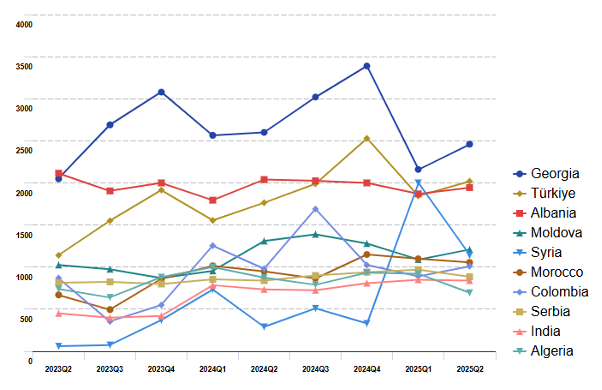
On pillar four, the Pact offers less detail. While it promises closer cooperation on readmission alongside anti-smuggling operations and legal pathways, it does not fundamentally change the incentive structure for third countries that are reluctant to issue travel documents or accept back their nationals. It also creates perverse incentives for the EU in deciding which countries should be prioritised for comprehensive migration agreements. That being said, agreements have apparently been sought with the roughly the right countries to date from a returns perspective. Figure 1 details the top 10 countries of migrant origin ordered to leave the EU from Q2 2023 to Q2 2025. Of these, Morocco, Tunisia, and Bangladesh have been prioritised for a Talent Partnership; indeed, Tunisia has already signed theirs. While an imperfect comparison, the top ten nationalities of migrants who actually left the EU (whether forced or voluntarily) included those from Algeria, Türkiye, Syria, Moldova, and Georgia (Figure 2).
Many of these countries are EU candidate countries, creating strong incentives for returns and readmission cooperation. This would suggest that comprehensive partnerships should be sought with the remaining top 10 countries, with high numbers of nationals ordered to leave. Yet both Mali and Afghanistan have political challenges which make both political dealings and returns difficult. And a Talent Partnership with Senegal has already been announced (albeit, stalled).
Figure 1. Third-country nationals ordered to leave, top 10 citizenships, Q2 2023-Q2 2025
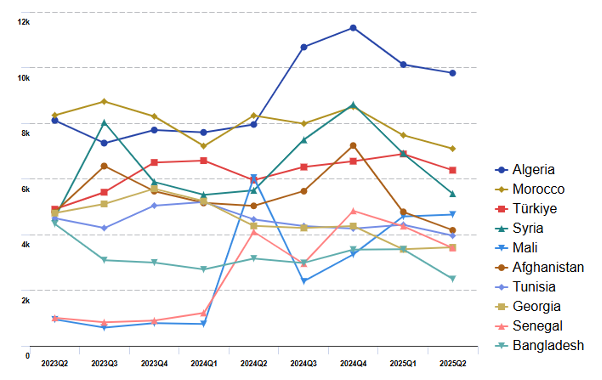
Figure 2. Third-country nationals returned to a third country following an order to leave, top 10 citizenships, Q2 2023-Q2 2025
If the EU is to properly manage irregular migration, it will be important that pillar four maintains a balance between returns and legal migration pathways. This will mean making sure there are meaningful legal migration opportunities included within the Talent Partnerships and other comprehensive migration agreements. It may also mean that the EU has to make some tough choices: prioritising countries which offer a large, skilled, educated, and ambitious labour pool, despite not being a priority country from a returns and readmission perspective. For example, by 2050, Nigeria will account for 1 in 10 births globally. This makes it an obvious candidate for a Talent Partnership if the EU is to manage potential future migration from the country and support the training and migration of skilled workers.
Conclusion
As the MFF negotiations move ahead under the Cypriot presidency, the EU has a unique opportunity to embed these principles into its next seven-year budget. A well-designed returns system—one that is humane, predictable, and part of broader mobility partnerships—can help restore confidence in migration management while safeguarding development resources; ensuring fair market access for the poorest countries; and creating space to expand legal migration pathways.
Ultimately, getting returns right is not just about demonstrating control; it is a prerequisite for building durable, mutually beneficial relationships with partner countries and for showing domestic audiences that managed migration can deliver clear economic and social value.
Topics
DISCLAIMER & PERMISSIONS
CGD's publications reflect the views of the authors, drawing on prior research and experience in their areas of expertise. CGD is a nonpartisan, independent organization and does not take institutional positions. You may use and disseminate CGD's publications under these conditions.