Recommended
Blog Post
How the UK Should Focus Its Aid in 2026
Blog Post
Breaking Down Prime Minister Starmer’s Aid Cut
The UK government is finalising country finance allocations, with £3 billion in cuts to its international budget planned over the next two years.In our last blog, we proposed three high-level tests by which the FCDO’s allocations can be judged: Will a greater share of aid be channelled through multilateral institutions? Will more of the bilateral budget be directed to Africa? And will grants to upper-middle-income countries come to an end?
Here, we look in more detail at individual country allocations, offering recommendations on which to protect and which to deprioritise in order to advance the government’s poverty reduction mission.
In particular, we analyse where extreme poverty is concentrated and develop a metric to show where recipient countries are neglected by other providers (given what we know about US cuts). We use this metric to identify 12 developing country partners that are significantly under-supported by other providers, argue for the UK to protect these investments in the cuts, and provide an illustrative reduction.
Little time, big consequences
Despite also featuring confirmation of major cuts to international spend, one silver lining in the 2025 Spring Statement and Spending Review was a predictable, ringfenced budget for the Foreign, Commonwealth and Development Office (FCDO) and its official development assistance (ODA). Now, multi-year planning is possible, without programmes being directed to hold back a fifth of budgets in case of the Home Office overspends on refugee hosting. In the autumn, the FCDO plans to publish indicative allocations covering the period FY2026 to FY2028 (following those just published for FY2025). Its programme ODA budget will be cut by a third during this period, from £9.3 billion in FY2024 to £6.2 billion in FY2027.
This places us at a critical moment, with little time to make decisions on the FCDO’s country allocations with consequences for the rest of the decade.
How many countries does UK ODA support?
The government has said it will prioritise its humanitarian support to Ukraine, Gaza and Sudan—but beyond this it has given little indication of how its bilateral country allocations will be determined. The FCDO’s FY2025 ODA plans include specific budgets for 34 countries (30 of which are over £10 million), and a further 57 countries are listed under allocations to multi-country groupings. This blog focuses on how the 34 countries with specific budgets should be prioritised in the coming cuts.
Table 1. Number of countries supported by FCDO
| Year | Countries specifically allocated over £10m | Countries specifically allocated under £10m | Additional countries listed under allocations to multi-country groupings* |
|---|---|---|---|
| FY2025 (plans) | 30 | 4 | 57 |
| FY2024 | 28 | 12 | 59 |
| FY2023 | 27 | 8 | 45 |
*Including only ODA-eligible countries not also allocated a specific budget
Source: FCDO (July 2025) Annual Report and Accounts 2024 to 2025, Annex A & FCDO (July 2024) Annual Report and Accounts 2023 to 2024, Annex A
A focus on the poorest countries, neglected by other providers
The government’s mission on international development is “to create a world free from poverty on a liveable planet”. As such, its allocation should reflect the global distribution of poverty, and focus on those places where poverty is greatest. A focus on need can also yield greater impact: the principle of diminishing marginal utility suggests that the economic returns to spending in middle-income countries must be many multiples higher than in lower-income countries to achieve the same welfare gains. Yet the poverty focus of UK finance has declined over recent years. And the FCDO’s latest allocations are not moving in the right direction: the Equality Impact Assessment of its FY2025 plans found no change in the least developed country (LDC) share from the previous year. Prioritising the poorest countries is necessary to reverse this trend.
To be strategic, FCDO investment allocations should also consider the allocations of other providers, and prioritise those countries which receive less support than they really should. As cuts to some FCDO country allocations are inevitable, these will have the least harmful impact if they fall on countries which are already relatively over-prioritised by other donors. To ascertain which countries to prioritise then, we need to take a view on how much each country ideally should receive, and there are multiple options here (something we considered for our 2021 assessment of ODA quality, QuODA). Below, we opt for a simple benchmark which reflects the global distribution of extreme poverty, in accordance with the government’s stated mission.
In considering the allocations of other providers, it’s also important to factor in the impact of the recent cuts to US Foreign Assistance. In February we conducted some early analysis into which recipient countries were most exposed to the USAID cuts, if the spending pause had continued for the rest of the year. But our colleagues Charles Kenny and Justin Sandefur updated this picture in March, based on a list of terminated USAID programmes shared with Congress. The difference is significant: in February we found that eight of the most macroeconomically exposed countries faced potential cuts ranging from 3.1 to 9.1 percent of their GNI; but the March list of terminated programmes were below 1.4 percent of GNI in each of these countries. This may not be the final picture of US aid cuts but we felt it was better to include the latest estimates of known reductions.
Which countries are under-supported by other providers?
To identify where UK investment could have the most impact on extreme poverty, we created a metric to assess the degree to which countries are under- or over-prioritised by other providers (after considering the confirmed USAID cuts). This metric reflects the ratio between each country’s actual aid allocation and the amount they should have received if the global aid budget were divided equally across each person living in extreme poverty (defined using the World Bank’s international poverty line, recently updated from $2.15 to $3 a day). Ratios below 100 percent indicate that a recipient country is under-prioritised by non-UK providers relative to their level of poverty, and ratios above 100 percent indicate it is over-prioritised.
Were the global aid budget distributed equally per person living in extreme poverty, after excluding the UK’s budget, and USAID cuts, each would be allocated $239. Relative to this benchmark, a country which received about $50 per person living in extreme poverty would have a ratio of just over 20 percent; whereas a country which received about $600 per person living in extreme poverty would have a ratio of just over 250 percent.
An alternative way to understand our metric is that it reflects the ratio between the actual share of global aid a country receives and its share of global extreme poverty. For instance, if 4 percent of the extreme poor live within a country, but it received 1 percent of global aid, it would score 25 percent; whereas if it received 6 percent of global aid it would score 150 percent.
This is not the only way to think about over or under-prioritisation—but it provides an intuitive guide to which countries providers neglect, and a benchmark of equal aid per person living in extreme poverty is especially relevant for the UK government’s mission on international development.
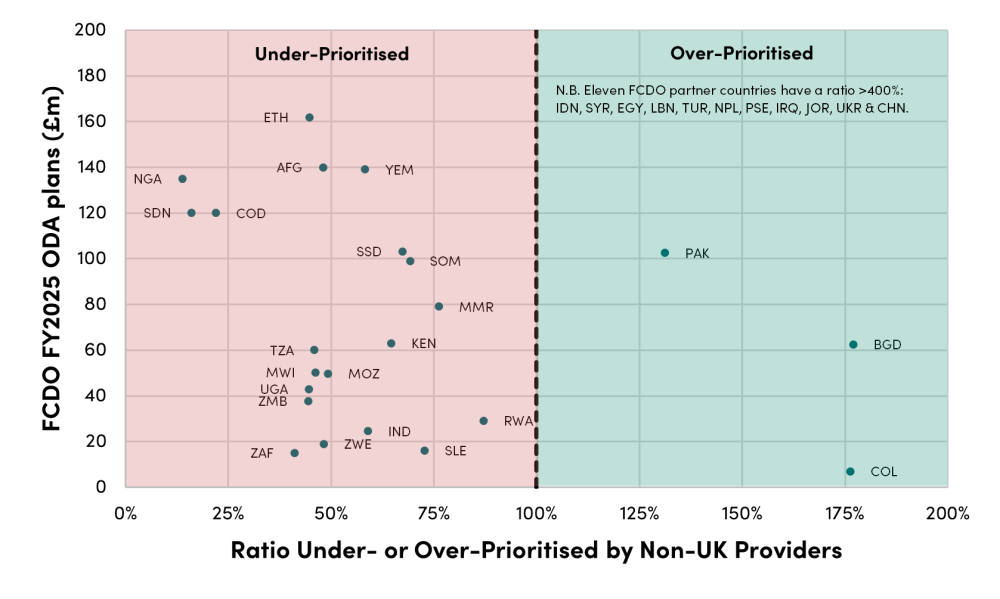
The below figure plots the extent to which countries are under- or over-prioritised against FCDO FY2025 allocation plans.
Figure 1. FCDO partner countries under-prioritised by other providers
Source: CGD analysis of FCDO, OECD, World Bank and SSP data. Full sources in linked spreadsheet.
The huge variation in these figures is remarkable. Eleven FCDO partner countries received over four times the benchmark, or more than $1000 per person living in extreme poverty. (This multiple is so high that they aren’t even plotted on the above chart.) But the twenty under-prioritised FCDO partner countries all receive under $210 per person living in extreme poverty.This reflects a failure of global aid to target extreme poverty, and highlights the importance of the UK’s commitment to that aim.
Twelve partner countries to prioritise, and 12 allocations to cut
We identify 12 FCDO country allocations to protect as decisions are made about where to make cuts, and 12 which should be deprioritised.
FCDO partner countries that are significantly under-supported by others are Nigeria, Sudan, DRC, South Africa, Zambia, Uganda, Ethiopia, Tanzania, Malawi, Afghanistan, Zimbabwe and Mozambique. The over-prioritised countries include Pakistan, Bangladesh, Nepal, Jordan, Turkey, Lebanon and Indonesia.
Of course, this analysis is only part of the story on country prioritisations. Whilst ending poverty is the government’s mission, it will still want to support activities in countries where that is not its objective – clearly this includes Ukraine and Gaza, but potentially also supporting refugees in Jordan or Turkey. Similarly, the statistics on extreme poverty are only part of the picture. Take Syria, for example: Our analysis suggests that others prioritise Syria, and that the UK can therefore step back. But in a dynamic picture based on a richer analysis, there may be a significant opportunity to support a country in transition.
Even so, in the face of implementing budget cuts of around a third; there must be ruthless prioritisation, and this analysis identifies where that might happen to achieve the government’s core goal.
Table 2. FCDO partner countries to prioritise and deprioritise in the coming cuts
| Extreme Poverty, 2025 | Non-UK support | ||||
|---|---|---|---|---|---|
| Country | FCDO FY2025 ODA plans (£m) | Million people | Rate | $ per person in extreme poverty | Ratio under- or over-prioritised |
| Significantly under-prioritised | |||||
| Nigeria | 135 | 113.9 | 50% | 33 | 14% |
| Sudan | 120 | 34.6 | 69% | 38 | 16% |
| DRC | 120 | 76.7 | 73% | 52 | 22% |
| South Africa | 15 | 14.2 | 23% | 98 | 41% |
| Zambia | 38 | 12.9 | 62% | 106 | 44% |
| Uganda | 43 | 19.8 | 41% | 106 | 45% |
| Ethiopia | 162 | 48.0 | 37% | 107 | 45% |
| Tanzania | 60 | 28.2 | 42% | 110 | 46% |
| Malawi | 50 | 15.0 | 71% | 110 | 46% |
| Afghanistan | 140 | 24.2 | 58% | 115 | 48% |
| Zimbabwe | 19 | 5.9 | 36% | 115 | 48% |
| Mozambique | 50 | 25.3 | 75% | 117 | 49% |
| Under-prioritised | |||||
| Yemen | 139 | 28.9 | 73% | 139 | 58% |
| India | 25 | 43.1 | 3% | 141 | 59% |
| Kenya | 63 | 18.8 | 34% | 154 | 65% |
| South Sudan | 103 | 10.4 | 91% | 161 | 67% |
| Somalia | 99 | 13.6 | 74% | 165 | 69% |
| Sierra Leone | 16 | 3.0 | 35% | 173 | 73% |
| Myanmar | 79 | 7.0 | 13% | 182 | 76% |
| Rwanda | 29 | 6.5 | 47% | 208 | 87% |
| Over-prioritised | |||||
| Pakistan | 103 | 17.6 | 7% | 313 | 131% |
| Colombia | 7 | 2.4 | 5% | 420 | 176% |
| Bangladesh | 63 | 15.9 | 9% | 422 | 177% |
| Indonesia | 27 | 2.8 | 1% | >1000 | >400% |
| Syria | 97 | 7.7 | 33% | >1000 | >400% |
| Egypt | 3 | 1.1 | 1% | >1000 | >400% |
| Lebanon | 34 | 0.4 | 7% | >1000 | >400% |
| Türkiye | 33 | 0.2 | 0% | >1000 | >400% |
| Nepal | 47 | 0.1 | 0% | >1000 | >400% |
| West Bank & Gaza Strip | 101 | 0.1 | 2% | >1000 | >400% |
| Iraq | 7 | 0.0 | 0% | >1000 | >400% |
| Jordan | 44 | 0.0 | 0% | >1000 | >400% |
| Ukraine | 240 | 0.0 | 0% | >1000 | >400% |
| China | 0.4 | 0.0 | 0% | >1000 | >400% |
Sources: CGD analysis of FCDO, OECD, World Bank and SSP data. Full sources in linked spreadsheet.
Notes: Data on extreme poverty in 2025 is collated from a variety of sources to ensure complete country coverage. In the few cases where no surveys have been conducted, we estimate the extreme poverty rate. See attached spreadsheet for full details.
The presence of Bangladesh and Pakistan on the over-prioritised list is notable—they are long-standing UK development partners and are relatively low-income countries with collectively over 30 million people living in extreme poverty. Our analysis does not suggest that these countries do not need aid, rather, it highlights that, even after US aid cuts, other providers are providing over $12 billion, which amounts to over $400 and $300 per person in extreme poverty respectively. This is double the level of equivalent support provided to any of the twelve under-supported countries.
What cuts might countries need to face?
If country budgets take cuts in line with the overall FCDO ODA budget, they will reduce by 20 percent next year, a fall of around £400 million. If FCDO cut all support to the countries over-prioritised by others, it would save £464 million and could protect all twenty under-prioritised countries from any cuts. Below we present another scenario where it cuts over-prioritised countries in half to largely protect those that are significantly under-prioritised:
Table 3. Illustrative scenario for FCDO ODA cuts that prioritise extreme poverty
| Country group | FY2025 Budget (£m) | Potential cut | FY2026 (£m) |
|---|---|---|---|
| Significantly under prioritised (12) | 951 | 5% | 904 |
| Under prioritised (8) | 553 | 20% | 442 |
| Over prioritised (12, excl. Ukraine & West Bank & Gaza Strip) | 464 | 50% | 232 |
| Total | 1,968 | 1,578 |
Tackle poverty, show taxpayers and partners you focus on those most in need
Ministers are clear about the need for tough choices in allocating investments from the much-reduced budget. That will mean that many objectives and opportunities for UK finance will need to be forgone. Still, there is room to concentrate the remaining budget on tackling the poverty at the heart of the government’s mission. This analysis seeks to supplement the government’s own country prioritisation with an up-to-date estimate of countries that, taking account of US cuts, are relatively neglected by other providers. Investments have the potential to go much further in these countries. There are also direct benefits to the UK of this approach—taxpayers and developing countries would see the UK put partner need at the heart of its approach; and the UK would be a more important and influential partner in countries with more limited aid from elsewhere.
Small corrections were made to this blog on 28th August 2025, affecting the total estimated number of people living in extreme poverty across ODA-eligible countries, and to include the West Bank and Gaza Strip in Figure 1 and Table 2. These corrections did not affect our identification of under- and over-prioritised FCDO partner countries to protect or cut.
Topics
DISCLAIMER & PERMISSIONS
CGD's publications reflect the views of the authors, drawing on prior research and experience in their areas of expertise. CGD is a nonpartisan, independent organization and does not take institutional positions. You may use and disseminate CGD's publications under these conditions.
Thumbnail image by: Flickr/ DFID