Recommended
Blog Post
Tracking the Impact of Recent US Foreign Policy Shifts

DATA VISUALIZATION

In a nutshell:
Between January and July 2025 (the latest available data), the behavior of US importers reflected expectations about the trajectory of US tariffs:
- Increases in tariffs on China since February 2025—and expectations they would remain high or rise further—led US importers to frontload imports from China in January and then contract them thereafter.
- In contrast, relatively low tariffs on imports from the rest of the world (excluding China) at the beginning of the year combined with pauses in the rollout of new tariffs until August encouraged US importers to continue frontloading through July 2025. As a result, the full effects of tariffs on most countries’ exports have not yet been felt.
With reciprocal tariffs taking effect in August 2025, US imports from a large number of countries may contract worldwide in the months ahead. This would hold for US imports from all country income groupings except low-income countries, where imports have already declined. For the latter, expectations regarding AGOA expiration played an important role.
Since pauses applied to reciprocal tariffs, but not sectoral tariffs, this may have contributed to the slowdown in import growth from high-income countries—the group most affected by sectoral tariffs, particularly those on automobiles and auto parts.
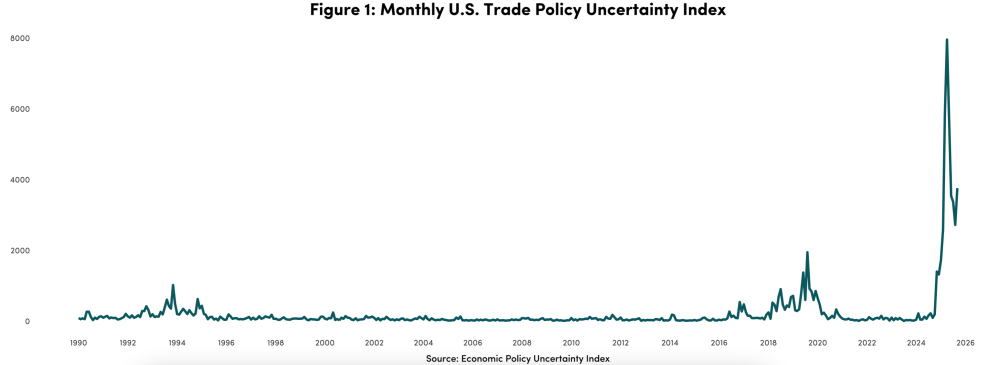
The US’s 2025 tariff announcements have been nothing short of staggering. From the April 2 announcements of reciprocal tariffs, to the 90-day pause first issued on April 9 and later extended to August 1, to the special tariff regimes targeting China, Mexico, and Canada—not to mention higher tariffs on products such as copper, steel and aluminum, and on countries like India and Brazil—US trade policy has been defined by uncertainty. Not surprisingly, the index of Trade Policy Uncertainty, though off its April 2025 peak, remains extremely high and well above historical levels.
Economic actors make decisions based on expectations—even in uncertain environments. For example, if firms and consumers believe tariffs on a country will remain persistently high, they will likely cut imports from that country and shift to alternative sources. Conversely, if they expect tariffs on other countries to rise in the future, they will frontload imports now to avoid paying higher costs later.
That is precisely what the data shows in the first seven months of 2025. To explain, here is a world tour of US import behavior:
Data suggests high tariffs on China are seen as credibly persistent
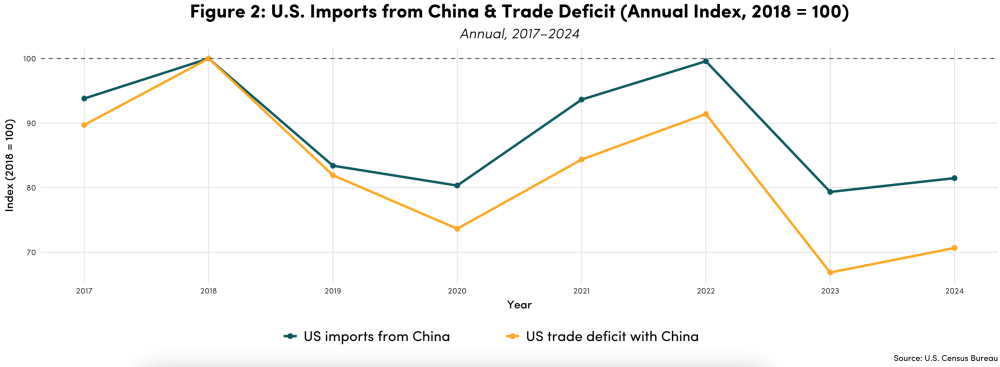
Policy actions from administrations of both parties since 2018 have made clear that the US-China trade war would be persistent and sustained. The first Trump administration raised tariffs on China twice, reaching about 20 percent by the end of 2020, which the Biden administration maintained. Since February 2025, the second Trump administration has imposed a series of new tariffs on China. These began with two consecutive 10-percentage-point increases to existing tariffs on February 1 and March 3, 2025, linked to demands for fentanyl cooperation but imposed on all Chinese goods. This was followed by a roller coaster of further tariff hikes and pauses in implementation. New sectoral tariffs—such as those on auto parts and low-value de minimis products—have also affected China’s exports. As of now, tariffs on China stand at roughly 57 percent, with the possibility of additional increases once the current tariff truce expires on November 10, 2025.
In this context, firms and consumers judged that high US tariffs on China were here to stay, and adjusted their behavior accordingly: imports from China declined from 2018 to 2024, as did the US trade deficit with China (Figure 2). The exception was during the COVID-19 years (2020-21), when consumer demand for goods manufactured in China—especially electronics, toys, and home goods—temporarily surged as Americans shifted spending from services to physical products while staying at home. It also helped that many of these products were not subject to tariffs then.
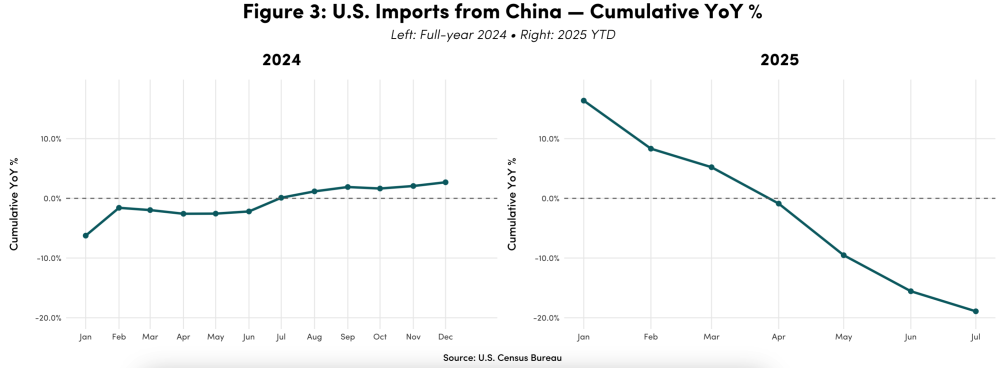
Anticipating the new tariffs on China beginning in February 2025, imports in January spiked as firms frontloaded—US imports from China in January 2025 rose by about 35 percent relative to January 2024. By contrast, the growth rate between January 2023 and January 2024 had been -6 percent. Once the first Executive Order imposing tariffs took effect in February, the cumulative year-on-year change in US imports from China began to decline, turning negative by April 2025. By July, year-to-date cumulative imports had fallen nearly 20 percent compared with the same period in 2024, which itself had shown little change relative to 2023. Consecutive announcements of pauses on tariffs did little to prevent this decline, given the already very high tariffs in place.
Expectations for US tariffs on the rest of the world differed significantly from those on China: frontloading continued
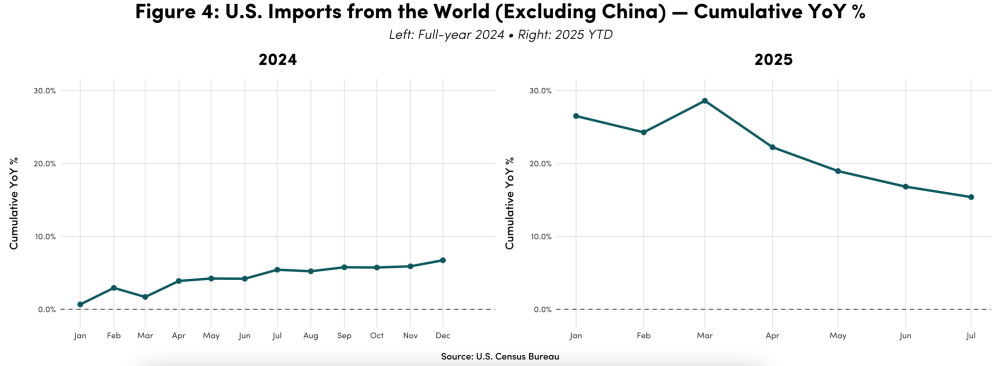
Importers behaved quite differently toward the rest of the world. January 2025 saw frontloading across the board, but while imports from China have since contracted, imports from other countries have increased. As shown in Figure 4, the cumulative rates of change for US imports from the world excluding China remained positive and significantly higher than in comparable periods of 2024. Two factors help explain this divergence when considered together:
- Starting point: As noted above, tariffs on China were already around 20 percent in January 2025, while tariffs on the rest of the world averaged around 3 percent. By early March 2025, tariffs on China rose to 40 percent due to the fentanyl-related measures, whereas the world ex-China average remained at 3 percent.
- Pauses on reciprocal tariffs: The April and July pauses allowed importers to continue frontloading imports from the world ex-China beyond January. After all, with the exception of China, Canada and Mexico, the new reciprocal tariffs stayed at 10 percent for most of the April-July period—high, but for many countries well below the rates announced on the so-called Liberation Day.
That said, effective tariff rates (ETRs)—tariffs adjusted for product exemptions and sectoral tariffs—likely also played a role. ETRs were certainly much higher than 10 percent for some countries, as reflected in the CGD tracker, due to the sectoral tariffs, which were not paused. This may have moderated the high global import growth as shown in Figure 4.
Overall, US import data from the first seven months of 2025 are consistent with expectations that tariffs on the world ex-China would rise significantly and persistently starting in August.
However, the aggregate “world ex-China” conceals some significant differences across countries. We now turn to discussing US imports by country groupings.
China’s competitors: Trade diversion accelerates
As noted in a previous CGD note, the 2018–19 tariffs on China spurred US imports from competing exporters, particularly in Asia. The large tariff differential between China and its competitors created strong incentives for trade diversion and even rerouting—namely, shipping Chinese goods through third-party countries like Vietnam. By the end of 2024, the US bilateral trade deficit with non-China Asian countries exceeded that with China.
Enter 2025. The increase in Trump tariffs on China since the beginning of the year triggered a reaction similar to that following the 2018–19 tariffs: a surge in the growth rate of US imports from non-China Asian countries, notably Vietnam, as well as Indonesia, Thailand, and Taiwan. By July 2025, the year-on-year cumulative rate of change for US imports from these countries had reached over 40 percent—more than double the rate in the comparable period of 2024 (Figure 5).
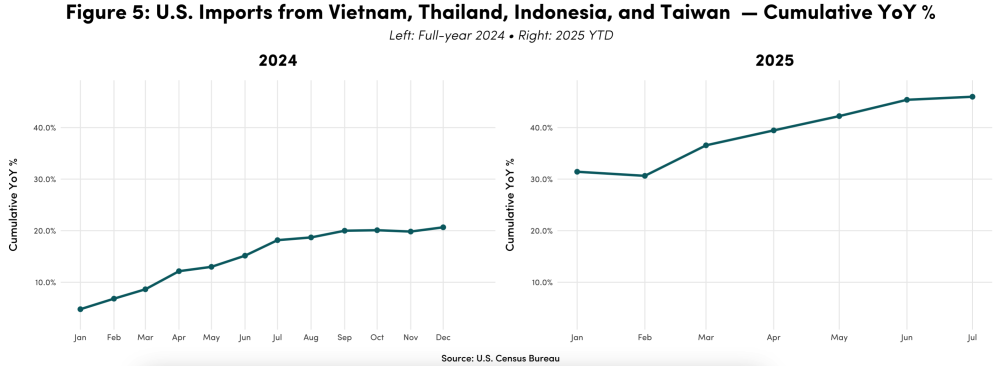
Although high tariffs were also announced for these competitors, the April and July tariff pauses reinforced incentives to stockpile imports ahead of their implementation in August. For these countries, it is possible that large US imports will continue in the latter part of the year. Since they export relatively little in sectors subject to US sectoral tariffs (e.g., steel, copper, autos), their effective tariff advantage relative to China remains substantial. There has been a 40 percent tariff on transshipped goods effective since August 1, but evidence suggests it may prove difficult to implement.
How have tariffs affected imports from countries of different income levels?
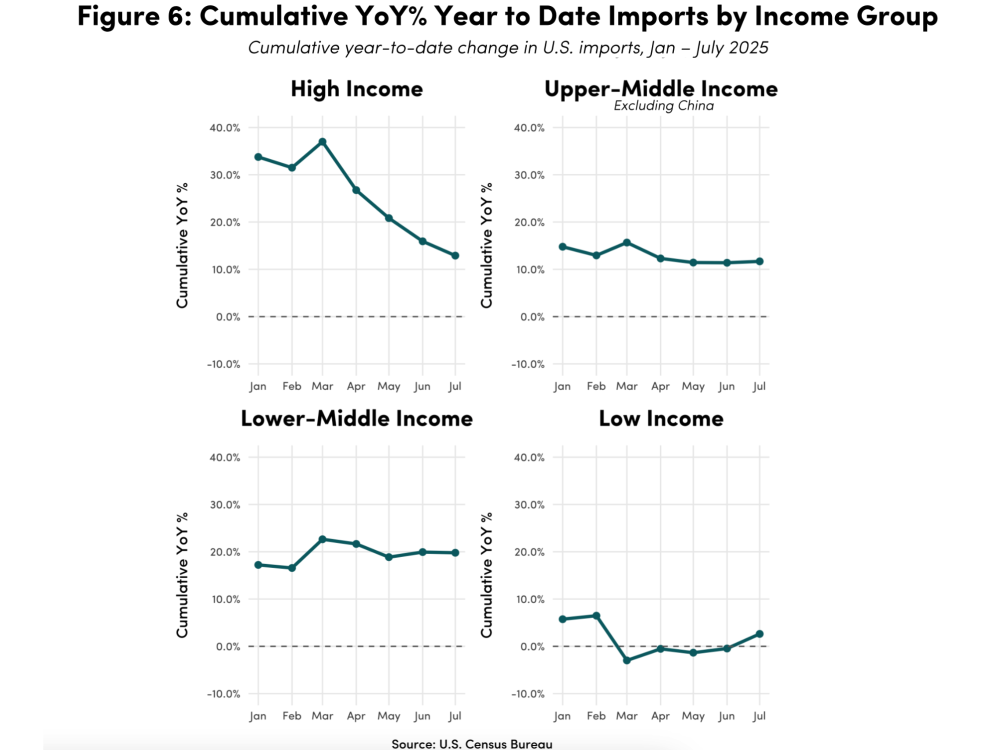
Figure 6 breaks down US imports in 2025 by country income levels: high-income, upper-middle-income, lower-middle-income, and low-income. The upper-middle income group excludes China.
The most notable divergence is between the first three income groups and low-income countries:
- High-, upper-middle-, and lower-middle-income countries show clear evidence of frontloading in January 2025 (charts for 2024 are omitted to save space),[1] with strong import growth continuing through July
- Low-income countries show no frontloading in January,[2] and imports contracted for most of the period.
Clearly, the deceleration of US import growth from the world ex-China in the first seven months of 2025 can be attributed to the observed slowdown in imports from high-income countries and, to a lesser extent (due to much lower import values), to the year-on-year contraction of imports from low-income countries.
High-income countries
High-income countries are the group most affected by sectoral tariffs, which were implemented without pauses. For example, Germany, Japan, and South Korea saw declines in their exports of cars to the US in the first seven months of 2025, affecting the overall value of their exports. Likewise, the UK and European Union countries reportedly experienced declines in their steel exports to the US attributable to the tariffs on steel and aluminum. Recently announced trade “deals” —reducing some sectoral tariffs in exchange for these countries’ investments in the US—may ease the deceleration of these exports in the months ahead.
Low-income countries
For most countries in this group, it is important to note, the US is not a major export destination. Indeed, only Liberia (42 percent) and Madagascar (14 percent) direct significant shares of their exports to the US. For all other countries in this group, exports to the US as a share of total exports in 2024 ranged from 0.01 percent (Niger) to 3.6 percent (Malawi and Togo). However, this does not imply that tariffs are having no effect on these countries. Rather, the impact is concentrated in a few sectors, which in many cases are labor intensive, such as textiles and apparel. For example, US cumulative import growth rates from Madagascar fell into negative territory in some months of 2025. Reportedly, tariff announcements have significantly affected the local apparel industry.
US imports from many low-income countries, as well as several lower-middle and upper-middle-income countries in Africa, are particularly influenced by developments around the African Growth and Opportunity Act (AGOA), a US trade program providing duty-free access to the US market for eligible sub-Saharan African countries. Importers correctly judged that AGOA would be allowed to expire at the end of September 2025, which did not generally support US imports from these countries in the first seven months of the year. Frontloading occurred in some countries, but not the majority, signaling that the US importers are willing to quickly re-shift their business to other suppliers if problems arise with African countries. A precedent occurred in Madagascar in 2009, when a coup led to the country losing AGOA eligibility. At that time, US imports from Madagascar reportedly fell by over 56 percent, resulting in tens of thousands of jobs losses.
The first seven months of 2025 saw a clear pattern: US importers adjusted their behavior based on tariff expectations. The US-China trade war led to increased tariffs with no relief in sight, so businesses frontloaded imports and then cut back drastically. The story elsewhere is one of frontloading and strategic stockpiling—businesses racing to import before reciprocal tariffs took effect in August.
The question now is whether Act II will mirror Act I: if firms believe the post-August tariff regime is here to stay, the import surge from the rest of the world may soon reverse, contracting—just as Chinese imports did.
[1] US imports from high-income countries in January 2025 rose by about 35 percent compared with January 2024. By contrast, the growth rate between January 2023 and January 2024 for this group was close to zero. For upper-middle- and lower-middle-income countries, the January 2025 year-on-year growth rates were 15 percent and 18 percent, respectively, compared with 1 percent and –12 percent for January 2024.
[2]For low-income countries, the year-on-year growth rates were 6 percent in January 2025 and 18 percent in January 2024. However, there is considerable variation in these rates across individual countries.
Topics
DISCLAIMER & PERMISSIONS
CGD's publications reflect the views of the authors, drawing on prior research and experience in their areas of expertise. CGD is a nonpartisan, independent organization and does not take institutional positions. You may use and disseminate CGD's publications under these conditions.
Thumbnail image by: Kalyakan/ Adobe Stock