Recommended


Blog Post
Can Generative AI Enable Personalized Interventions at Scale?

Vaccines are among the most impactful global health innovations. They drive major declines in child mortality and prevent an estimated 3.5 to 5 million deaths every year. The golden age of vaccine development may even still be ahead, with life-saving protection against more diseases being developed faster than ever before. But vaccines only save lives when people actually get them—so clear guidance and widespread uptake matter just as much as scientific breakthroughs.
Figure 1. Number of lives saved by childhood vaccinations from 1974 to 2024
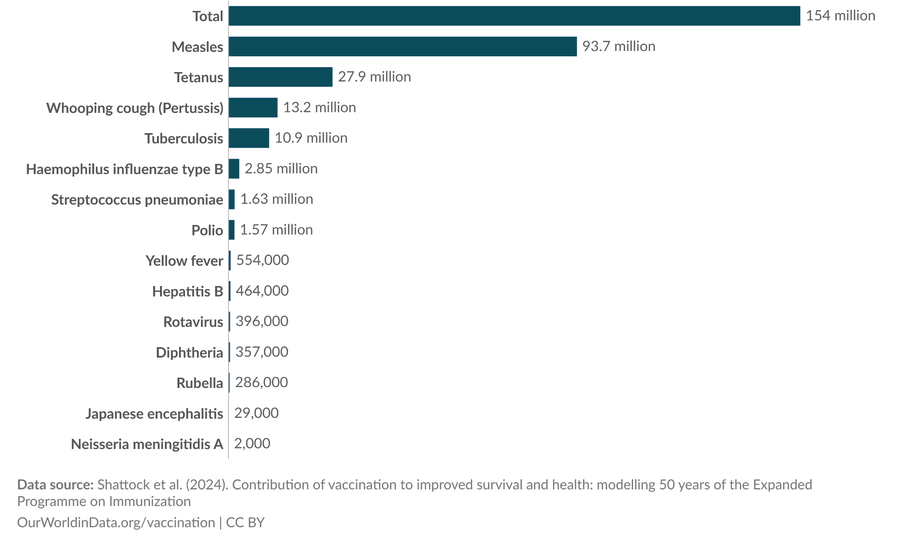
Source: Our World in Data
Last week the U.S. Centers for Disease Control and Prevention moved several childhood immunizations from a “universal recommendation” default to a “shared clinical decision-making” choice. Effectively, that shifts more of the burden onto parents to know what to ask—and onto clinicians to have time to answer. The “universal recommendation” guideline serves a practical function by offering a clear signal that helps families navigate complex choices quickly and confidently. When that signal becomes more ambiguous, confusion rises and questions multiply—making reliable, trusted decision support even more essential.
The U.S. categorization change may drive doubt and missed doses abroad. Even if other countries don’t revise their schedules, U.S. guidance functions as a global reference point and questions travel as fast as global headlines. That matters because hepatitis B and rotavirus are routine parts of childhood immunization worldwide—so shifts in U.S. signals can shape questions and concerns abroad. And more questions, in more places, run into the same constraint: limited time for clinician-parent conversations.
The bottleneck: conversation capacity
Shared decision-making is only as good as the system’s ability to deliver high-quality conversations. But that “conversation capacity” is constrained: visit time is short; clinicians are juggling several priorities; and many parents are trying to sort genuine questions from a noisy, politicized information environment. When the system can’t meet that demand, the gap gets filled elsewhere—group chats and social media—where misinformation spreads.
If more vaccination decisions now hinge on conversation, public health needs scalable decision support that helps parents get to the right questions—before the visit, and on the platforms where families already look. I experienced this firsthand at my daughter’s six-month appointment: I used AI beforehand to think through my questions and the main tradeoffs of additional RSV, flu, and COVID protection for her, so I came in ready to ask one focused question and confirm the plan with her pediatrician. This is where well-designed AI could help support—by answering common questions at scale and helping families arrive better prepared for a clinician conversation.
A scalable complement: AI chatbots
In a recently published Journal of Politics article, my coauthor and I found that a conversation with a scripted chatbot on Facebook among social media users in Kenya and Nigeria who were not yet vaccinated against COVID-19 increased willingness and intentions to get vaccinated—especially among the most initially hesitant respondents. Using a two-stage adaptive experimental design, we first tested multiple concern-addressing responses and optimized the chatbot’s replies for different questions. We then evaluated the optimized chatbot against a chatbot that delivered static, public-service-announcement-style pro-vaccine messaging. The conversational, personalized version performed better—especially among those who were most hesitant at baseline. We measured willingness and intentions (not verified uptake), which is a key limitation of the study but other studies find real-world impact on development outcomes.
Growing evidence suggests that these tools can move actual behavior—and we already know people are using them at scale. Chatbots have been found to increase vaccination in other contexts, including HPV vaccination in China and pneumococcal vaccination among older adults in Hong Kong. In the U.S., 58.5 percent of adults report using the internet to look for health or medical information, and OpenAI reports over 230 million people ask ChatGPT health and wellness questions each week. OpenAI also recently launched ChatGPT Health, which the company says “securely brings your health information and ChatGPT’s intelligence together, to help you feel more informed, prepared, and confident navigating your health.”
Chatbots won’t replace clinicians, but the fact that patients already use them to navigate care means getting the design right is high stakes. As CGD’s recent working group on AI for Global Development underscored, AI tools need to be evidence-based, clearly communicate uncertainty, include strong privacy protections, and be frequently evaluated so we learn what works and for whom. The goal should be to build and test chatbots like other public health interventions, iterating with users and judging success based on health outcomes, not just engagement.
AI won’t be the solution to a breakdown in trust or an increasingly anti-science information environment. Used carelessly, chatbots could make things worse by amplifying misinformation. But they are being used and the question is who’s ensuring their answers are accurate and worth trusting.
This blog was updated on July 16, 2026
Topics
DISCLAIMER & PERMISSIONS
CGD's publications reflect the views of the authors, drawing on prior research and experience in their areas of expertise. CGD is a nonpartisan, independent organization and does not take institutional positions. You may use and disseminate CGD's publications under these conditions.
Thumbnail image by: Mikhailov Studio/ Adobe Stock