Recommended
Earlier this month, the North East Universities Development Consortium annual conference hosted presentations of more than 150 recent economic development studies! It can be hard to keep up with so much new work. More than 60 of those studies were in the social or human development sectors. Reviewing these is a great way to see the frontier of social sector research within economic development.
We went through each of those 60+ studies in the areas closest to our areas of work: early childhood development, education, fertility and family planning, gender, health, households and marriage, labor, migration and refugees, nutrition, safety nets, and climate. While we focus on these, the conference covered many other topics, from economic growth and trade to econometrics and measurement. We identified studies based on sessions with titles around human development sectors, so we missed some relevant studies in other sessions. The full program has links to almost all the papers; check them out!
Where are the studies from?
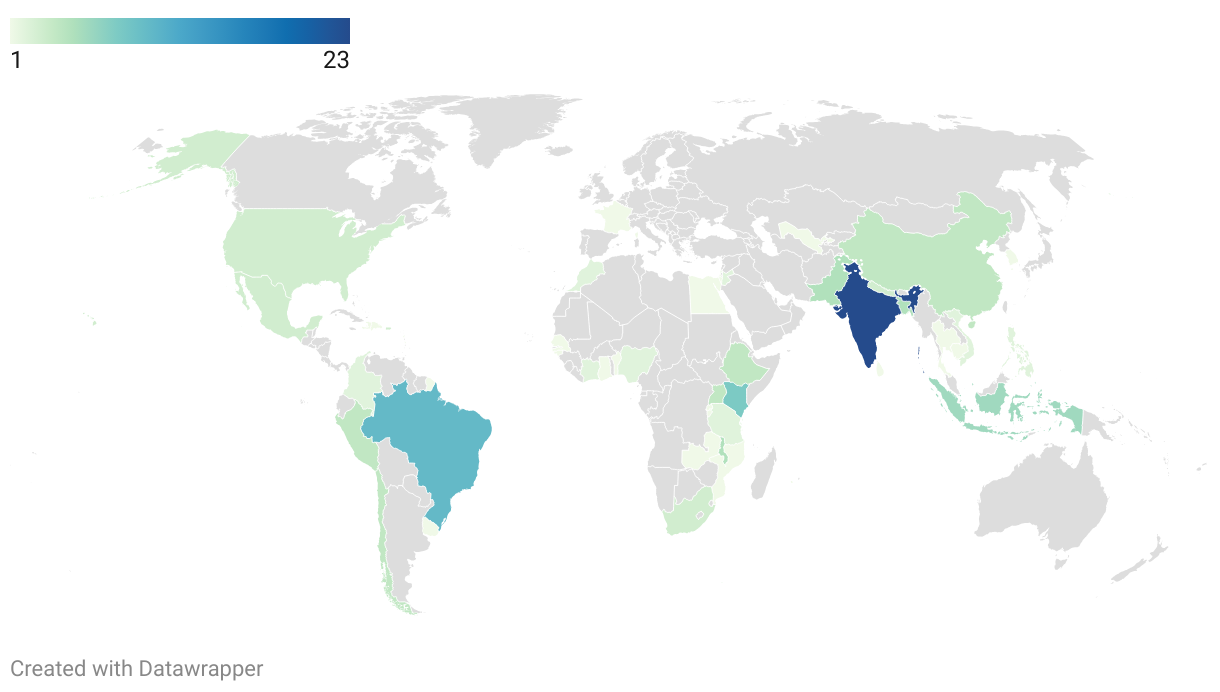
More than twice as many studies (14) used data from India than from any other country (Figure 1). That was true when we did this roundup in 2023 as well.
Pakistan follows with five studies, Mexico with four, and then several had three: Brazil, Jordan, Uganda, and Zambia. Once you adjust for population, India and Brazil had about the same number of studies per thousand population.
Figure 1. Absolute number of studies per country in the social sectors at NEUDC
What methods do the studies use?
Researchers used randomized controlled trials (RCTs) in half the studies, followed by difference-in-differences, fixed effects, instrumental variables, regression discontinuity designs, and one survey experiment (Figure 2). A couple of studies generated databases or were descriptive. We strongly suspect the high number of RCTs is largely a function of the sectors we’re examining: in the “trade and spatial economics” session, the four papers use two event studies, one pure theory model, and one instrumental variables strategy. But in the social sectors, while RCTs continue to be the most common, they clearly haven’t crowded out other methods.
Figure 2. Methods used across 68 studies in the social sectors at NEUDC
What do we learn from the studies?
We provide a quick takeaway from each study below. Of course, these are our takeaways. Most good studies have more than one thing to tell us, so if you’re interested, follow the links in the summaries. We also largely take the studies’ claims at face value, so read more closely before taking dramatic policy action based on our 180-character summary.
#RCT Randomized controlled trials (including lab-in-the-field experiments)
#DID Difference-in-differences
#FE Fixed effects
#RD Regression discontinuity
#IV Instrumental variables
#SurveyExperiment Survey experiment
- Benefiting from South Africa’s social protection program (the Older Person’s Grant) increased parents’ reported engagement with young children (talking, singing, and reading). (Alloush) #FE
- In Nepal, multiple early childhood education models were evaluated, showing improved developmental outcomes by 0.10–0.20 standard deviations. The most effective model provided teacher training + a teacher helper in the classroom. (Saraswat et al.) #RCT
- Experiencing an earthquake at a young age in Chile decreased cognitive test scores by 0.17 SD and non-cognitive test scores by 0.13 SD. (Gillmore) #DID
- In Brazil, reports revealing that schools are high in the test score distribution increased the incumbent mayor’s vote share by about 2 percentage points. (Dias, Ferraz, and Sandholtz) #DID
- In Uganda, student numeracy increases by 0.33 SD when community volunteers provide remedial education under the direction of a manager, approximately twice as much as when community volunteers work without a manager. (Brooks et al.) #RCT
- Students assigned to an off-site test center scored 0.14 SD lower in China’s high-stakes National College Entrance Examination than classmates testing at their home school. (Hong, Lei, and Li) #FE
- In Pakistan, being exposed to a 1 SD better school increases adult test scores by 0.2 SD, total years of schooling by nearly 1 year (12 percent), the likelihood of graduating high school by 10 ppt (51 percent), and college enrollment by 5 ppt (48 percent). (Bau, Das, and Michaud-Leclerc) #FE
- In Brazil, receiving a conditional cash transfer in the days preceding the college entrance exam increases test scores relative to receiving it the subsequent week. (Eizmendi and Reyes) #FE
- In Mexico, a social and emotional learning program improved reported rapport (affective relationship) between tutors and students and increased math learning by 0.0495 SD. Aguilar Llanes, García Bulle, and Albo Alarcon) #RCT
- Drops in tariffs between the US and Vietnam in 2001 led women in Vietnam to have more boys, to work more hours, and to have fewer births overall. (Huynh & Nguyen) #DID
- In Zambia, few women undergraduates use hormonal contraceptives despite not wanting to get pregnant, in part due to (incorrect) beliefs that these contraceptives may lead to later infertility. Lowering the cost of visiting clinics only boosts use of the contraceptives temporarily, but coupling that cost reduction with information addressing those incorrect beliefs actually reduces pregnancy. (Bau et al.) #RCT
- A family planning reform in Peru that got rid of restrictions based on age and introduced confidentiality for adolescents dramatically reduced adolescent fertility: it dropped by 15 percent overall and even more for girls living close to the family planning facilities. (Aréstegui) #DID
- Expansion of the ready-made garment industry in Bangladesh improved the probability of neonatal survival for children. "This is driven by the improved labor market participation by mothers, enabling them to delay childbirth and improve their intra-household bargaining power." (Vasishth) #DID
- Safe spaces and business training for adolescent girls and young wives, supported by the Sahel Women’s Empowerment and Demographic Dividend program, had overall null effects due to restrictive social norms posing a barrier to girls’ participation. Take-up is the lowest among women and girls who stand to benefit the most (those living in conservative villages or with low access to sexual and reproductive health care and birth controls). (Kazianha & Plucker) #RCT
- In India, encouraging female vocational trainees to use a digital job platform made them more realistic about their job prospects and improved job quality (if they got a job). (Anukriti, Herrera-Almanz, and Ochmann) #RCT
- Adolescent girls who were trained in negotiation skills in Lusaka, Zambia complete 0.27 more years of education 10 years later. They also begin sexual activity later, marry later, have smaller age gaps with their husbands, are less likely to report a high likelihood of having HIV, and express less traditional gender attitudes. (Ashraf et al.) #RCT
- Pay disclosure on a job search platform in Pakistan increases women's applications by 95 percent and men's by 59 percent. (Jalal) #RCT
- In Pakistan, women-only transport more than doubles job application rates, while mixed-gender transport has minimal effects on men’s and women’s application rates. (Garlick, Field, and Vyborny) #RCT
- Six years after a school-based gender attitude change program in India, girls didn't complete more school or marry later, but they report higher autonomy, younger siblings of program participants and fathers of participant boys report more progressive gender attitudes. (Dhar et al.) #RCT
- Access to mobile phones in Afghanistan improved men's attitudes towards women's education and work (but didn't actually increase women's education or work), and it also boosted votes for women candidates and the share of women elected to office. (Chung et al.) #IV
- Shared housing for single women in India is listed at rents 6-8 percent higher than for men. The gaps are even there in a single building, but not when one owner rents to both women and men. (Molnar et al.)
- In Malawi, an effort to target job descriptions to women candidates led more women to apply, but the people screening the applications selected less qualified women, with the result that fewer women were hired. Why? Less qualified women put more effort into signaling "soft skills," which are harder to verify objectively but which evaluators put weight on. (Fleischman & Saxena) #RCT
- After asking women microentrepreneurs in Pakistan a question about whether they had consulted their family about their business decisions, they were less likely to join a network through a printed business directory but more likely to join a network through a WhatsApp group. (Shaukat) #RCT
- Small firms managed by women that formed a consortium of firms in Tunisia were much more likely to export and increase their sales after two years. (Münch et al.) #RCT
- Married women in India were much more likely to apply for and turn up to an offered two-week job if it was in a women-only workplace, and this was particularly true among those who reported having jealous husbands. (Rajah) #RCT
- At a Jordanian research firm that only hires women as enumerators, the least productive employees report being willing to pay the most for job benefits like transportation. (Palmer) #SurveyExperiment
- In Bogotá (Colombia), most people support working mothers, but both women and men tend to believe that other people don't. Delivering info on others' beliefs led men to "nominate their wives for a career-building course rather than take the course for themselves." (Boltz et al.) #RCT
- In India's garment sector, nearly half of "married women in the sector work in the same factory as their husbands." Those same women value the option to switch to a new factory together with their husbands "as much as a 36 percent wage increase." The main reason seems to be to reduce risk: the husband can help if the workplace turns out to be dangerous or exploitative. (Tandon) #RCT
- The Global Gag Rule, an anti-abortion policy that prohibits foreign NGOs receiving US aid from providing or advocating for abortion-related services, is associated with a 16.7 percent increase in maternal mortality in highly exposed aid-receiving countries. (Bhalotra, Clarke, and Xun) #DID
- Eight years after receiving cognitive behavioral therapy for perinatal depression in rural Pakistan, women are 29 percent less likely to be depressed but experience more intimate partner violence. The rise in violence is in marriages where the husband has equal or more education than the wife. (Baranov et al.) #RCT
- At a Tunisian university, showing a video testimonial of a donor heart recipient followed by doctors explaining about organ donation led to a modest percentage point (but large percentage) increase in students agreeing to be a donor. (Fourati & Hauser) #RCT
- Which matters more for child health: community health workers or access to a physical healthcare center? In rural India, there are gains from health workers on vaccinations, but no clear impact of greater access to the physical centers. (Biswas) #FE
- Showing a documentary on mercury's health risks (a consequence of small-scale gold mining) to community leaders didn't affect communities in Ghana, but public screenings boosted community engagement. When community engagement rose, those communities shifted towards stricter mining rules, but only when their leaders weren't benefiting from the gold mining. (Cheung) #RCT
- Access to a road in rural India increases the probability of making an insurance claim by 38 percent. (Chakraborty & Mori) #DID
- Eradicating guinea worm disease in Ghana boosted agricultural productivity and lowered child marriage. In the long run, it led to more formal employment and more literacy. (Carney & Denton-Schneider) #DID
- In Guinea-Bissau, a health campaign that was based on science but that referenced traditional beliefs and included traditional health practitioners increased health knowledge and reduced malnutrition. (Álvarez-Pereira et al.) #RCT
- Rolling out community-based health insurance in Senegal led to more mothers being covered and fewer having big health expenditures, but no obvious improvements in mortality among newborns. (Dieye) #DID
- In two Indian states, public clinics are cheaper than private ones, but they also have much higher child survival rates. This gap seems to be driven by the fact that private clinics separate moms and babies more often (and then charge extra for additional health interventions after that separation). (Franz) #RD
- In Malaysia, public hospitals that specialize lead to more private hospitals (because specialist doctors can work and train in both public and private hospitals simultaneously), whereas generalist public hospitals lead to fewer private hospitals (because of competition). (Lim) #DID
- A public-private partnership in health in India—whereby people could use public insurance to access private hospitals—led to more deliveries in private hospitals and lower costs to clients, but no change in infant mortality. (Bhattacharya et al.) #RD
- In Ethiopia, couples-based skills development training increased women's business profits by 50 percent and boosted women’s economic autonomy, with treated women being 30 percent more likely to report sole decision-making power in their business. (Friedson-Ridenour et al.) #RCT
- Climate information services, such as weather forecasts and planting recommendations, improved farmers' welfare in Zambia, and increased investment decisions that are preferred by both spouses. (Kramer, Trachtman, and Zuze) #RCT
- In South Africa, mandated rest boosts productivity by 0.3 SD, thus making up for forgone earnings from resting. (Schubert & Wang) #RCT
- The rise in São Paulo's (Brazil) gig work reduced crime on average by 10.4 percent. (Frankenthal) #DID
- Credential visibility on LinkedIn increased new employment by 6 percent (1.0 percentage point), with larger effects of 9 percent (1.2 percentage points) for jobs related to certificates. (Athey & Palikot) #RCT
- In Liberia, reassigning applicants away from preferred job skills to business training showed higher short-term gains in employment and earnings on average, but the gains faded over time. (Zenker et al.) #RCT
- Minimum wages at banks in Tunisia result in higher wages, but younger, skilled workers voluntarily leave the jobs to move to companies that pay more for skills. (Ali & Tran) #DID
- During the COVID pandemic, firms in Uganda often laid off the highest-paid workers—those with the most experience or skill. But those who had received vocational training several years earlier, despite being more likely to be laid off, were also more likely to find other work. (Alfonsi et al.) #RCT
- New data on hours worked across 150+ countries shows that as countries get richer, women's working hours rise while men's rise and then fall. (Gethin & Saez)
- When firms are legally obligated to share profits with workers, they sometimes lower wages to make up the difference. In Mexico, a reform enforcing profit sharing led to only a small drop in wages, resulting in a net increase in overall compensation to workers. (Colonna & Aldeco) #DID
- In Jordan, housing subsidies for Syrian refugees had limited measurable benefits for refugee well-being while worsening social cohesion, highlighting the possible need for alternative forms of aid. (Tamim et al.) #RCT
- Granting work permits to Syrian refugees in Jordan increased aggregate output by nearly 11 percent, driven by improved utilization of refugee labor and translating into large wage gains for refugees. (Winton) #FE
- In Mumbai (India), slum residents who received in-situ compensation moved to slum neighborhoods elsewhere. Slum redevelopment noncompletion and lags between eviction and in-situ compensation decreased the slum residents’ likelihood of moving to a formal neighborhood. (Philip) #DID
- Places that received more refugees during the 1947 Partition of British India show gains 70 years later: higher night-time luminosity, more employment, and more large firms, especially in manufacturing. Households in refugee-exposed districts have higher consumption, asset ownership, and schooling, and greater intergenerational mobility in educational attainment. (George & Nicholson) #IV
- Removing information frictions about rural-urban income differences in Kenya would increase the migration rate from 17 percent to 22 percent and reduce the rural-urban income gap by 25 percent. (Barnett-Howell et al.) #RCT
- Offering income smoothing to youth in case of unemployment conditional to migrating to Nairobi (Kenya) more than triples the migration rate over seven months and results in more persistent moves, even after the program ends. (Miner) #RCT
- In Mexico, students who migrated from municipalities in the 90th percentile of the violence distribution to municipalities in the 10th percentile experienced improvements of 5.3 percent of a SD in their test scores two years after they migrated. (Padilla-Romo & Peluffo) #FE
- In India, firms more exposed to the increased uncertainty around H-1B visas after President Trump’s win in the 2016 Republican primary election increased their India-based job postings. (Chaurey, Mahajan, and Toma) #DID
- Between 1984-86, Ethiopia forcibly resettled over 600,000 people in an emergency program, increasing ethnic diversity across districts. Those districts later saw more conflicts targeting civilians when ethnicity became salient. (Gebresilasse) #DID
- Individuals exposed to India's Green Revolution in early childhood tend to be shorter and have higher rates of metabolic syndrome. (Singh) #DID
- Households in areas of sub-Saharan Africa that historically rely on cattle have less diversity in their diets than those that historically rely on goats and sheep. (Stehl & Vollmer) #RD
- Maternal cash transfers in India increased calorie intake for mothers and children by 9.6–15.5 percent along with gains in dietary diversity, nutrient consumption, and children’s functional development. (Weaver et al.) #RCT
- In Egypt, informing households about a new economic inclusion program’s income-earning potential via testimonies increased uptake by 40 percent. (Allen IV et al.) #RCT
- In Uganda, a livelihoods program that provided agricultural and livestock inputs and training, and support for health, savings, and entrepreneurship increased household income by 26 percent (USD 40 PPP), non-land wealth by 31 percent (USD 389 PPP) and consumption by 10 percent (USD 59 PPP). (Mahmud & Riley) #RCT
- In Dakar (Senegal), firms that received vouchers for flooding mitigation in a group setting experienced less flood losses and were less likely to close due to a flood. Uncoordinated and individual firm investments can create negative spillovers for those nearby. (Doruska) #RCT
- In Mexico City (Mexico), housing units that have experienced more sinking of land areas due to groundwater over-extraction are more likely to be redeveloped, as these have a lower opportunity cost of being rebuilt. (Hackett & Rodríguez Zamora) #FE
- Climate risk threatens sub-Saharan Africa’s rain-fed agriculture: A one-week delay in the onset of the rainy season reduces yields by 2 percent and consumption by 1 percent. The negative impacts are concentrated in locations experiencing long-term climatic shifts, indicating a persistent failure to adapt. (Taveras) #FE
The order of authors on this blog was determined by a virtual coin flip. This blog post benefited from research assistance and organization by Thi Le.
Topics
DISCLAIMER & PERMISSIONS
CGD's publications reflect the views of the authors, drawing on prior research and experience in their areas of expertise. CGD is a nonpartisan, independent organization and does not take institutional positions. You may use and disseminate CGD's publications under these conditions.