At the last spending review, the Treasury confirmed that the UK’s aid budget would be reduced to 0.3 percent of Gross National Income (GNI) by 2027. This is very low by historic standards and (since a large share is spent inside the UK) will mean actual international spending will reach an all-time low.
However, our analysis shows there is a strong likelihood that the Treasury will need to allocate additional funds to meet the 0.3 percent level.
In this blog, we review the government’s existing spending plans alongside the Treasury’s latest survey of economic forecasts to project likely national income (GNI). We find that planned spending will undershoot the target in even the most pessimistic scenario for the economy in the Treasury’s latest survey of forecasters and, on the central forecast, will be £412m short.
The upcoming budget is an opportunity to allocate additional funds to the aid budget in good time and avoid two years of criticism while waiting for confirmation on missing a target that was only set last year.
A stable spending review settlement
At the last spending review, the Treasury confirmed the government’s commitment to “reduce ODA spending [from 0.5 percent in 2024] to the equivalent of 0.3 percent of Gross National Income (GNI) by 2027”, and set out spending plans for ODA by department over three years. It also removed Foreign Commonwealth and Development Office's (FCDO) automatic role as spender and saver of last resort, meaning that FCDO no-longer had to make in-year cuts to fund other departments’ over-spends or falls in expected GNI, but would also not automatically benefit from under-spends or higher-than expected GNI. This stability has enabled departments to have certainty over their ODA spending levels.
What is ODA planned to be?
The government has set out plans to spend around £9.4 billion in Official Development Assistance (ODA) in 2027. The spending review in June 2025 set Departmental Expenditure Limit (DEL) ODA by fiscal year with the 2026/27 and 2027/28 totals of £10 billion and £8.9 billion respectively, with a weighted 2027 average of £9.2 billion. In addition, there is some non-DEL ODA (which is difficult to plan in advance, like gift aid) which, in the last three years, added an average of £0.3 billion per year, giving a potential £9.5 billion total in 2027. This tallies with GNI projections at the time. Based on those, ODA in 2027 would need to be £9.4 billion. We return below to potential over- or underspends in these plans but this was clearly the starting point.
So, what do we now expect for the economy and GNI?
Since the spending review, growth projections have remained relatively steady but inflation has risen and is now higher than previously forecast, largely due to the impact of the conflict in Iran on energy prices. Higher prices across the economy mean that the nominal value of output is higher, which is reflected in higher than expected GDP and GNI. Higher prices automatically push up spending in many areas. Benefits and pension spend, for example, rise with inflation. But the Treasury also gets higher tax revenue from areas like higher VAT and income tax.
So, how much higher could GNI be in 2027? The Office for Budget Responsibility (OBR) provide the official forecasts and their March update already suggests GNI in 2027 will be some 2.6 percent above the initial estimates.
The OBR is finalising its updated forecasts and will publish on October 28th, but we can estimate based on other projections. In fact, the Treasury collates and publishes independent forecasts across the UK economy. These relate to GDP rather than GNI (the latter removes/ adds investment income to/ from overseas) but growth rates are likely to be a good guide (the OBR expect GNI to settle at 98.8 percent of GDP in its projections).
Chart 1: Expected GNI set to exceed initial projections
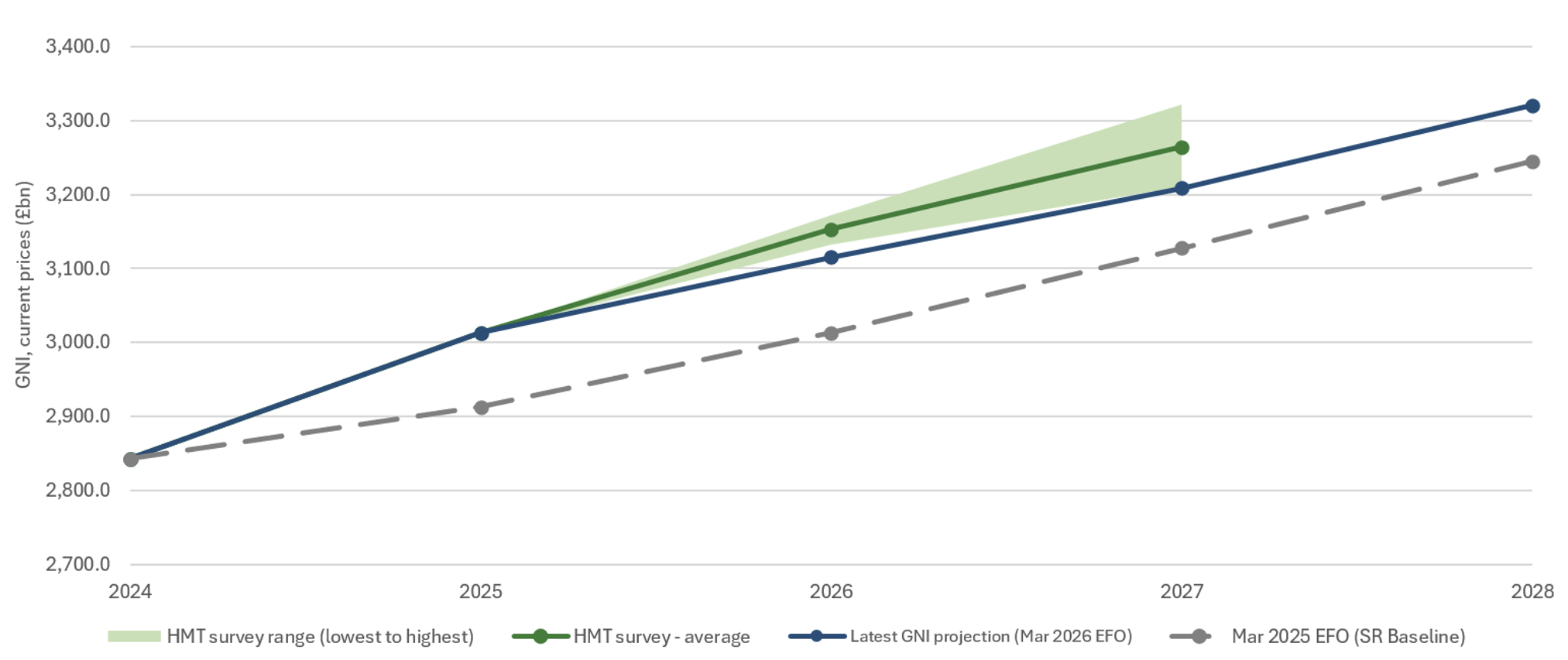
Source and notes: Authors’ analysis of Sep 2026 HMT Comparison of independent forecasts combining GDP and CPI projections.
It’s clear that independent forecasts are now well-above the March 2025 OBR figures used in the spending review. The central estimate is now 4.4 percent higher for 2027, with the UK economy set to be some £136 billion larger than anticipated. If ODA is indeed calculated as a share of GNI, a tiny slice of that additional growth should be allocated to it.
Could these be over-estimates? The OBR regularly evaluates its own forecast and in July last year also looked at the reliability of external forecasts. It found that both average external and OBR forecasts had under-estimated one-year ahead growth (by 0.5 and 0.4 percentage points respectively) but each overestimated five-year growth (by 0.6 and 0.7). This suggests that average external forecasts are a reasonable guide to OBR and official data, and (given our interest in 2027) that both external forecasts and the OBR may be on the pessimistic side. In short, GNI is likely to increase by just over 8 percent in nominal terms over this year and next based on the independent external average.
What do these projections mean for the 0.3 percent commitment?
The below table summarises the economic forecasts and the level of ODA spending necessary to reach 0.3 percent of GNI commitment.
Table: Forecast GDP growth and implications for GNI and ODA
| Original ODA plans (Mar 2025 EFO) | |
|---|---|
| GNI 2027 forecast (£bn) | 3,127.9 |
| ODA at 0.3% of GNI (£bn) | 9.38 |
| GNI forecast used | GNI 2027 (£bn) | Original ODA, % of revised GNI | ODA at 0.3% GNI (£bn) | Shortfall in original ODA budget (£bn) |
|---|---|---|---|---|
| Latest GNI projection (Mar 2026 EFO) | 3,209 | 0.29% | 9.63 | 0.24 |
| HTM September Survey of Independent Forecasts | ||||
| Average | 3,262 | 0.29% | 9.79 | 0.41 |
| Lowest of range | 3,210 | 0.29% | 9.63 | 0.25 |
| Highest of range | 3,322 | 0.28% | 9.97 | 0.58 |
Source and notes: Authors’ analysis of Sep 2026 HMT Comparison of independent forecasts combining GDP and CPI projections. For projections, baseline is 2025 GNI from the OBR in March 2026. Shortfall is calculated with respect to expected ODA at the time of the 2025 spending review (March 2025 OBR).
This table shows that the Treasury’s central forecast implies ODA spending will be just under 0.29 percent of GNI, a £410m shortfall. The lowest growth scenario also rounds to 0.29 percent of GNI and implies a £250m shortfall. In the highest growth scenario (still very plausible given the previous history of under-forecasts), the ODA share is just 0.28 percent and the underspend is £580m.
These are material shortfalls in the spending power of UK aid—£400m would be enough to halve the cuts to Africa that will cost thousands of lives and mean the UK’s de-facto exit from the south and east of the continent. It could fund and drive reform at the Green Climate Fund which is crucial to other countries’ ambitions on emissions at COP; or it could kick-start a major G20 initiative on food security and the cost of living building on Brazil’s efforts in 2023.
Refugee and other unpredictable ODA spend
Another factor in the expected level of spend is any variability in the Departmental ODA budgets, with refugee-hosting the largest and most volatile element. That spend is expected to fall by around £1 billion over the spending review but if it didn’t, then ODA spending would be higher. Still, The Home Office’s main estimate from July shows its final ODA budget in 2025/26 was unchanged from its original budget (of £2.26 billion) and it is expecting to spend £2.05 billion as ODA in 2026/27. This 10 percent year-on-year reduction is in line with the spending review figures. So far at least, there does not appear to be an over or under-spend expected and FCDO’s second permanent secretary told Parliament last week they are “tracking pretty close to… budget and expectation”.
Beware damaging accounting tricks
One way that the government could attempt to meet the target is to delay spending in the 2026/27 fiscal year (from April 2026 to March 2027), into the 2027 calendar year. FCDO have previously used this tactic to precisely hit prior GNI targets but that was a very different situation. At that time, the ODA budget was stable at 0.7 percent of GNI, whereas the 2026/27 budget has already experienced an incredibly steep fall of 30 percent, the steepest of any G7 country (including the US) and so holding back spending within the year could cause even greater damage to programmes already bearing deep cuts.
No other government department would be expected to deal with cuts of 30 percent in a single year, and reprofiling spend for cosmetic reasons is surely inconsistent with the government’s manifesto and other commitments to “rebuild Britain’s reputation” and be “a reliable partner, a dependable ally, and a good neighbour”.
This will also be an early test for the new foreign secretary and international development minister. The aid budget is one of few in Whitehall facing cuts and will already have funded over £6.5 billion in Defence spending in 2027. They should not agree to artificially delay their spending and should insist—as John Healey did as defence secretary—that the Treasury honors its commitment to 0.3 percent.
The upcoming budget is a moment for the new government to put its stamp on how Britain is run. The government made steep and damaging cuts and set a new target of 0.3 percent for 2027 that would be a 25 year low. The very least it could do is ensure that target is fulfilled.
Topics
DISCLAIMER & PERMISSIONS
CGD's publications reflect the views of the authors, drawing on prior research and experience in their areas of expertise. CGD is a nonpartisan, independent organization and does not take institutional positions. You may use and disseminate CGD's publications under these conditions.
Thumbnail image by: flickr-dfid