Recommended
Blog Post
How Much Aid is Actually Spent Abroad?
Blog Post
How the UK Should Focus Its Aid in 2026
The UK’s new Prime Minister Andy Burnham has announced his ministerial team. Ed Miliband has been appointed foreign secretary, and Kirsty McNeill development minister. While the development minister will no longer attend cabinet meetings (a move that has drawn criticism from development advocates), the foreign secretary is “taking personal leadership of the UK’s engagement on development and climate finance” as governor to the World Bank.
The next three years could be among the most important for UK foreign policy in decades. Against a backdrop of conflict and geopolitical rivalry, the UK will chair both the G20 and G7. The foreign secretary must realise that actual UK international assistance on development has already reached a 20-year low, and is set to fall, undermining the UK’s stability and security. His first priority then, should be to make the case to No10 and No11 that international development is an important tool which (alongside defence and diplomacy) must be properly resourced to support security—and he will need to win that argument in the coming spending review.
Here, we set out that case and three other immediate ambitions Ed Miliband should pursue in his new role.
1. Restoring resources for (and confidence in) international development
If the foreign secretary and his department are to succeed, they will need to rebuild public confidence that international action can make a difference, and make a compelling case for spending public money on international development.
The starting point here is to position international development as absolutely central to a country’s prosperity and security. History supports this case: US post-war commitment to Europe was a development project. The EU’s enlargement was also development—supporting neighbours’ development created new allies, new markets and weakened Russian influence. Each came with substantial finance. Today, instability in the Middle East and Africa is impacting our daily lives. The UK’s support—for the Africa Union, World Trade Organization, in climate negotiations and for the World Bank—are important investments to support economic progress and counter instability. But the UK’s real international assistance is set to reach an all-time low as a share of the UK’s economy, and could not be further from the manifesto promising a return to the UN target that Labour was elected on.
Figure 1. UK international assistance (%GNI), 1960 to 2028-29
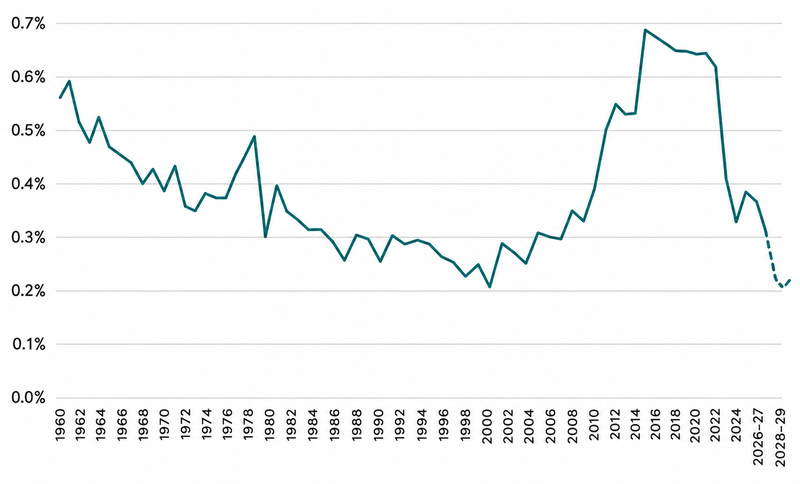
Source: CGD analysis based on the OECD’s DAC1 dataset for historical data; and on data from HMT, ICAI, OBR & SID for projections. International Assistance excludes non-cross border flows from official development assistance (ODA). Data here.
The idea that aid is not important in a more geopolitically insecure world is wrong and dangerous. During the Cold War, global aid reached all-time highs to complement defence in the battle for allies, hearts and minds. The West won that war. Cutting UK aid to an all-time low (with many Europeans following its lead) is a false economy that will actually lead to more insecurity and instability.
If the foreign secretary does not win this argument before the spending review, the UK will be seen as weak by international partners at a critical moment.
2. Re-focusing aid on Africa
It is impossible to target extreme poverty if resources are not focused on where it is. On the last day of parliament, the previous government’s FCDO ministers published their country allocations for the coming three years. While humanitarian spending was protected, ministers failed to refocus the remaining budget on the countries with the greatest need. Instead, they amount to a de facto exit from ten African countries including nearly all of south-eastern Africa (see chart). The share of bilateral spend in Africa will fall from 49 percent in 2024-25 to just 38 percent in 2028-29 (of FCDO regional programmes) and with support for Least Developed Countries also falling further.
Figure 2. Cuts in FCDO ODA to African countries, 2024-25 outturn to 2028-29 plans
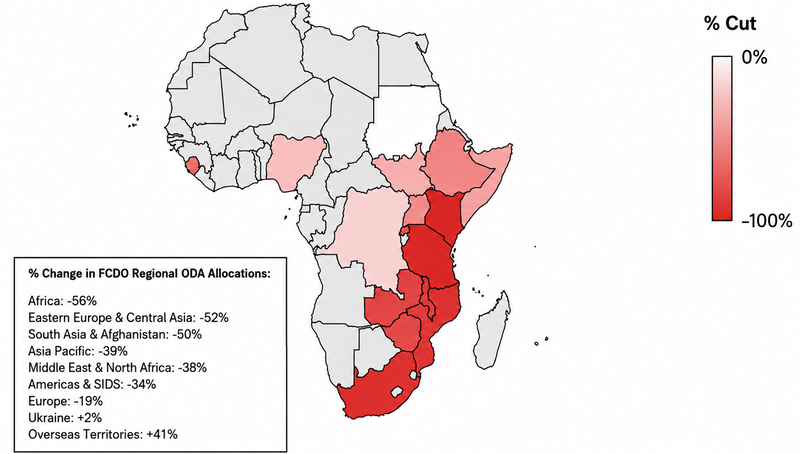
Source: FCDO annual reports (Annex A) for 2024-25 and 2025-26
Note: Egypt (not shown) is the only African country whose allocation increases over the period, from zero to £3 million. Ghana is also not shown as 2024-25 outturn figures are not available.
Former Development Minister Baroness Chapman has argued that the fall in bilateral funding for Africa is supplemented by replenishments at African-focused multilaterals— but spending through African-focused multilaterals remains broadly unchanged as a share of the aid budget (see chart below), meaning it does not offset the bilateral cuts.
The government has chosen to maintain high levels of support to four places—Ukraine, Palestine, Lebanon and Sudan—on humanitarian grounds. But over a third (34 percent) of the FCDO’s regional programmes budget in 2028-29 will be spent in twelve countries (including Bangladesh, Jordan, Pakistan and Syria) that we assess as relatively over-prioritised. These countries have real needs, but other donors are providing significant support and a more strategic approach would see the UK use its resources on those in greater need.
The foreign secretary may not wish to reopen a process just concluded, but the withdrawal of aid from the poorest countries will cost more lives; and he should find a way – perhaps through reducing central programmes, reallocating under-spends, or reclaiming other department’s under-spent ODA (official development assistance) – to identify at least £200m to retain at least the most impactful bilateral programmes. We suggest that is used to reprioritise five UK partners in Africa, based on the large share of populations living in extreme poverty and who are also significantly under-supported by other providers—specifically Malawi, Mozambique, Tanzania, Zambia and Zimbabwe (whose collective budgets have been slashed to £25 million, down from £231 million in 24-25).
3. Making non-aid resources count
A significant step forward has been the recognition that not all international effort must be ODA (official development assistance). The “donor to investor” shift set out by the last government has seen efforts on the Emerging Markets and Developing Economies taskforce accelerated and announcements of £6.7 billion of non-ODA climate finance.
But the new foreign secretary could go much further on this. For example, if non-ODA capital injections are made to British International Investment (as the US does to its Development Finance Corporation) they do not add to UK debt or spending, and billions could be invested to benefit the UK taxpayer with positive returns while also tackling climate and food security through investing in private companies in Africa and Asia.
We will have more to say on the ambition of these wider finance tools but for now, we also note that the infrastructure around transparency and impact that is so important in ensuring aid is spent well is missing for the vast majority of these billions and must be addressed. This is not about regulating or slowing down those flows, it is about ensuring that that taxpayer money has impact and that the government has an opportunity to showcase that impact.
On climate, for example, the UK can play a major role in ensuring that finance actually leads to transformation rather than just displacing private investors. But this needs to begin at home, a starting point would be an annual summary of non-ODA climate finance covering export finance, guarantees, British International Investment and other instruments, and what they aim to achieve.
This could be presented at Climate COPs and should come alongside the evidence available on the impact and results that is already reported for ODA.
4. A renewed multilateralism
The last Labour manifesto committed to “greater multilateral action”, rightly understanding its importance. But the most recent allocations appear to suggest a historically normal share of aid being spent multilaterally (see Figure 3).
Figure 3. Multilateral share of FCDO ODA
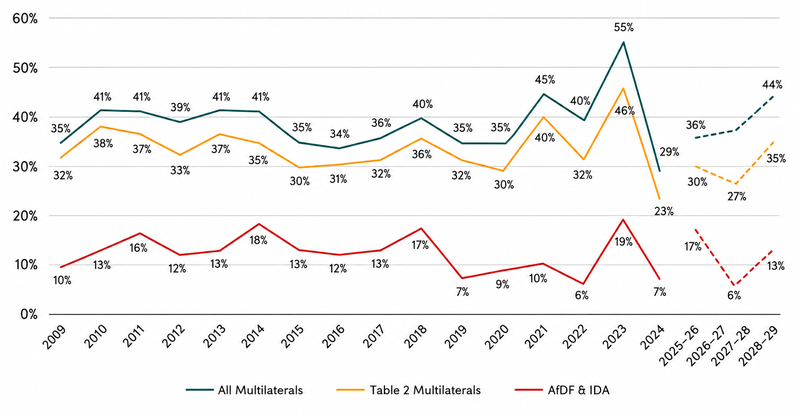
Sources: Data underlying the UK Statistics on International Development (SID), Final 2024 (covering 2017–2024) and 2009–2016; Yvette Cooper (19th March 2026) Official Development Assistance (ODA) programme allocations 2026/27 – 2028/29 (Statement UIN HCWS1425), Tables 1 & 2; Lucy Fisher (19th March 2026) UK reveals cuts to aid for Africa and Middle East
Notes: “Table 2 Multilaterals” refers to those included in Table 2 of Cooper’s written statement (though no outturn data is available in the SID for core contributions to the Global Financing Facility and Education Cannot Wait). Data for the former Department for International Development and the Foreign and Commonwealth Office are combined for years prior to their merger into the FCDO.
The UK is a mid-sized economy that relies on open trade and capital markets; and it is hard to see it succeed if the multilateral system—the IMF, World Bank, WTO, WHO—does not. The best multilaterals are more effective than bilateral aid. They focus resources where needs are greatest, work at a scale bilateral providers cannot, and use loans where possible to be more efficient, and receiving much-stronger positive feedback from recipients.
We are at the beginning of the cycle of multilateral replenishments—including arguably the most important, the World Bank’s IDA—with pledges for the next replenishment to be made next year. These institutions need shareholder leadership to reform and do more and the foreign secretary should prioritise both funding and officials’ efforts towards these institutions. As governor at the World Bank, he will see first-hand the opportunities and challenges of reform, and he should use the UK’s chair of the G20 to drive forward that agenda.
Bring Burnham’s vision for change to international development
Prime Minister Andy Burnham has warned against aping Reform, but on international development, the Kier Starmer government effectively implemented Reform’s 2024 manifesto commitment to halve international development spend, and have enabled Reform to go even lower. The foreign secretary takes charge in a key moment for the UK internationally – he will need to persuade No10 and No11 that international development must be at the heart of it.
I'm grateful for advice and comments from colleagues on this blog, and particularly for analysis and charts from Sam Hughes. All views and any mistakes are my own.
Topics
DISCLAIMER & PERMISSIONS
CGD's publications reflect the views of the authors, drawing on prior research and experience in their areas of expertise. CGD is a nonpartisan, independent organization and does not take institutional positions. You may use and disseminate CGD's publications under these conditions.
Thumbnail image by: Ben Dance / FCDO