Recommended
Event
Annual Bank Conference on Development Economics 2025
HYBRID
July 22, 2025 8:00—2:30 PM ET
Last week was the Annual Bank Conference on Development Economics 2025: Development in the Age of Populism. It was a great program with big-picture speeches (“The End of Development Cooperation?”) and panels (“African growth” and “How can development economics meet the moment?”) together with overview talks (“Trends in poverty reduction,” “The role of safety nets”) and individual studies (“How does lead exposure affect learning outcomes?”). I learned new things and thought about old concepts in new ways, which are two of my favorite things. I enjoyed every session I saw, but five takeaways on human capital stood out for me.
1. Countries that send migrants may gain at least as much human capital as they lose
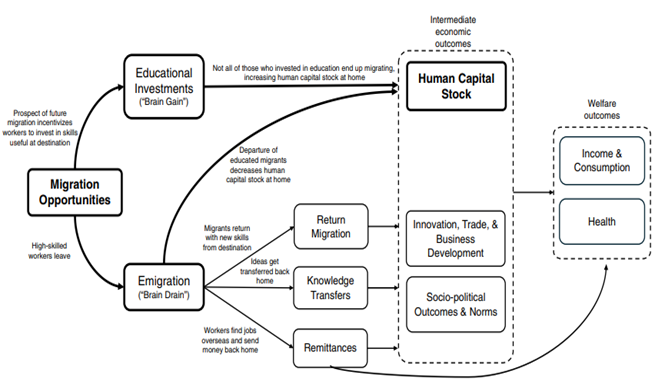
Caroline Theoharides presented an illuminating conceptual model of the human capital effects of migration on the sending country (Figure 1). Not only do exiting migrants take their human capital with them; they also create incentives for those left behind to invest in their own human capital (to open the possibility of future migration). They also transfer knowledge and cash home through return migration, sharing ideas, and remittances.
Figure 1. How migration affects human capital in the sending country
Source: Batista et al. 2025
Theoharides went on to share evidence from the Philippines that “for each additional nurse migrant, nine more pass” the nurse licensing exam. In other words, many more enroll in nursing school because of the possibility of migration than would otherwise; but many do not migrate, resulting in more nurses in the Philippines as well.
2. Changing how we gather data on school violence shows much higher rates (in at least one case, double)
Gabriela Smarrelli showed results of an experiment in Malawi that provided greater privacy to children when asked about violence. Switching from the standard survey method (asking the child face-to-face at home in the most private setting possible) to a more private environment (at school where there were more open spaces, using computer-assisted self-interviewing) more than doubled the number of reports of sexual violence perpetrated by school staff. (Rest assured, the children were provided with follow-up support!)
Remember: even though school violence is a big problem in many countries, kids still tend to be safer from violence in school than out of it. So reduce the violence and keep kids in school.
3. Social protection programs do a lot!
Tom Vogl showed that Mexico’s rollback of its flagship conditional cash transfer program led to a 12- percentage-point drop in school enrollment and an 8-percentage-point rise in working among teenage boys. Kathy Baylis showed that India’s massive food transfer program significantly reduced stunting among young children at similar rates to cash programs in other countries (Table 1).
Table 1. How big are the impacts of food and cash transfers across programs?
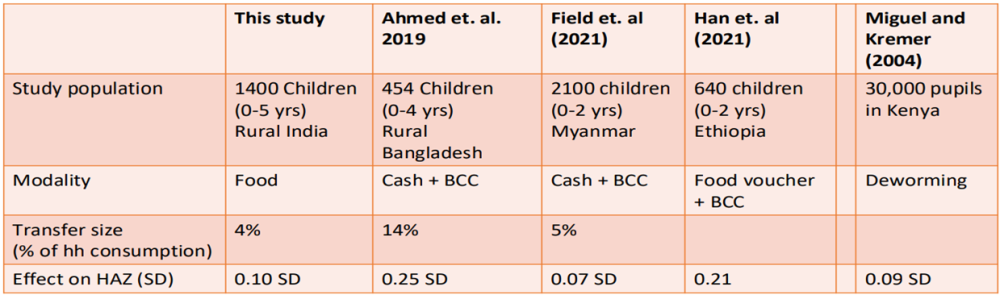
Source: Baylis 2025, based on Shrinivas, Baylis, and Crost 2025.
In a masterful overview of social protection programs, Rema Hanna showed that many policymakers still believe that these programs reduce work and increase spending on things like booze and cigarettes, both of which fly in the face of the evidence (see Exhibit A and Exhibit B). She also highlighted that many countries can finance these programs themselves: “Most middle-income countries, including many lower-middle countries, are likely to be able to finance large, meaningful social assistance programs themselves.”
4. Making the case for human capital to finance ministers may not be as hard as you think
Mamta Murthi, a World Bank vice president, underlined the importance of talking to finance ministers, who are tasked with looking forward even while balancing today’s budget. She highlighted that somewhere between one- and two-thirds of cross-country differences in income can be attributed to human capital, so it’s hard to see how countries would grow. So that’s the first point in the case to make to finance ministers, but the second point is just as important: how do you spend that money? “Even as you make the case [for human capital investment], you really have to be making the case that the money can be spent well.”
Rachel Glennerster, president of the Center for Global Development (and former chief economist for the UK’s major aid agency), proposed that “as development experts, we have pushed non-experts away, saying it was too complicated for regular people to understand. That is not good for building support. Radically simplifying would help us communicate better and make for more effective aid.”
5. One great metric can help civil society to do its job
William Masters talked about the development of a new measure, the cost of healthy diets, which calculates the cost of healthy diets across countries using “locally available items that meet national food-based dietary guidelines.” It turns out that it costs about $3-4 per day to feed a person a healthy diet, but food spending is far below that in many countries (Figure 2).
Figure 2. How much does it cost to feed a person a healthy diet (and are people spending that much)?
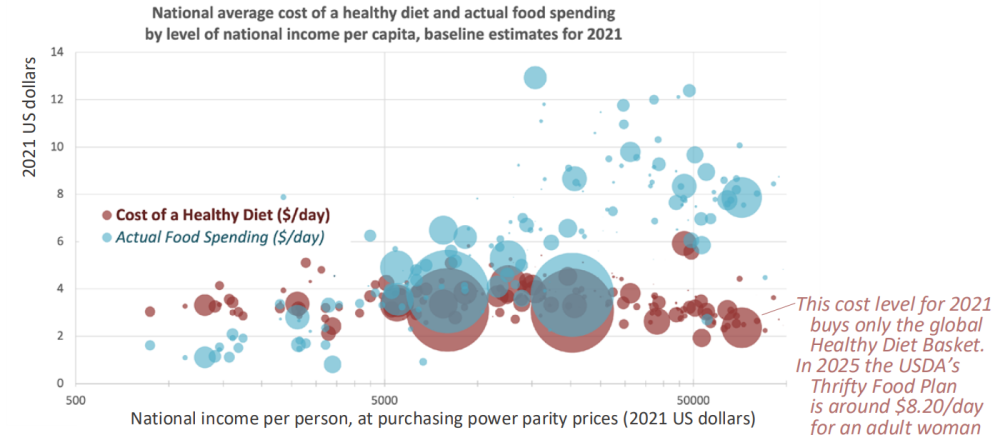
Source: Masters 2025, based on FAO and World Bank 2024.
What struck me was Masters’ case study of Nigeria, where the data on the cost of a healthy diet are published monthly and are “widely cited in local policy debates.” A simple but well-grounded metric can infuse the policy dialogue with evidence. As Rachel Glennerster said earlier in the conference, “evidence clearly explained is more important than ever. With lower aid budgets, we need to make sure that every single dollar is used as effectively as possible.”
There was much more of great value. If you learn half as much as I did, then catching up on the conference will be well worth your time: the full agenda, with videos of the sessions and copies of the slides, are all waiting for you.
Topics
DISCLAIMER & PERMISSIONS
CGD's publications reflect the views of the authors, drawing on prior research and experience in their areas of expertise. CGD is a nonpartisan, independent organization and does not take institutional positions. You may use and disseminate CGD's publications under these conditions.
Thumbnail image by: Kaveh Sardari