Recommended
Blog Post
The US Administration’s Tariff Regime
In April, we wrote about the potential impact of President Trump’s tariffs on 31 African countries that had enjoyed duty free treatment under the African Growth and Opportunity Act (AGOA). The nonsensical formula used to set tariffs generated rates from 20 to 60 percent, with Lesotho, Mauritius, and Madagascar hit with especially punitive levels.
The tariff saga has since followed a soap-opera-like narrative, replete with cliffhangers, brinkmanship, and sudden reprieves. This included the April 9 decision to delay most tariff increases hours before they were due to take effect and instead apply universal levels of 10 percent on most countries for a 90-day period. The purpose of the stay was to enable the administration to negotiate trade deals with 90 trading partners, giving them an opportunity to secure lower rates. Ninety days is an unrealistic period for negotiating even one comprehensive agreement. By the deadline, the administration championed several deals, including with the EU, Korea, and Japan, but details remain scarce.
The administration did not negotiate trade agreements with any AGOA countries, which is hardly surprising given their tiny share of the US market. According to the latest report on AGOA, US imports from eligible countries totaled $9.7 billion in 2023, of which 43 percent was crude oil, representing less than .25 percent of the US total import market for that year.
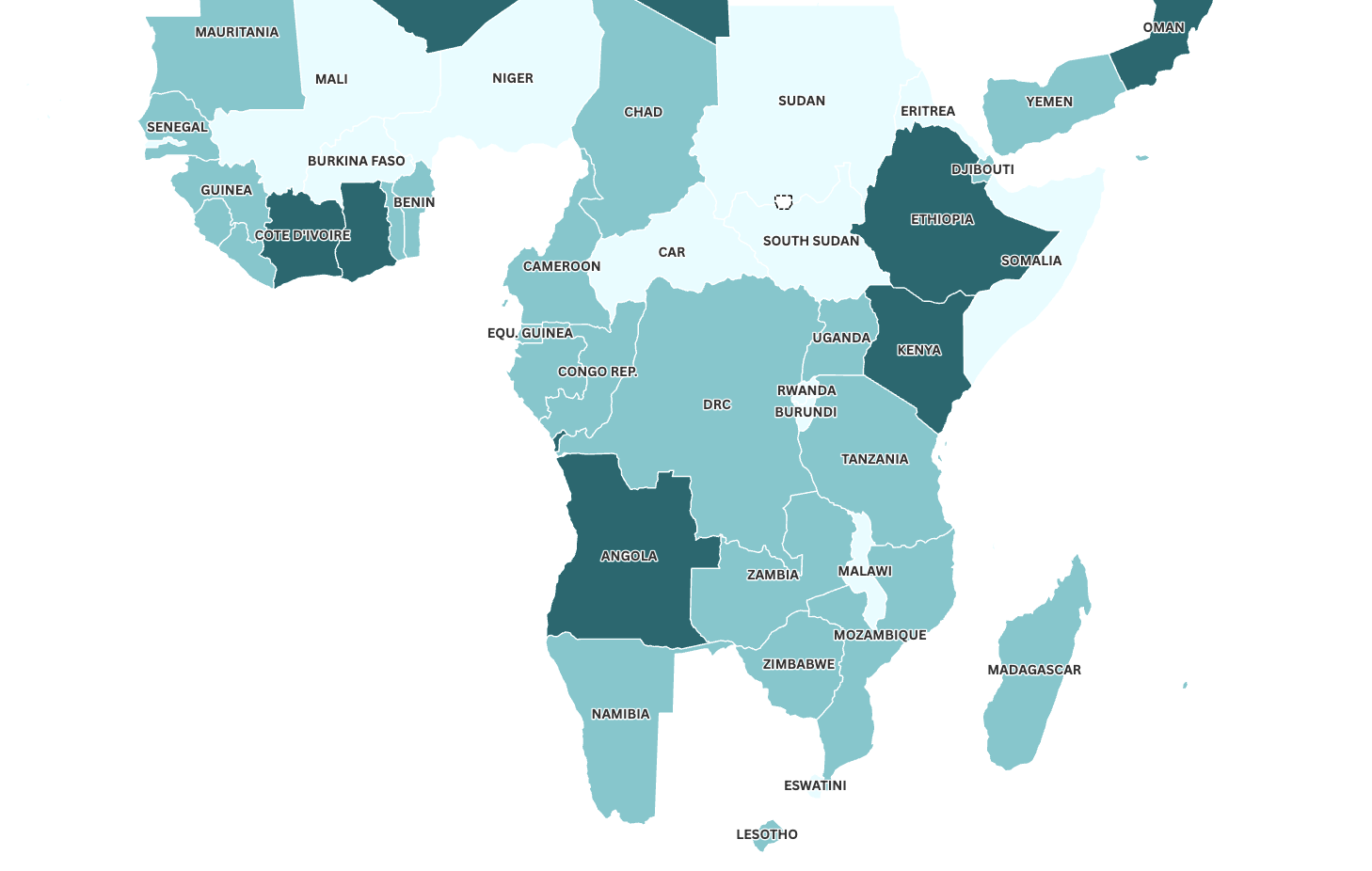
But instead of being subject to the country-specific rates as laid out in the April tariff chart, 13 countries found their rates increased from 10 to 15 percent, while 16 countries’ tariff rates remained at 10 percent. (See Table 1.) No rationale was offered for the dual tariff scenario, but the likely explanation is that more rational minds within the administration prevailed. As we argued here, punitive tariffs on the world’s smallest and poorest countries were never going to generate any discernible benefits to the US economy.
That said, why some countries were hit with 15 percent and others kept at 10 percent is a mystery. The Executive Order announcing the new tariff schedule referred vaguely to “additional information and recommendations from various senior officials on, among other things, the continued lack of reciprocity in our bilateral trade relationships and the impact of foreign trading partners’ disparate tariff rates and non-tariff barriers on US exports, the domestic manufacturing base, critical supply chains, and the defense industrial base.” It’s possible the main criterion was simply market size: nine of the ten AGOA countries with the smallest share of US exports did not see their tariffs increase.
The exception was South Africa, which was slapped with a 30 percent rate—the highest in sub-Saharan Africa. The basis for the rate appears to be President Trump’s broader unhappiness with the country and his aim for concessions unrelated to trade policy. After soaring in February, imports from South Africa have since fallen to their lowest levels in five years. (See Figure 1.) On August 12, the government published terms of a new offer, which includes several additional trade-related concessions.
Too little too late?
The imposition of 15 percent tariffs was relatively good news for the countries threatened with tariffs well above that level. Unfortunately for some countries slated to be hit with the highest tariffs—notably Lesotho (60 percent) and Botswana (47 percent)—the threat of tariffs alone has already proved disruptive. With the prospect of 60 percent tariffs in Lesotho, US apparel companies rushed to cancel orders. According to US census data, June imports from Lesotho fell below $10 million, the lowest monthly level since 2020 (during the pandemic), down from $16 million in April and May and $28 million in March. Imports from Botswana fell precipitously from $45.7 million in May to $4.7 million in June. Part of this likely reflects a seasonal drop; imports from May to June 2024, when Botswana still had duty free access to the US, fell from $87 million to $19.6 million.
With 15 percent apparently the new normal for these countries, a key question is whether US firms will resume business with them or whether they have already secured new suppliers. This has profound implications for Lesotho, which declared a state of disaster due to the prospect of 40,000 job losses in a country of 2 million people.
Another question is whether there will be any shifts from markets with 15 percent tariffs to those with 10 percent tariffs who export similar products like apparel (e.g., Kenya, Madagascar, and Mauritius).
Is there more to come?
Tariff decisions by the Trump administration are difficult to predict, but officials have not telegraphed plans for any further changes. Given the transactional nature of this White House, one scenario is that countries will try to negotiate lower tariffs in exchange for access to resources like critical materials. In May, Trump hosted the leaders of five West African countries—Senegal, Liberia, Guinea-Bissau, Mauritania, and Gabon—and emphasized the region’s “great” oil and mineral deposits, but that has yet to produce any tangible outcomes.
Meanwhile, China is countering the US stick approach by offering new duty-free access for all but one African country (Eswatini, due to its ties with Taiwan). Like the US, China had already offered duty-free access to low-income countries, but this move will expand that access to large lower-middle-income economies like Nigeria, Kenya, and South Africa (as well as countries in North Africa). Time will tell (and we will track) which is the savvier approach, but most bets are on China.
Topics
DISCLAIMER & PERMISSIONS
CGD's publications reflect the views of the authors, drawing on prior research and experience in their areas of expertise. CGD is a nonpartisan, independent organization and does not take institutional positions. You may use and disseminate CGD's publications under these conditions.
Thumbnail image by: Make It Kenya Photo / Stuart Price