
In July, the global health team published the first entry to CGD’s Tough Times, Tough Choices series, targeting the World Health Organization (WHO). We argued that WHO leadership and its member states lacked a clear, shared vision of the WHO’s needed role in the global health ecosystem—and were attempting to solve the current budget crisis via technical efficiencies and unstrategic, across-the-board cuts.
Instead, we proposed a different approach: radically streamlining the WHO to fulfil its unique global functions: global leadership, global health security, and global public goods—the irreplaceable core of its mission and mandate. We recognised that this would be a challenging shift, especially for the poorest countries which are also facing significant aid cuts. Therefore, our proposal preserved most country-level funding for the poorest and most fragile states, at least in the interim.
Our goals in putting out this piece were two-pronged: to advance our specific proposal, but also to prompt a robust public debate about where the WHO goes from here. To that end, we were delighted to receive four excellent responses to our brief which are published below, followed by a response.
- Zainab Naimy pushes back against our proposed cuts at the country-level, and argues that deep country presence and partnerships are essential for the WHO to legitimately and effectively carry out its global normative roles.
- Claire Chaumont agrees the WHO must focus on its comparative advantages, but argues for a greater role on emerging threats such as climate change, industrial pollution, tobacco, and alcohol.
- Peter Singer agrees that the WHO cuts lack vision, but makes the case that results, not functions, should drive reform.
- Nadia Yakhelef argues for even greater country prioritisation, calling for more focus of resources on a full range of WHO services in the most fragile states.
We encourage further debate—in the comments and in real life discussion fora—as we all work to create a strong, fit-for-the-future WHO.
“Country offices are not passive intermediaries but active participants in technical and policy processes”
Zainab Naimy, former WHO Executive Officer
Can the WHO truly claim global leadership without a strong country presence? And can its guidance be considered a global public good if it fails to incorporate the local context and understanding necessary to make it relevant and country-owned? These questions challenge the CGD's recommendations to centralize WHO’s functions and diminish the role of its country offices. WHO’s technical and normative expertise is deeply rooted in long-term engagement through country offices. These offices provide the essential local context that makes global guidance relevant, credible, and country-owned. CGD’s proposal to produce global public goods through a member state committee and consolidated global technical centres overlooks the robustness of WHO’s existing processes. WHO already employs an inclusive approach to developing technical guidance, involving global centres of expertise, country experts, and WHO country technical advisors. This process ensures that guidance is informed not just by excellent expertise from a few countries but by the collective wisdom of representatives across regions.
The suggestion to reduce country offices to mere liaisons misunderstands their role. Country offices are not passive intermediaries but active participants in technical and policy processes, offering impartial guidance to Ministries of Health. Their long-standing presence fosters trust and credibility, not solely because WHO is a UN agency, but because these offices are serving national systems, less burdened by the need to promote specific donor-funded projects. Stripping them of this role would erode the relationships and access that make their contributions so valuable. Further, the problem is not a lack of technical expertise at HQ but rather the need for better coordination across HQ departments. Complex country problems require integrated solutions, yet HQ technical departments often operate in silos. This gap would be better addressed by incentivizing HQ departments to collaborate in both the development of guidance and the provision of joint technical assistance. Strengthening the interplay between HQ and country offices would enhance WHO’s effectiveness, rather than centralizing resources at the expense of its country presence.
“Arguing that the WHO risks scope creep when it focuses on climate change, industrial pollution, or alcohol is short-sighted”
Claire Chaumont, Special Advisor to the Chancellor on Strategic Plan Initiatives, UCLA, and Former Delivery Expert, WHO
I agree that the World Health Organization should narrow its mandate to the functions where it has a global comparative advantage, a position I have argued in the past. Scaling back country offices and technical assistance, except in fragile states, could free up resources during the current crisis.
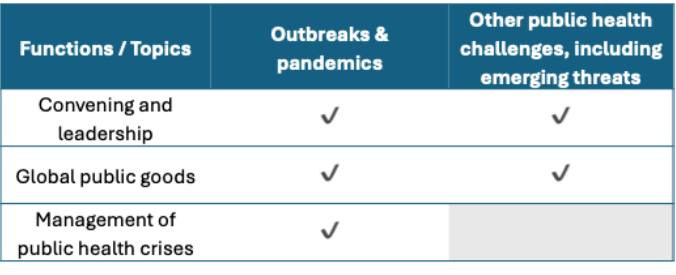
However, I think the authors conflate functions and health challenges in their analysis of the organization’s priorities. Health security is not a core function in itself—rather surveillance, information sharing, and coordination during health crises are. Arguing that the WHO risks scope creep when it focuses on climate change, industrial pollution, or alcohol is short-sighted.
Instead, I propose three core functions for WHO:
- Convening and leadership;
- Production of global public goods; and
- Management of public health crises.
For outbreaks and pandemics, WHO would play a central role across all functions to lead global pandemic preparedness and response. For other public health challenges, such as non-communicable diseases, health financing or environmental health, the organization should only focus on the first two functions: global public goods and convening and leadership (see table below).
During my years at WHO, I saw how the production of international norms and standards helped shape national priorities. When WHO released its 2021 air quality guidelines, far stricter than most national regulations, it not only set a global standard, it helped shape a different narrative all together. Similar processes have been at play in for tobacco control or more recently obesity. In a world where science is increasingly challenged, it would be a mistake to ignore the role WHO can play in raising global awareness on emerging threats.
“Should ‘global’ be the organizing principle of WHO? No, it should be results.”
Peter Singer, Professor Emeritus at University of Toronto; co-founder, Grand Challenges Canada; and former Special Advisor to the Director-General of the World Health Organization.
In their CGD brief, Pete Baker and colleagues start from the premise that WHO’s cost-cutting strategy lacks a clear vision. That is hard to argue with.
But then they propose a strategy around ‘global good’—global leadership and convening, global health security, and global public goods. What follows is the logical consequence: reallocate resources from country offices to HQ.
This is the opposite of the trend over the past eight years, when the proportion of the WHO budget going to country offices rose from 39 percent to 49 percent. This rise was about how to achieve results—which occur in countries.
When he started, Tedros’ central tenet was captured in four words: “measurable impact in countries.” WHO developed annual results reports and three successive investment cases. Its initial strategy focused on the ‘triple billion’ targets—a billion more people leading healthier populations, with universal health coverage, and better prepared for health emergencies. Subsequent work identified a way to measure the contribution of the Secretariat to countries’ priorities and a dashboard to track these. Recognizing that WHO did not exist in a vacuum, it led an initiative to coordinate action around 13 multilateral agencies in health and to measure joint progress using country ratings of how well the agencies worked together and followed country priorities.
This results architecture is being undermined by recent cost-cutting. It was already weakening before the cuts because it never connected with the governance and budget of WHO.
Where I agree with Baker et al. is that global governance, with measurement and management of results based on data (which is a global public good), is WHO’s most important function. But that requires an overhaul of the way governance is conducted today, with shift in focus from resolutions to results.
The way forward is not some Platonic ideal of making WHO more global, but the more particular Aristotelian work of building on this results-based foundation and connecting it to the governance of the organization. Indeed, WHO’s results experience could serve as a model for UN 80 reform. What inspires future investment is not a theoretical concept of the global good but measurable results in the lives of people.
“A linear cut places a burden on those least equipped to bear it, the opposite of global health equity”
Nadia Yakhelef, Head of Health Economics and Financing, Africa CDC
I agree with the authors of the brief; we need to refocus the WHO on its normative and strategic functions. It must be the guarantor of standards, and of alerts for global threats to health. It is in this latter role that she proved indispensable: in 2003 and SARS, she issued a global alert despite Chinese reluctance, a structuring act for the International Health Regulations. In 2020 and with COVID, it remains the only multilateral framework that articulates information, coordination, and access to essential tools for countries excluded from vaccine diplomacy despite political tensions.
I, however, would go further than the authors in protecting the full range of WHO services in the poorest and most fragile countries. These country offices are "the eyes and ears" of the international system, and in Syria, Sudan, DRC, or Palestine, WHO is often the only continuously present actor, perceived as neutral, capable of coordinating responses or detecting signs of an outbreak. Removing these presences would disarm the organization where risks emerge and where others do not go. This would inevitably mean greater cuts in wealthier and more stable countries. A linear cut places a burden on those least equipped to bear it, the opposite of global health equity.
What to do? First, adopt a differentiated typology of country presence, based on health risks, institutional fragility, and coordination needs. This would allow it to stay where it is most useful and withdraw where other actors can take over. Next, emphasize its non-earmarked funding base. Today, more than 80 percent of its budget comes from voluntary contributions earmarked by donors, limiting its strategic autonomy and its ability to embody a coherent global vision. The commitment of mandatory contributions by member states and the signing of the Pandemic Fund are necessary but not sufficient. WHO needs a budgetary lever that is directly attached to it. What we expect from it (alert, coordinate, and mobilize) requires the ability to act without delay, free from the cumbersome restrictions on funding. Finally, we need to collectively clarify its mission. This cannot come from the Secretariat alone but must be based on a structured dialogue between States, regions, regional health organizations, scientific institutions, public health centres, and civil society. An organization without a clear mandate is a vulnerable organization, ultimately exposed to political pressures, agenda drifts, and strategic inefficiency. An African proverb says, “When the drumbeat changes, the dance must also change.”
Author’s response
The contributors raise important considerations in defence of WHO country offices. WHO’s global work must indeed be grounded in country experience and country office technical assistance, particularly in the poorest states. However, it is not realistic or efficient for country offices to be the primary source of country evidence, nor can WHO country offices offer technical assistance for all health system needs. Instead, WHO should set up more efficient wider mechanisms to gather evidence from experts and policymakers and to support countries to access the technical assistance ecosystem—not try to be it. This would improve the quality of the information under consideration and the quality of technical assistance, as well as reducing costs, and focusing the WHO on its global mandate.
The call for WHO involvement in emerging non-pandemic threats is convincing, particularly if it is efficiently focused on global leadership and global public goods, and avoids direct involvement in response.
Finally, results and empirical effectiveness should be a component to any WHO prioritisation decision. However, three challenges remain. First, results cannot speak to what the WHO could be good at in the future, but only what it is currently good at. Second, during a period of major reform to global health architecture, an understanding of the comparative advantage of each institution over the medium term is required to carry out the re-allocation of functions strategically. Third, individual-level results such as the WHO’s “One billion more people better protected from health emergencies” may be too downstream for an organisation with a mandate to improve global systems such as pandemic preparedness.
Many thanks to the four contributors for their responses, and stay tuned as we explore further necessary, but tough, choices during this period of aid austerity.
Topics
DISCLAIMER & PERMISSIONS
CGD's publications reflect the views of the authors, drawing on prior research and experience in their areas of expertise. CGD is a nonpartisan, independent organization and does not take institutional positions. You may use and disseminate CGD's publications under these conditions.
Thumbnail image by: CURIOS/ Adobe Stock