Recommended

WORKING PAPER
Estimating Health Tax Capacity, Effort, and Potential

Blog Post
The Dual Dividend of Health Taxes
Non-communicable diseases (NCDs) impose immense health and economic costs worldwide, with a disproportionate burden on low- and middle-income countries. Excise taxes on tobacco, alcohol, and sugar-sweetened beverages (SSBs) are widely recognized as an effective policy instrument that both curbs harmful consumption and mobilizes public revenue. Yet, actual collections remain far below potential. On average, countries collect just 0.4 percent of GDP in tobacco excise revenues, compared to an estimated feasible level of 1.5 percent, indicating an untapped fiscal gap of 1.1 percent of GDP. For beer, spirits, and SSBs, countries apply only 35 percent, 25 percent, and 15 percent, respectively, of their feasible excise.
In a forthcoming paper, we review the IMF’s policy advice on health taxes over the 15-year period from January 2010 through the end of 2024. The analysis covers IMF surveillance of national economic policies, lending programs, technical assistance on tax policy and administration, and multilateral surveillance. While health policy lies outside the IMF’s direct mandate, the institution influences it indirectly through its work on tax mix and domestic resource mobilization.
The IMF’s core mandate is to safeguard the stability of the international monetary system by conducting surveillance of monetary, fiscal, exchange rate, and financial policies critical to macroeconomic and financial stability in its member countries. Unsurprisingly, based on our review of more than 5,400 IMF documents, we find that health taxes have not been a central focus of IMF engagement.
Our methodology
We identified discussions on health taxes in 5,400 country reports, including program documents, technical assistance reports, and multilateral surveillance reports. Based on this review, we constructed a country-level index with four equally weighted components:
- One point for a simple mention of health taxes
- An additional point if the document explicitly recommended raising such taxes
- Another point if raising these taxes was included as a program condition (e.g., a structural benchmark)
- A final point if IMF technical assistance explicitly advised increases in specific health taxes
Countries scoring zero on all components were excluded from the index.
Health taxes in IMF surveillance, programs, and technical assistance to member countries
Discussions of health taxes in IMF documents—spanning surveillance, lending programs, and technical assistance—have not followed a steady trajectory over the past 15 years but rather reflected shifting fiscal priorities (Figure 1). References rose steadily through the mid-2010s, peaking in 2017–2019, when excises on tobacco, alcohol, and SSBs were more frequently integrated into broader fiscal reform and revenue-mobilization agendas. Tobacco taxation was the most frequently discussed, followed by alcohol taxation.
Figure 1: Mentions of Health Taxes by Type (2010–2024)
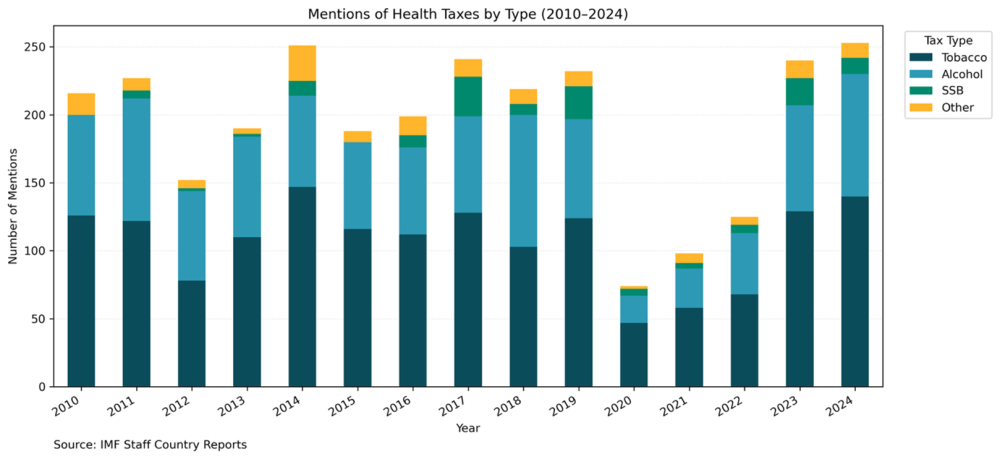
Note: “Other” includes generic health-tax language and any health-tax mention not explicitly tagged as tobacco, alcohol, or SSB. Non-health excises are filtered out by the rules.
This momentum was interrupted in 2020, as the COVID-19 crisis shifted IMF priorities toward emergency lending, health system support, and macroeconomic stabilization. Discussions reemerged after 2021, but at lower levels than before the pandemic—suggesting that while health taxes returned to the policy agenda, they now compete with post-pandemic concerns such as debt sustainability and climate policy. Engagement on health taxes thus remains context-dependent, shaped by country demand and macroeconomic circumstances.
Health taxes in multilateral surveillance
As expected, health taxes are not a central theme in IMF multilateral surveillance. When mentioned, they are primarily framed as fiscal instruments, occasionally as examples of international coordination, and only rarely in terms of their public health benefits.
IMF advice across surveillance, programs, and technical assistance to member countries
The component-level breakdown in Figure 2 sheds light on how the IMF has engaged with health taxes beyond simple mentions. Broad references and commodity-specific mentions dominate throughout the period, reflecting a tendency to acknowledge excises generally—or to cite tobacco and alcohol—without detailed recommendations.
Figure 2: Index Components of Health Tax Mentions (2010–2024)
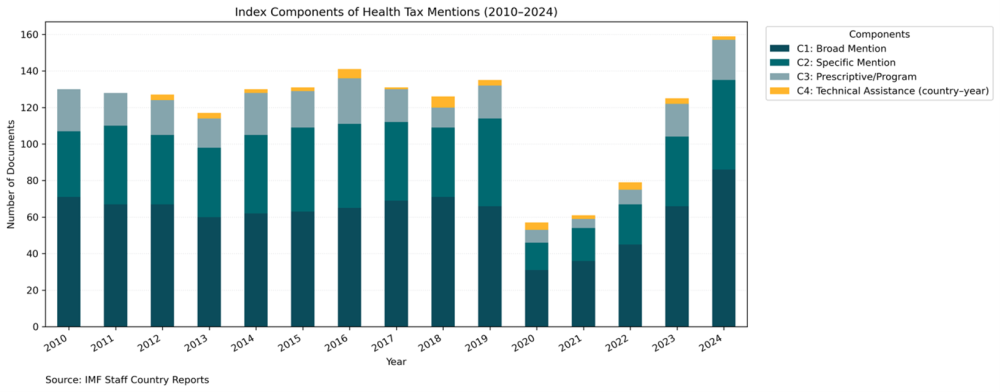
The 2014–2019 peak stands out not only for its volume of references but also for the rise in program-linked conditionality, when health taxes were more often embedded in IMF-supported fiscal reforms. This surge coincided with heightened global attention to NCDs: the 2017 revision of WHO’s “Best Buys,” the 2018 UN High-Level Meeting on NCDs, and high-profile advocacy such as the Task Force on Fiscal Policy for Health. These developments lent legitimacy to incorporating health taxes into fiscal reform agendas. At the same time, the IMF’s Fiscal Affairs Department also issued practical guidance on tobacco excise design.
Within IMF programs, the focus was overwhelmingly on tobacco, mentioned in about 90 percent of program-linked references, often alongside alcohol (63 percent), while SSBs appeared in only about 10 percent. This indicates that structural conditions, where applied, were primarily framed around tobacco taxation.
Technical assistance on health taxes has been episodic, concentrated in selected years (2012, 2016, 2018, and 2022), consistent with its demand-driven nature. These episodes represent the most substantive engagements, where the IMF provided detailed guidance on excise system design and administration.
The sharp decline across all components in 2020 reflects the shift toward emergency financing and pandemic response. Although references to health taxes have since rebounded, the post-COVID period has been characterized by a return to broad and specific mentions, rather than deeper programmatic or technical engagement.
Engagement by income level
IMF engagement on health taxes has been concentrated in emerging market economies (EMEs), which account for roughly half of all broad and specific references, as well as most program conditions. Advanced economies represent about one-fifth of mentions, while low-income countries (LICs) account for the remainder.
Technical assistance displays a similar concentration in EMEs. In the post-COVID period (2023–2024), these patterns sharpened: broad and specific references remained centered in EMEs, with no publicly available TA cases for advanced or LICs. TA advice has centered on technical design issues—such as ad valorem versus specific taxes, indexation, and enforcement.
The bottom line
The IMF engages in health taxes more than its mandate strictly requires. References to health taxes in surveillance, programs, and technical assistance peaked between 2014 and 2019, marked not only by a higher volume of mentions but also by more frequent program-linked conditionality, embedding excise tax increases within IMF-supported fiscal reforms.
By contrast, technical assistance has been more episodic, reflecting its demand-driven nature.
At the same time, EMEs and LICs face pressing revenue needs: domestic revenues have stagnated since 2012, and in some LICs, more than one-third of government revenues are absorbed by interest and debt service. Where administrative capacity exists, raising health taxes offers a relatively straightforward way to address the growing burden of NCDs while generating additional revenues—the “double dividend.”
Yet, substantial revenue shortfalls persist. Tobacco tax collections remain weak in EMEs and LICs, particularly in Latin America and the Caribbean, the Middle East and North Africa, and sub-Saharan Africa—while advanced economies show sizable gaps in beer and spirits (mainly in North America), and SSB taxation lags across both advanced and EMEs.
IMF advice could therefore more explicitly support countries in realizing this untapped revenue potential as part of its broader work on tax mix and domestic resource mobilization. Still, the appropriate level of sin taxation is necessarily country-specific, shaped by administrative capacity, regional coordination, and smuggling risks.
Topics
DISCLAIMER & PERMISSIONS
CGD's publications reflect the views of the authors, drawing on prior research and experience in their areas of expertise. CGD is a nonpartisan, independent organization and does not take institutional positions. You may use and disseminate CGD's publications under these conditions.
Thumbnail image by: winnievinzence/ Adobe Stock