Recommended

WORKING PAPER
Female Leadership in India
It is widely documented that education and health are critical for achieving sustainable economic development. How can countries catalyze public spending in these areas in an era of limited fiscal resources? In our recent paper, Women in Policymaking: Social Spending and Outcomes, we uncover a channel that has not received sufficient attention: raising the share of women who are policymakers. We find that in emerging markets and developing economies (EMDEs), raising the share of women in parliament and government cabinets can help raise health and education spending and achieve better socioeconomic outcomes.
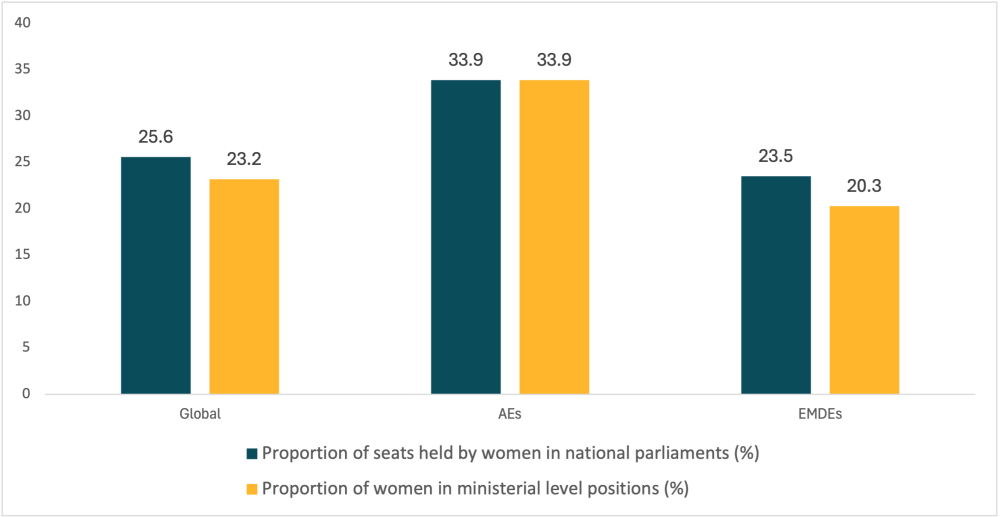
This represents an untapped opportunity in many countries, as there are fewer women than men in policymaking in most regions of the world. As of 2024—the latest year for which data are available—the global average share of women in national parliaments is 25.6 percent, while those in ministerial-level positions is 23.2 percent (Figure 1).
Figure 1. Share of women in policymaking
Global patterns in women’s representation in policymaking
EMDEs lag advanced economies (AEs) in appointing or electing women to high political positions. The share of women in national parliaments in EMDEs was about two-thirds that of AEs, while the share of women in ministerial-level positions was also substantially lower. Interestingly, some EMDEs are well ahead of AEs. For example, Rwanda (63.8 percent), Cuba (55.7 percent), and Nicaragua (53.8 percent) led global averages of women in national parliaments.
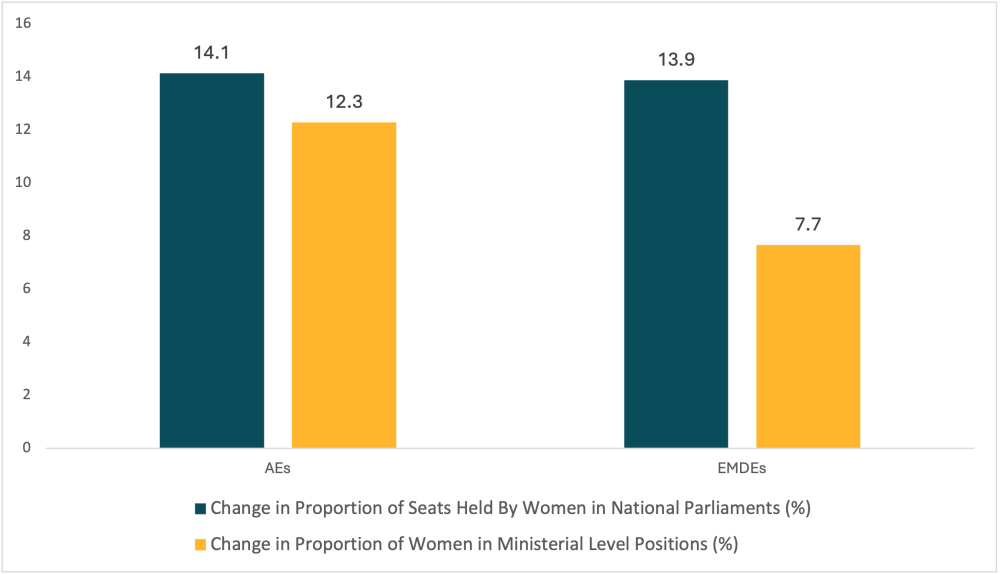
Even though the share of women in policymaking positions was lower in EMDEs than in AEs, it has risen over time, albeit at a slower rate than in AEs since 2000 (Figure 2).
Figure 2. Change in share of women in policymaking since 2000
Trends in social spending and socioeconomic outcomes
While education and health spending (as a share of GDP) have risen since 2000 in all EMDE regions, increasing the share of women in policymaking provides a further boost. We find that a 20-percentage-point increase in the share of women in parliament goes hand-in-hand with an increase in health spending by 0.4 percentage points of GDP, a significant increase from its average level in 2019 (2.8 percent). Raising the share of women as ministers has a broadly similar effect. For education spending, raising the share of women in parliament also has a positive effect of a similar magnitude, but this effect is not as strong when the share of women as ministers rises.
Another significant finding in our paper is the positive impact of greater female representation in government on socioeconomic outcomes, independent of spending on education and health. A greater share of women in parliament is associated with a reduction in infant and under-five mortality rates and improvements in learning-adjusted years of schooling, keeping the spending unchanged on these items. It is also associated with higher access to basic water services. These findings suggest that greater representation of women in policymaking may not only raise the level of social spending but also influence how effectively this spending translates into better outcomes.
Lessons from country experiences
Important lessons can be learnt from country cases as greater female representation in government can go hand-in-hand with changes in policy priorities. To take one example, in Ecuador, following the introduction of quotas, the proportion of seats held by women in national parliaments and in ministerial-level positions increased by more than 23 percentage points in two decades, reaching nearly 40 percent by 2019. Aided by constitutional reforms that brought about universal access to healthcare and free access to education, government spending on health increased from less than 1 percent of GDP to nearly 5 percent, and education spending from 1.2 percent of GDP to 4.2 percent during the 2000-2019 period. At the same time, socioeconomic indicators also improved, although significant disparities in access to services across income groups remained.
A number of studies on India also find that greater female leadership increases social spending and is associated with better health and education outcomes for children. A good example is in the field of education, a joint responsibility of the central government (which sets the national educational standards and policies) and the states and local bodies (which implement these policies). In 2015, the Beti Bachao Beti Padhao campaign was launched at the national level by the prime minister to promote girls’ education and awareness. This is being implemented by local governments—the Panchayati Raj Institutions (PRIs)—where the share of women in PRIs is very high by EMDE standards, ranging from 33 to 50 percent. The presence of women leaders at the local level appears to have contributed to an increase in learning-adjusted years of schooling from 5.9 years in 2010 to 7 years for girls in 2018, reflecting gradual improvements in education quality.
Looking forward, the modest outlook for global economic growth, high levels of public debt, rising military spending, and declining foreign aid will limit the scope of EMDEs to spend on education and health. Against this backdrop, creative solutions to improving social outcomes are needed. Appointing or electing women to top political positions may help forge the political coalitions needed to reprioritize public spending and improve socioeconomic outcomes.
Topics
DISCLAIMER & PERMISSIONS
CGD's publications reflect the views of the authors, drawing on prior research and experience in their areas of expertise. CGD is a nonpartisan, independent organization and does not take institutional positions. You may use and disseminate CGD's publications under these conditions.
Thumbnail image by: UN Women/Ryan Brown