
When leaders from the European and African Unions meet later this month for their first summit in three years, one of their top priorities will be advancing an “enhanced and reciprocal partnership for migration and mobility”, including addressing the "root causes” of irregular migration and forced displacement. This blog provides an overview of the funding the European Union (EU) has provided for this purpose, its impact, and what this means for a future partnership with the African Union (AU).
The EU’s investments in tackling “root causes”
The EU’s Emergency Trust Fund for Africa (EUTF) is about to shut its doors after 10 years of operation. Over that period, almost €5 billion has been disbursed in three African regions: the Sahel and Lake Chad; the Horn of Africa; and North Africa (Figure 1). Around 250 programmes have been financed in 36 countries, aiming to address the “root causes” of irregular migration through better migration management.
Figure 1. EUTF disbursements by region, 2015-2022
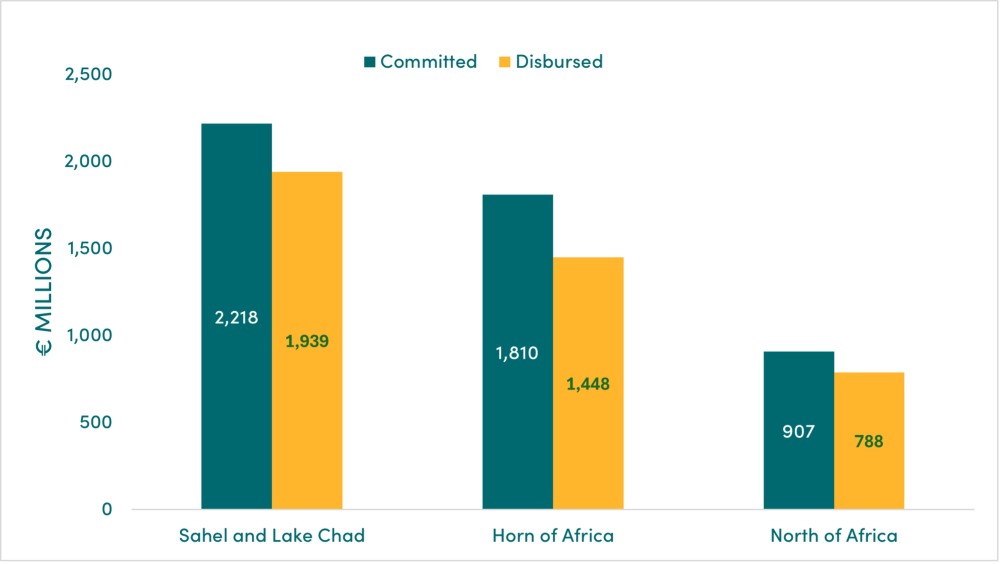
Source: https://trust-fund-for-africa.europa.eu/our-mission/state-play-and-financial-resources_en
Since January 2022, projects have been continued under the €79.5 billion Neighbourhood, Development, and International Cooperation Instrument (NDICI). Approximately 10 percent of the 2021-2027 NDICI funds are allocated to migration- and forced displacement-related projects, including addressing “root causes” (a term which has been the topic of much criticism and debate). As the Carnegie Endowment for International Peace (CEIP) outlines, this shift in funding has “served to strengthen the conditionality framework—whereby aid to transit countries depends on their willingness to cooperate with EU migration management”.
Exactly how the EU’s new seven-year budget (the 2028-2034 Multiannual Financial Framework or MFF) will position migration and forced displacement will ultimately depend on the outcome of ongoing negotiations. Overall, the EU has clearly communicated that its approach to development cooperation will be one of equal partnership and investment, rather than traditional aid, mainly through the Global Gateway.
As in other thematic areas, the MFF proposals have dropped the 10 percent spending target for migration, but indicate an intention to deepen cooperation with partner countries, framing migration as an area of strategic leverage. Cooperation on migration appears likely to be even more explicitly linked to—potentially even conditional on—progress on returns, readmission, and border management. Beyond external action, the overall budget foresees increased spending on border management and internal security, underscoring that migration management remains a key EU priority.
In this context—where migration management and sustainable development are increasingly tied, and the development budgets of European donors are shrinking—what lessons have we learned from previous attempts to address the “root causes” of irregular migration, and how can effective interventions be best designed to benefit both sides of the EU-AU partnership?
What works to address “root causes”?
The “root causes” of irregular migration are the social, economic, or external drivers that might contribute to someone choosing to move irregularly. They are, of course, compounding and complex, but broad patterns can be seen: climate change, conflict, and a lack of basic services and perceived economic opportunities are all common drivers.
Yet examining “what works” to address these drivers is difficult. For example, in 2022 CGD published a study looking at “what works” to address the “root causes” of irregular migration from Central America to the US. Our approach was to identify within a driver (e.g., climate shocks) which programmatic approaches rigorous evidence suggests are most promising to discourage irregular migration (e.g., index insurance schemes); which have mixed evidence; and which are less effective.
We were therefore excited to see that the same methodological approach was recently applied by the European Commission’s Joint Research Centre (JRC) to Africa. The study examined 47 projects in seven countries and at the regional level, focusing on three key drivers of irregular migration: a lack of employment and livelihood opportunities; conflict and social tensions; and poor migration and forced displacement management. The research found a number of key approaches which were effective at reducing the “root causes” of irregular migration, as well as those which had more limited impacts.
Table 1. “Root causes” approaches identified in EUTF programming and their impact
| Driver | Effective | Limited impact |
|---|---|---|
| A lack of employment and livelihood opportunities |
|
|
| Conflict and social tensions |
|
|
| Poor migration and forced displacement management |
|
|
Across the spectrum of projects reviewed, the research found external events such as political instability, environmental shocks, and inflation limited the impact and implementation of individual projects. (Interestingly, these external events are often considered the “root causes” of irregular migration themselves).
Challenges in measurement
However, just because these approaches are effective in reducing the “root causes” of irregular migration in the short-term, doesn’t mean they are effective in actually reducing irregular migration.
Both the Central American and African studies found that most projects used generic monitoring and evaluation (M&E) systems, with limited migration-related outcomes. Some projects deliver surveys which ask about migration aspirations, without following up to see whether such migration happened. A better approach is to measure active, costly, preparations to migrate (which more accurately tally to migration rates). This would also be cheaper than measuring actual migration rates, which would require reliable, time consistent, data on migration flows at the country and regional level—a huge challenge.
However, there is always a risk that otherwise successful development projects (those that reduce “root causes”) will be cut if they fail to deliver on reducing irregular migration rates. While it would be useful to gather more data on whether such “root causes” interventions actually reduce irregular migration, the success of projects shouldn’t be contingent on this metric. Rather, it should be one outcome of many.
Going forward
A focus on tackling the “root causes” of irregular migration is here to stay. Although aid is not (yet) explicitly tied to migration management, development agencies are increasingly under pressure to demonstrate how their projects contribute to reducing irregular migration.
For some policymakers, this framing has provided a way to maintain political support for aid. For instance, Hungary’s Minister of Foreign Affairs and Trade recently defended their participation in development initiatives by arguing that: “we know full well that if tensions in Africa decrease, then so will the root causes of migration, which will further improve the security of Europe”.
The theme also remains prominent at the EU level. Just last month, the European Parliament’s Committee on Development published a “draft report on reinforcing development cooperation to address irregular population movements and their root causes in partner countries”. The report hasn’t been debated and voted on yet, and will likely see significant amendments. Yet it’s interesting to see that it argues that migration-related conditionality should be explicitly integrated into development funding, especially with regards to partner countries’ cooperation on return and readmission (while excluding humanitarian aid from such conditionality).
As European and African states discuss this issue, there are four lessons they should bear in mind.
Projects aimed at addressing the “root causes” of irregular migration should:
- Prioritise approaches already identified as impactful. Both the Central American and African studies identified approaches which were effective at reducing the “root causes” of irregular migration (Table 1). These approaches should be replicated and scaled, with less promising approaches avoided.
- Measure whether individual recipients are making active, costly, preparations to migrate. This could be done through surveys, carefully distinguishing between aspirations and active preparations. Such measurement should be built into the projects’ M&E framework and its theory of change.
- Be judged primarily on their development outcomes, not their impact on irregular migration rates. Aid should be focused on improving well-being and resilience, not on preventing movement. Impact on the latter should be one of many indicators, but not the primary one.
- Be part of broader cooperation with partner countries. CGD research has shown that member states must expand both legal migration pathways and returns to manage irregular migration. Investments in “root causes” must therefore go alongside other investments: building well-being and resilience; developing migration and forced displacement management systems; and expanding legal migration pathways. Such holistic and demand-led engagement is key to promoting true partnerships.
With thanks to Camilla Fogli who we spoke to in the development of this blog.
Topics
DISCLAIMER & PERMISSIONS
CGD's publications reflect the views of the authors, drawing on prior research and experience in their areas of expertise. CGD is a nonpartisan, independent organization and does not take institutional positions. You may use and disseminate CGD's publications under these conditions.
Thumbnail image by: aalutcenko / Adobe Stock