
Military spending has surged worldwide in the wake of Russia’s invasion of Ukraine in 2022 and growing tensions in Asia and the Middle East. This resurgence comes just as global public debt has climbed to historic highs. The trend marks a sharp break from the long decline in military outlays between 1990 and 2008—both as a share of GDP and as a share of government budgets—relative to the Cold War years.
This blog, which draws on a new background paper I wrote for the IMF’s Independent Evaluation Office, discusses the likely implications of reallocating public resources toward defense. In advanced economies, where debt-to-GDP ratios now exceed more than 100 percent, on average, higher defense spending will inevitably force difficult tradeoffs, particularly as age-related spending on health and pensions continues to rise and political space for tax increases remains limited. For developing countries confronting instability, violence, or terrorism, high defense budgets risk crowding out vital social and infrastructure investment—undermining long-term growth.
Military spending trends, 1970 to 2023
Globally, military spending as a share of GDP fell by half between 1990 and 2008 compared with the Cold War period (1970–1990). This decline held across all country groups—advanced economies (AEs), emerging markets and middle-income economies (EMMIEs), and low-income developing countries (LICs)—reflecting the “peace dividend” that followed the collapse of the Soviet Union. In European countries, defense spending fell from 2.5 percent of GDP in early 1990s to just 1.5 percent of GDP in 2014. Military spending to GDP was broadly constant, on average, until about 2020, and then started rise again in 2022 onwards across all country groups.
The same downward shift appears in budget composition: the share of government outlays devoted to defense has steadily decreased since the 1980s. Still, fragile- and conflict-affected states continue to devote the highest budget shares—around 10 percent—to the military. Today, EMMIEs spend roughly 8 percent of their budgets on defense, compared with about 5 percent in AEs. Middle Eastern countries allocate the largest shares of both GDP and budget to defense, while Latin American countries allocate the least.
Figure 1a. Military expenditure as a share of GDP, 1970–2023
(Average within country group, percentage of GDP)
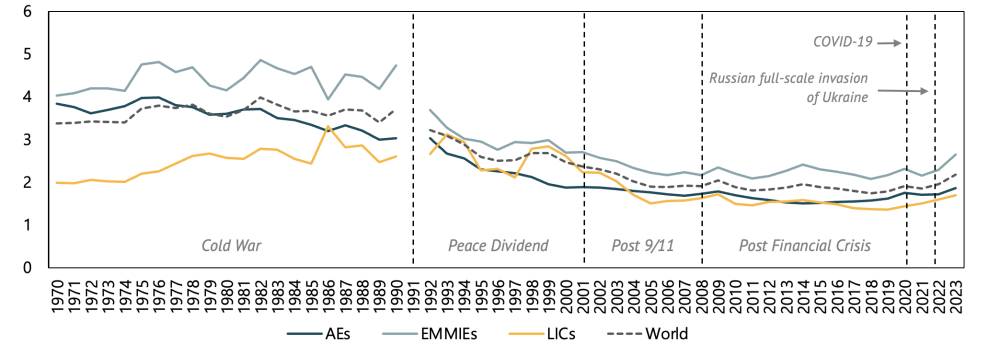
Figure 1b. Military expenditure as a share of government expenditure, 1980-2023
(Average within country group, percentage of general government expenditure)
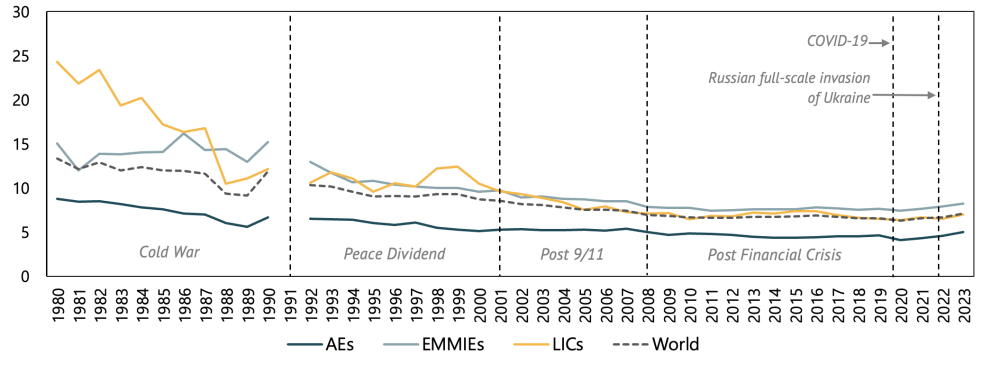
Source: SIPRI data.
Notes: AEs = Advanced Economies; EMMIEs = Emerging Markets and Middle-Income Economies; LICs = Low-Income Countries. Military expenditure calculated as the unweighted country average within each country group. Data for 1991 are not available due to the breakup of the former Soviet Union. The number of countries in the sample varies over time.
Europe’s defense buildup
Nowhere is the recent shift more pronounced than in Europe. According to The Economist, European military spending is already about 50 percent higher in nominal terms than in 2022 and rising—driven by national initiatives and new EU-level support.
In March 2025, the European Commission unveiled a package to strengthen the EU’s security framework. It recommended that member states activate the national escape clause of the Stability and Growth Pact (SGP), giving governments room to expand defense budgets without triggering the excessive deficit procedure. It also proposed the Security Action for Europe (SAFE) initiative—€150 billion in loans to support defense-related investment.
Germany has amended its constitutional debt brake to exempt military spending above 1 percent of GDP and to create a €500 billion infrastructure fund. The United Kingdom plans to raise defense spending by 0.2 percentage points of GDP in 2027, with a longer-term goal of reaching 3 percent. This increase will be financed not by higher taxes or borrowing but by cutting official development assistance from 0.5 to 0.3 percent of GNI.
By October 2025, sixteen EU countries had activated the SGP escape clause, and the full SAFE loan envelope had been allocated to nineteen member states—though disbursements have yet to begin. Poland is set to receive the largest share, followed by Romania, France, Hungary, and Italy.
Despite these steps, Europe remains far from meeting NATO’s new target—agreed at the 2025 summit in The Hague—for allies to spend 3.5 percent of GDP on core defense plus up to 1.5 percent on broader security-related items such as critical infrastructure, cyber defense, civil resilience, and defense-industrial capacity by 2035.
This buildup will add pressure to already constrained budgets. With revenue-raising options limited and spending on health and pensions rising, fiscal space in advanced economies will tighten further. In developing countries, higher defense budgets are likely to crowd out health, education, and infrastructure investment—unless domestic revenues can be strengthened and spending becomes more efficient. In sub-Saharan Africa—where conflict has recently increased in about one-third of countries—military spending already claims the highest budget share among all regions.
What does rising military spending mean for growth and budgets?
Higher defense spending in Europe could provide a temporary boost to demand and spur technological innovation. However, empirical evidence suggests that these effects are modest for advanced economies and negligible for EMMIEs and LICs. In fact, growth impacts in AEs may even turn negative if higher defense spending is financed through tax increases.
One notable exception is military R&D. In AEs, increases in government-funded military research can spill over into private-sector innovation, enhancing productivity across the economy. This effect is largely absent in developing countries, which typically import their military equipment and lack domestic defense industries. Arms imports can also have a significant impact on balance-of-payments positions and strain budgets in the years they occur.
For developing countries with limited fiscal space, rising defense spending often means less money for health, education, and infrastructure—areas with far higher long-term growth returns. But even advanced economies may face similar pressures as they ramp up defense budgets in response to Russia’s war in Ukraine and changing geopolitics.
Conclusion
The resurgence of military spending marks a clear shift in global fiscal priorities. While security threats have undeniably intensified, the resources required to address them are being mobilized at a time when governments—both advanced and developing—face tightening fiscal constraints, aging populations, and mounting development pressures. The challenge is not only to strengthen defense capabilities, but to do so without eroding social protection, underinvesting in human capital at a time of rapid AI-driven change, or slowing the climate transition. Without careful policy choices, today’s security imperatives risk becoming tomorrow’s fiscal vulnerabilities.
I wish to thank Benedict Clements for helpful comments on an earlier draft.
Topics
DISCLAIMER & PERMISSIONS
CGD's publications reflect the views of the authors, drawing on prior research and experience in their areas of expertise. CGD is a nonpartisan, independent organization and does not take institutional positions. You may use and disseminate CGD's publications under these conditions.
Thumbnail image by: Reza / Adobe Stock