Recommended
Blog Post
Update on Lives Lost from USAID Cuts
Humanitarian and global health financing is vital to save lives worldwide. But so is humanitarian and global health data. The 2026 aid budget that the US Congress passed provides sufficient resources to help prevent hundreds of thousands of deaths, but effectively targeting those resources will require support for the data systems that track needs and delivery. Congress and the administration should work together to ensure these essential monitoring systems—from the famine early warning network through PEPFAR and the President’s Malaria Initiative data platforms—have the inputs they need to perform their essential role.
In 2025, World Food Programme (WFP) financing was 34 percent below its 2024 level. The WFP estimated that the cuts could lead to 3 million people in IPC Phase 4 (Emergency) food security status losing aid and 13.7 million people in IPC Phase 3 (Crisis) slipping to Phase 4 status. (IPC stands for Integrated Food Security Phase Classification. The WFP uses this five-point scale to classify levels of hunger, with Phase 1 being None or Minimal Hunger and Phase 5 being Catastrophe/Famine.)
The UNHCR suggests mortality can climb two to tenfold over usual levels during an emergency. For comparison, the standard emergency threshold of one death per 10,000 people per day corresponds to four times the average mortality rate in sub-Saharan Africa. If the three million people in Phase 4 who lost aid saw mortality climb from one to two deaths per 10,000 per day, while the Phase 3 recipients saw mortality climb from 0.5 to one death per 10,000 per day, the WFP cuts in 2025 would have been associated with about a thousand deaths each day or more. A disproportionate proportion of those deaths would have been young children.
Table 1. Food insecurity and mortality risk
| IPC Phase | Reference Crude Mortality Rate (/10k/day) | Reference Under-Five Mortality Rate (/10k/day) |
|---|---|---|
| 1 Minimal | <0.5 | <=1 |
| 2 Stressed | <0.5 | <=1 |
| 3 Crisis | 0.5-1 | 1-2 |
| 4 Emergency | 1-2 | >2 |
| 5 Famine | >2 |
Source: FAO
While this calculation suggests the urgent need to restore humanitarian funding, it also points to the vital role of targeting. Knowing the number and location of IPC Phase 3, 4, and 5 populations is vital to response, and advance indicators like market prices are needed to ensure support arrives before famine strikes. That’s what allows for tools like FEWSNET, the US-backed famine early warning network, to predict humanitarian support needs at the district level in the months ahead.
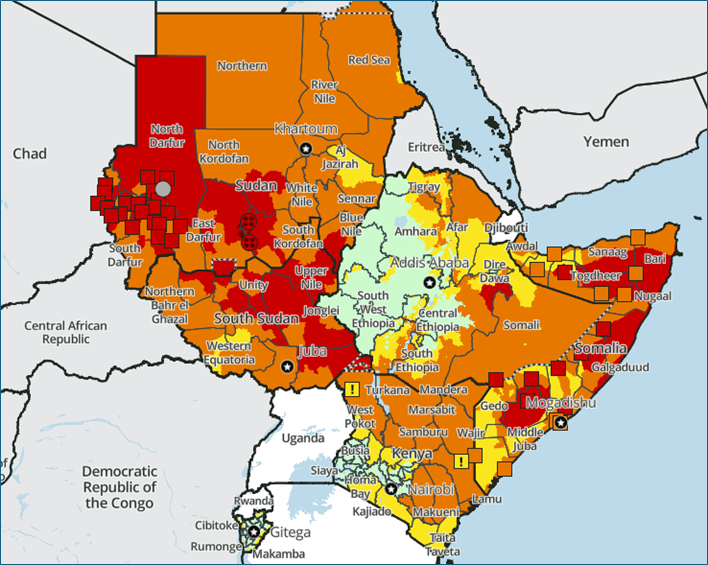
FEWSNET February 2026 IPC Map for East Africa IPC Phase 1 green, 2 yellow, 3 orange, 4 red, 5 brown.
But that system requires data to operate, and generating data, in turn, involves surveying people and prices as well as using tools like mobile phone tracking and satellite imaging. And another victim of aid cuts last year was the data collection system run by the WFP amongst others. As a result, our ability to forecast and target needs has declined, and dwindling available finance will become less effective at saving lives. Indeed, the WFP reports that an apparent decrease in food insecurity from 343 million in 2024 to 318 million in 2025 at the global level ”is primarily due to reduced country coverage and data availability. It does not reflect an actual improvement in food security.”
This is part of a broader and ongoing collapse in the data systems required to target and monitor US foreign assistance spending to ensure impact. As the America First Global Health Strategy noted, PEPFAR has "one of the most robust data reporting and monitoring systems of any foreign assistance program in history.” That system will have a particularly important role in monitoring the new PEPFAR Global Health Agreements that shift responsibility for delivering lifesaving aid from USAID and State contractors to host governments. But the reporting system remains down after nearly a year. The same is true for reporting on the President’s Malaria Initiative.
Congress has demonstrated its interest in data for targeting and monitoring. The bill providing FY26 funding to US assistance programs not only provides considerable resources for humanitarian and global health support but also demands data and details around spending and outcomes from that assistance. That includes requirements for reports on nutrition outcomes achieved in FY25, nutrition-specific treatment and prevention interventions on a country-by country basis, an assessment of current global food insecurity and actions undertaken by the Department of State to address each emerging food crisis identified during calendar year 2025, including projected needs, and a forward-looking assistance-wide spending plan by region, country, program, and type of support, alongside subsequent quarterly spend plans including actual obligations and disbursements.
As part of this oversight role, Congress and the administration should work to ensure that additional funding also supports the data collection and systems that allow US assistance to have the maximum lifesaving impact—and demonstrate that impact. That means fully funding the survey and other data work that underpins famine early warning and response, and delivery of lifesaving medications and prophylactics from antiretrovirals through bed nets and vaccines. Effectiveness and appropriate congressional oversight require no less.
Topics
DISCLAIMER & PERMISSIONS
CGD's publications reflect the views of the authors, drawing on prior research and experience in their areas of expertise. CGD is a nonpartisan, independent organization and does not take institutional positions. You may use and disseminate CGD's publications under these conditions.
Thumbnail image by: Kate Holt / AusAID, via Wiki Comms