Recommended

Blog Post
How Has the IMF Engaged on Health Taxes?
US foreign aid cuts in 2025 severely affected health, education, and economic development programs in several low- and lower-middle-income countries, many of which lacked the fiscal space to offset reductions in external financing. More broadly, the aid environment deteriorated in 2025 as major donors scaled back assistance in response to mounting fiscal pressures and the growing urgency to increase defense spending following Russia’s invasion of Ukraine. In sub-Saharan Africa (SSA), USAID played an outsized role in many countries’ health sectors, leaving them particularly exposed to the cuts, including to critical HIV/AIDS, malaria, tuberculosis, and maternal and child health programs.
Did these developments prompt aid-recipient countries to raise domestic taxes or cut lower-priority spending to compensate for declining aid flows? In this blog post, we examine budget statements and policy announcements from many SSA countries in response to the tightening external financing environment. We find that policy responses were limited—confined to only two of the 18 countries studied—and, where they occurred, focused on mobilizing additional resources. Several countries acknowledged USAID cuts, but none took concrete steps to reprioritize spending from lower-priority areas to protect critical health expenditures.
Countries affected by aid cuts
We selected SSA countries that received US aid equivalent to at least 0.5 percent of gross national income in 2023, as per an analysis by our colleagues. This yielded a sample of 29 countries: Benin, Burkina Faso, Burundi, Central African Republic, Chad, Democratic Republic of Congo, Djibouti, Eswatini, Ethiopia, The Gambia, Kenya, Lesotho, Liberia, Madagascar, Malawi, Mali, Mozambique, Namibia, Niger, Rwanda, Senegal, Sierra Leone, Somalia, South Sudan, Sudan, Tanzania, Uganda, Zambia, and Zimbabwe. Of this group, we focus on 18 countries where recent budget documents were readily available. We examine fiscal targets and budget statements in these countries to identify policy pronouncements explicitly aimed at addressing aid shortfalls.
Budgets in these countries are typically presented in early June, that is, after US aid programs were paused in January 2025 and 83 percent of contracts were cancelled in March. Thus, it would be reasonable to expect the decline in external financing to have elicited a policy response, reflected in fiscal targets and budget statements for the fiscal year starting in July 2025. We would thus expect to see a response to these aid cuts in targets in the latter half of 2025 and calendar year 2026 and beyond.
Figures 1 and 2 present the median projections for revenues, expenditures, and public debt (all expressed as a share of GDP) from 2024 through 2030, drawn from the IMF’s World Economic Outlook (WEO). Countries projected an increase in expenditure in 2025, before the aid cuts were fully realized. For 2026, expenditures are projected to fall, before resuming their upward trajectory. What is most striking in the projections is that there is little evidence of new revenue-raising measures to offset the decline in grants and concessional financing; adjustment instead is expected through spending restraint in 2026 in response to declining external financing. In the aggregate, the WEO projections present an optimistic fiscal outlook, reflected in a decline of nearly six percentage points in the debt-to-GDP ratio over the period. This optimism may rest on expectations of medium-term reforms that have yet to be implemented—and may ultimately not materialize.
Figure 1. Median revenue & expenditure to GDP US aid-exposed SSA countries
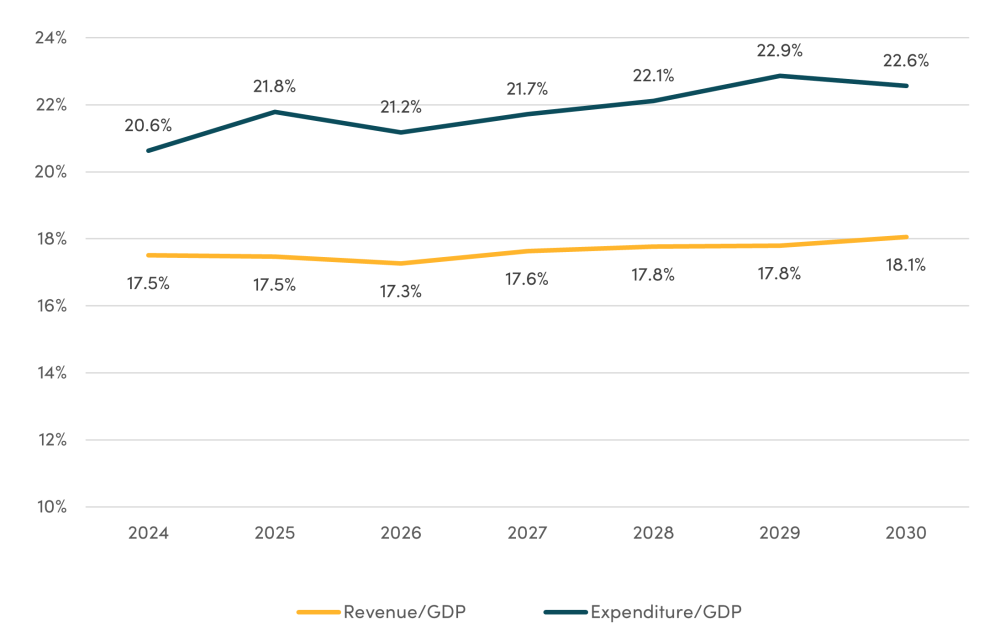
Source: IMF WEO
Figure 2. Median gross debt to GDP US aid-exposed SSA countries
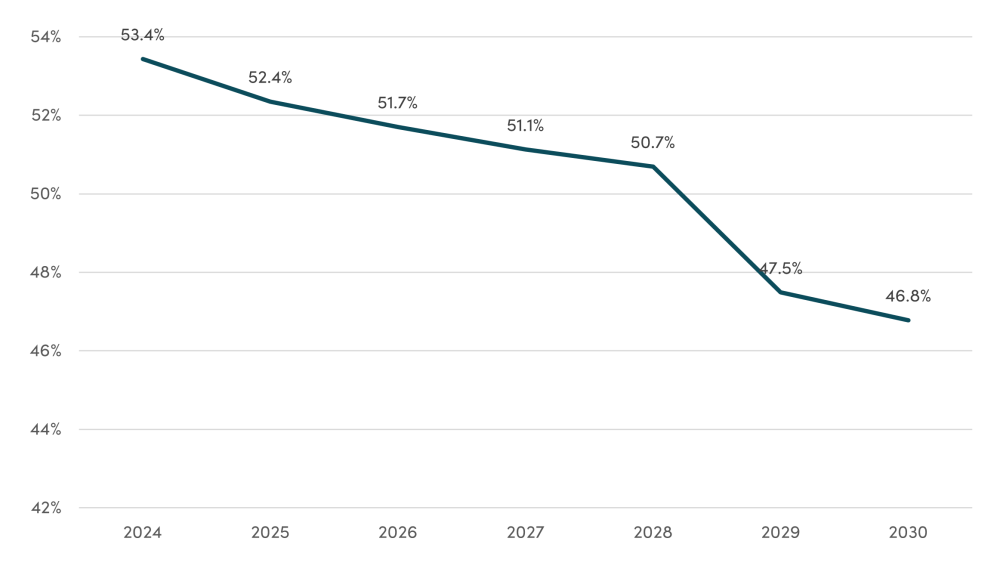
Source: IMF WEO
Country responses to aid cuts
Twelve of the 18 countries acknowledged aid cuts or a broader decline in donor support in their budget documents, with some noting adverse effects on the economy beyond the fiscal accounts (Lesotho, Malawi, Senegal, Somalia). In Benin, the budget statement indicated that the expected effects would be minor, while in Kenya, a rebound in service exports—particularly tourism—was expected to help offset the macroeconomic impact of reduced donor flows. Eswatini and the Democratic Republic of the Congo both expressed concern about the effects of lost funding on their health sectors.
Only two countries proposed raising revenues to replace the funding lost from the cuts. In Sierra Leone, the government indicated the need to broaden the tax base and improve revenue administration and reiterated its commitment to implement its Medium-Term Revenue Strategy. However, the government’s budget speech did not indicate which policy measures this would imply. The most comprehensive policy response came from Tanzania, which raised taxes on alcohol, imported motor vehicles, telecommunications, gaming, and rail and air tickets. Looking ahead, Tanzania also proposed an import-substitution strategy aimed at reducing dependence on foreign financing.
Overall, the evidence suggests that most countries examined did not respond to the 2025 aid shock with broader tax reform or systematic expenditure prioritization. Instead, much of the adjustment to declining aid appears to have been absorbed within the existing budget envelopes—through reduced service delivery, or delays in implementation—rather than through transparent fiscal policy choices. These findings raise concerns about the sustainability of fiscal policy in these countries in an environment of prolonged aid retrenchment.
That said, this analysis has several limitations. First, it relies on publicly available budget documents; in-year reallocations or administrative measures may not be captured. Second, the analysis focuses on short-term responses. Future budgets may reveal more substantial adjustments as the external environment remains tight. Also, uncertainty over the scope, timing, and possible replacement of US aid cuts may have delayed governments’ implementation of new spending measures.
Conclusion
The 2025 aid cuts represented a major external shock for aid-dependent countries in SSA. Yet the budgetary responses observed so far suggest that aid cuts did not catalyze domestic fiscal adjustment. With few exceptions, governments neither raised new revenues nor reallocated spending to compensate for lost external financing. Instead, the burden of adjustment appears to have fallen on service delivery.
The expectation that reductions in aid will automatically lead to swift domestic policy action is not borne out by the evidence. As donor retrenchment persists, this raises questions about the sustainability of current development financing models and the protection of essential social spending in aid-receiving countries.
Topics
DISCLAIMER & PERMISSIONS
CGD's publications reflect the views of the authors, drawing on prior research and experience in their areas of expertise. CGD is a nonpartisan, independent organization and does not take institutional positions. You may use and disseminate CGD's publications under these conditions.
Thumbnail image by: Angela Meier/ Adobe Stock