Recommended

BRIEF
Charting PEPFAR’s Next Chapter While Safeguarding Its Legacy
Blog Post
How Many Lives Does US Foreign Aid Save?
Note: The numbers for 2025 Quarter Four were released in April 2026.
The country-level data remains largely the same as reported in the blog, with updates only for South Africa in Q4 2025: the final figures show 111,455 more people on ART and 273,739 more people tested than in the draft. All other countries report identical data.
The global program results broadly match that change for ART: suggesting 20.6 million were on ART in 2025 Q4, the same as was reported in 2024. This is “supported by” PEPFAR, so that includes direct service delivery and clinic-level technical assistance but also central (non-clinic level) support.
The credit that PEPFAR will take excluding central support has dropped: the program results suggest 19.4 were receiving ART in 2024 by PEPFAR supported clinics compared to 17.4 million in 2025Q4. This largely appears to be about South Africa, where the program suggests 4.3 million were receiving ART from PEPFAR supported clinics in 2024 compared to 2.6 million for Q4 2025. The global numbers suggest that other clinics/agencies are reported to have stepped in to fill the gap.
Data for the first three quarters of 2025 is not reported in this release because “program interruptions, reporting challenges, and programmatic shifts have occurred since January 2025.” I would suggest the draft data points to those interruptions being significant, as suggested in this blog.
The US State Department has collected data on the performance of PEPFAR in 2025, but is yet to officially release it. A Freedom of Information suit is ongoing. In the meantime, some data has become available. And the (potentially draft) headline numbers for 2025 can be compared to 2024: PEPFAR supported 67 million people to receive testing and counselling, down from 84 million in 2024 (leading to a drop in positive tests from 1.7 to 1.3 million people). It also supported 100,000 fewer on antiretrovirals (20.5 million down from 20.6 million), saw a 1.6 million drop in antiretroviral therapy (ART) patients with documented viral load (15.2 million down from 16.8 million), and a 1.3 million drop in patients with suppressed viral load results (14.7 million down from 16.0 million). At the same time, the number of pregnant women who knew their status was stable over the year as a whole, and there was a reported 110,000 increase in the number of pregnant women newly enrolled in prophylactic treatment with PEPFAR support.
These numbers, particularly on antiretroviral coverage, would likely translate into mortality impacts considerably below the approximate 200,000 deaths per year predicted by estimating PEPFAR funding cuts from March 2025. That estimate is based on a simple calculation of lives saved per dollar spent, which assumes no later funding response from the US government, prioritization of lifesaving services, or host country governments or other donors stepping in. Clinton Health Access Initiative (CHAI) estimates in July 2025 suggested the potential for 30,000 additional deaths over five years.
This reflects evidence both that lifesaving services were prioritized and that host governments did step in to fill gaps left by the withdrawal of US finance. Even within the PEPFAR monitoring data, the figure that 20.5 million people are receiving ART with PEPFAR support does not mean that PEPFAR is providing all of the drugs and services involved—and last year others may have provided some of the drugs or services previously provided by PEPFAR (perhaps particularly in South Africa).
On the other hand, there are reasons to fear the longer-term impact might be larger than suggested by the 2025 PEPFAR data—not least that PEPFAR-supported coverage may drop again as short-term coping mechanisms and stocks of supplies from before the foreign assistance pause run out. The topline numbers also hide considerable differences in outcomes at the country level, over time and in subgroups. In particular, quarterly data vividly illustrates the impact of the foreign assistance pause and shuttering of USAID.
Analysis of country level data comes with the (further) caveat that it appears imperfectly cleaned, and (as much as the global data) may reflect reporting weaknesses driven by the funding pause and USAID’s dismantling as much as drops in PEPFAR-supported coverage. But it suggests 22 countries out of 53 reporting saw no drop in PEPFAR-supported ART after the first quarter of fiscal year 2025. At the same time, in the 31 countries that did see a drop in PEPFAR-supported coverage after January 1, 2025, the sum total decline was 3.7 million people. Approximately 2.9 million of those people were in South Africa alone. But Zambia, Lesotho and Mozambique all saw PEPFAR-supported coverage drop by more than 100,000 before rebounding. Twelve countries report PEPFAR-backed coverage falling by more than 10 percent; and in Lesotho the reported decline was over 50 percent.
Thankfully, by the end of the fiscal year, reported PEPFAR-supported coverage had rebounded almost everywhere. Out of 53 countries, 36 reported Q4 2025 coverage above Q1 levels, and 12 more were within 5 percent of their Q1 levels.
Regarding PEPFAR-supported testing, the reported global decline in the middle quarters of FY2025 was similar in magnitude to the testing slowdown during the peak of the COVID-19 epidemic. Four million fewer people got tested and received their results under PEPFAR programs in Q2 than in Q1 2025 (and the number was closer to six million below 2024 Q2 levels). About 2.8 million of that decline is accounted for by Zambia, Uganda, Tanzania, Nigeria, and South Africa, but excluding cases where zero tests were reported in a given quarter, all but three of 51 countries saw a PEPFAR-supported testing decline after Q1 2025. The average decline at the country level was over 30 percent.
As with treatment access, PEPFAR-supported testing has largely rebounded. And we have seen there are some areas that appear to have suffered less disruption: the number of pregnant women attending PEPFAR-supported antenatal care who know their HIV status fell about 6 percent between Q1 and Q2 2025 before rebounding. Again, more pregnant women were put on prophylactic ARV treatment.
This is a partial view, with unverified data, covering only a few measures, and ignoring potentially larger differences in some subgroups. The CHAI survey reported a 20 percent decline in early infant diagnosis across surveyed countries, and there was significant disruption of targeted services for adolescent girls and young women in the Democratic Republic of the Congo, and for men who have sex with men in South Africa, for example. And even temporary disruption will have led to an increased AIDS burden, as well as the spread of HIV strains resistant to first-line treatments. But hopefully the reported rebound in PEPFAR-supported coverage, alongside responses from host governments and other donors, will have reduced the health and well-being effects of the foreign assistance pause and USAID’s closure.
Lives have already been lost because of the disruption and cuts to PEPFAR. Moving forward, many thousands of lives still hang in the balance, particularly amongst some of the hardest-to-reach communities. The State Department needs to ensure access to services returns in full, everywhere. And both testing as well as broader monitoring of PEPFAR’s impact will be crucial to understanding—and maximizing—the impact of the new global health compacts. As a first step, the full and final data on PEPFAR coverage in 2025 must be published.
Figure 1. The number of people on PEPFAR-supported treatment, 2019–2025
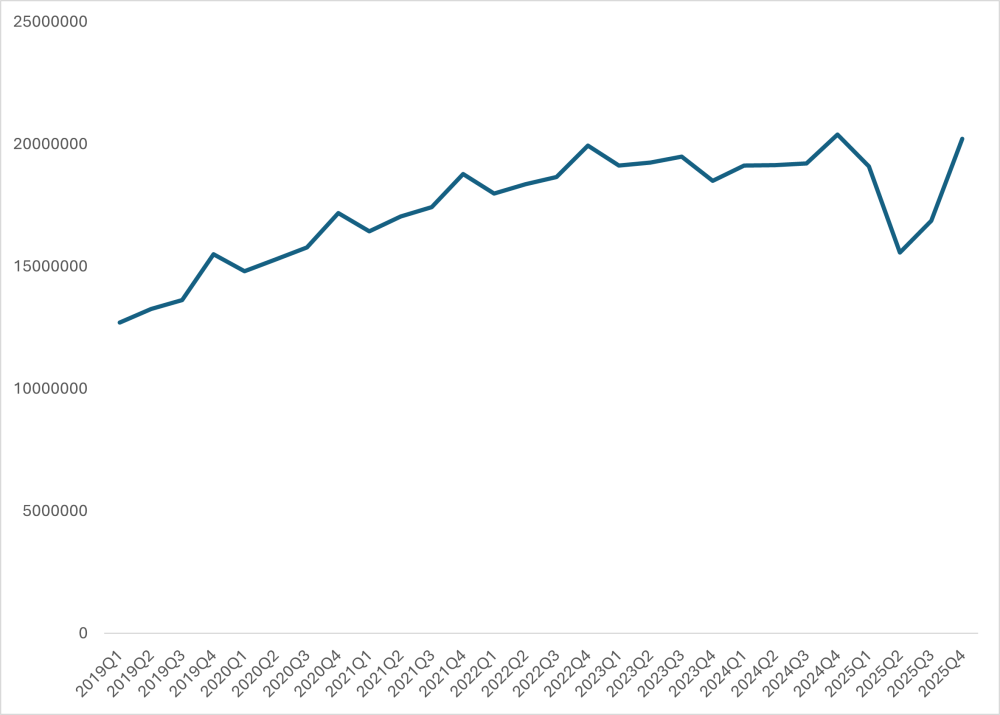
Note: The chart uses aggregated PEPFAR country data, which produces somewhat different numbers from PEPFAR topline reports.
Figure 2. The number of people receiving PEPFAR-supported HIV test results
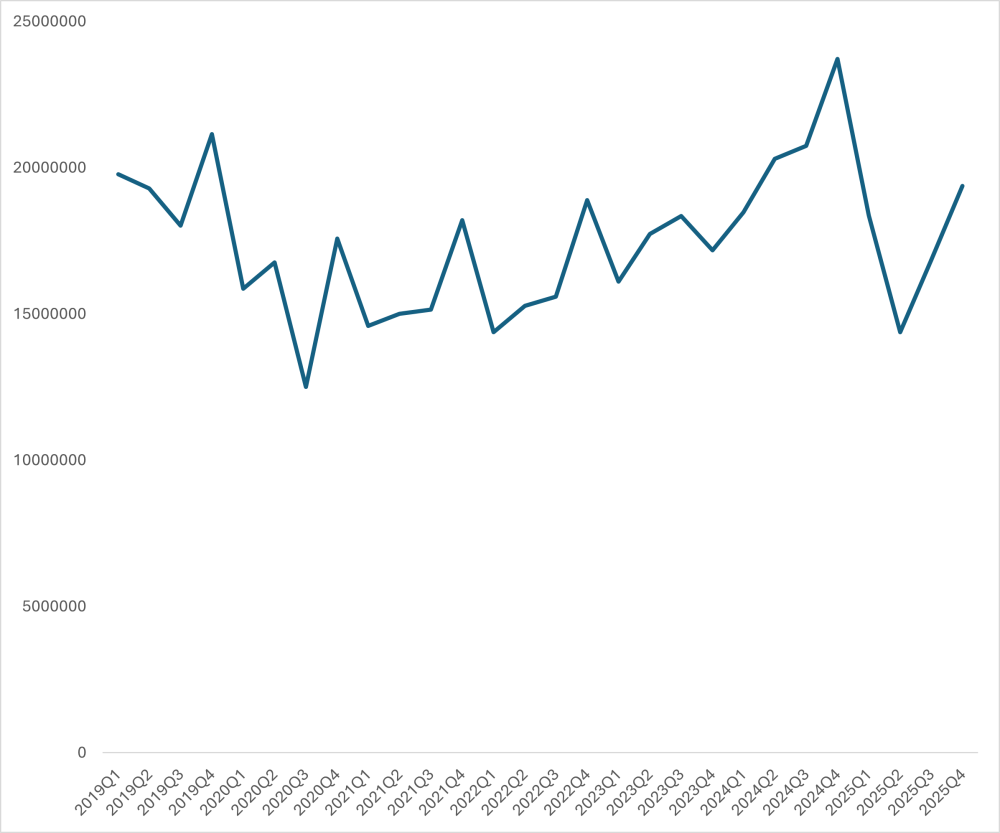
Note: The chart uses aggregated PEPFAR country data, which produces somewhat different numbers from PEPFAR topline reports
CLARIFICATION/UPDATE: The data used in the blog likely suffers from reporting errors and underreporting. Analysing data at the aggregated levels likely misses significant nuance in the changes in actual service delivery that have taken place during the past year.
Topics
DISCLAIMER & PERMISSIONS
CGD's publications reflect the views of the authors, drawing on prior research and experience in their areas of expertise. CGD is a nonpartisan, independent organization and does not take institutional positions. You may use and disseminate CGD's publications under these conditions.
Thumbnail image by: UNFPA East and Southern Africa/ Flickr