Recommended
Blog Post
The Untapped Power of Health Taxes in Sub-Saharan Africa
Blog Post
How Has the IMF Engaged on Health Taxes?
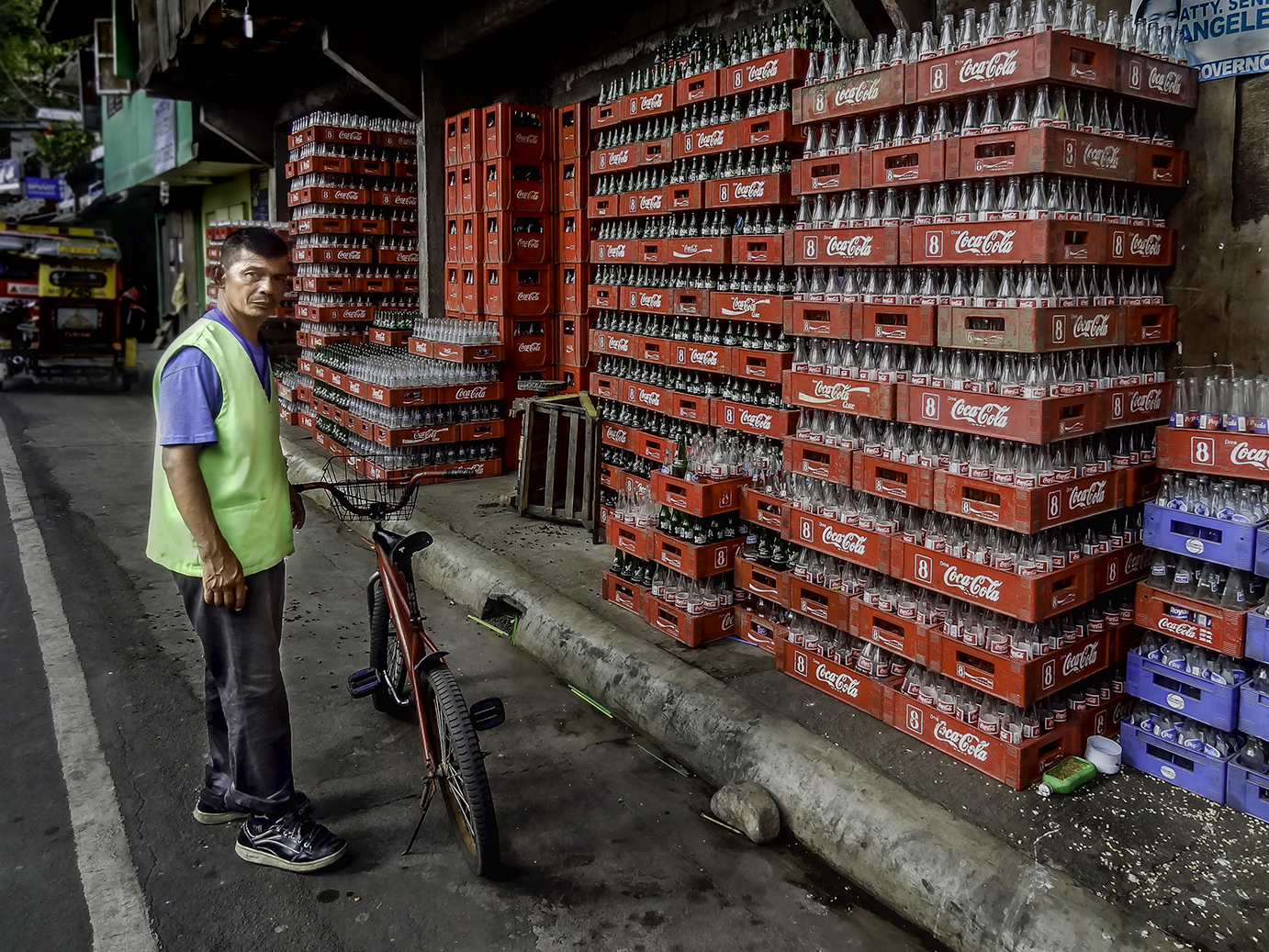
Health taxes on tobacco, alcohol, and sugar-sweetened beverages (SSBs) offer a “dual dividend”—raising public revenue while reducing harmful consumption. Yet actual collections remain far below their potential. On average, countries collect just 0.4 percent of GDP in tobacco excise revenue, compared with a feasible 1.5 percent—leaving an untapped potential of 1.1 percent of GDP. For beer, spirits, and SSBs, countries apply only 35 percent, 25 percent, and 15 percent of their feasible excise rates, respectively.
While health policy is not a core focus, the IMF advises member countries on raising domestic revenue in ways that are fair, efficient, and administratively feasible. As part of its tax policy guidance, it recommends health taxes—where appropriate—as a component of a balanced and well-functioning tax system. This advice is reflected in its three core activities: surveillance of member country policies, lending, and capacity development.
We previously discussed the IMF’s surveillance advice on health taxes during 2010–2024 in detail. This blog focuses instead on health taxes in IMF-supported lending arrangements and capacity development in tax design and administration during the same period. We find that these two activities differ markedly in their regional focus, and that conditionality in particular bears little relationship to countries’ estimated revenue potential. It appears that reform commitments are concentrated in lower-income countries, while technical support is more visible elsewhere.
Program conditionality and capacity development in health taxes
Sub-Saharan Africa (SSA) accounts for roughly 45 percent of all health-tax conditionality cases, particularly in Extended Credit Facility arrangements supported by the IMF. They are overwhelmingly framed as revenue mobilization measures. About 90 percent of these cases mention tobacco, often alongside alcohol, while only about 10 percent reference SSBs.
Capacity development tells a different story. Europe accounts for 32 percent of published technical assistance (TA) reports that engage with health tax topics, followed by Asia-Pacific (22 percent) and the Western Hemisphere (19 percent). IMF capacity development on health taxes is heavily concentrated in emerging market economies, which account for 78 percent of TA reports, while low-income, developing countries account for 9 percent.
SSA accounts for 20 percent of published TA reports and 13 percent of estimated health tax potential. The emphasis on health taxes in this region reflects the fact that roughly 70 percent of SSA countries collect less than 15 percent of GDP in tax revenue—a level considered essential for sustained development of a country.
Figure 1. Program conditionality and capacity development in health taxes
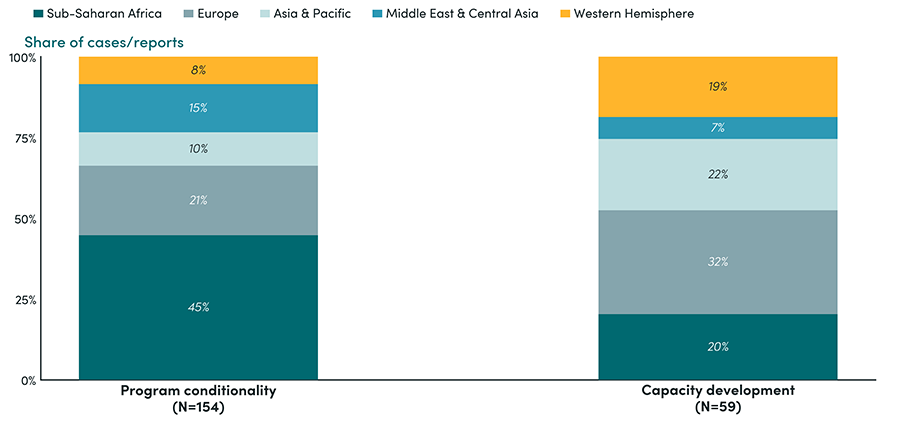
Note: Bars show the regional distribution of identified IMF health-tax program conditionality cases and technical assistance reports. Conditionality counts reflect instances of formal program-related policy commitments on health taxes, identified through text analysis of program documents and counted at the country-year-document level. Technical assistance counts reflect publicly available IMF Technical Assistance Reports mentioning health taxes. Because not all TA reports are published, these counts likely understate total activity. Source: Gupta, Sanjeev, and Ainhoa Petri-Hidalgo (2025), “Health Taxes and the IMF: What 15 Years of Policy Advice Reveal.” Center for Global Development.
Figure 2. Top countries by health-tax program conditionality
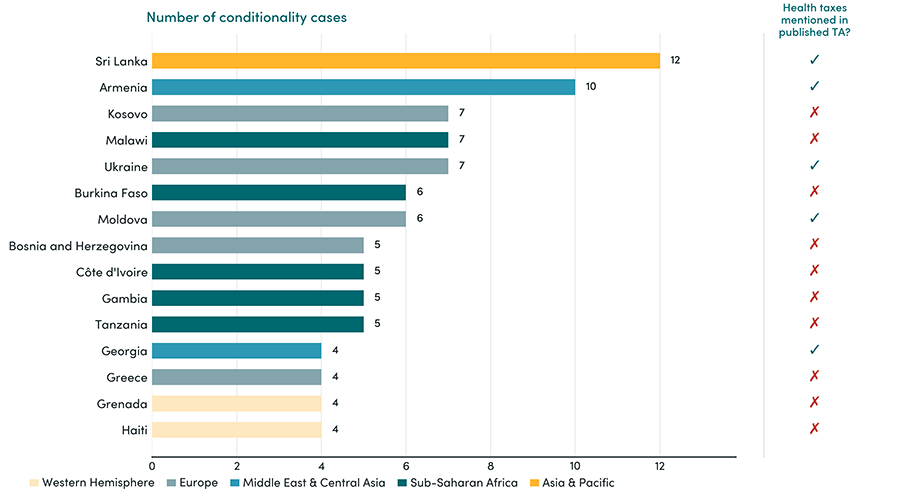
Note: Bars show the number of health-tax conditionality cases per country, counted at the country–year–document level. The right column indicates whether any publicly available IMF Technical Assistance Report engages with health tax topics for that country. Because not all TA reports are published, the absence of a published report does not necessarily mean no TA was provided. Bar color indicates IMF departmental region. Source: Gupta, Sanjeev, and Ainhoa Petri-Hidalgo (2025), “Health Taxes and the IMF: What 15 Years of Policy Advice Reveal.” Center for Global Development.
At the country level, the pattern is even more pronounced. Among SSA countries with the highest number of conditionality cases, virtually none reference health taxes in published IMF TA reports that conducted broader tax policy reviews. By contrast, European countries with comparable levels of conditionality do feature such discussions in their reports.
Nearly all health-tax conditionality cases occur in low- and middle-income countries, yet more than one-third of published TA focused on health tax design is directed toward high-income countries—reflecting, in part, demand for excise tax harmonization advice within the European Union.
These are not simple reforms
Health tax reform is rarely a simple rate increase. IMF practical guidance on tobacco and alcohol excises highlights a set of recurring technical challenges: choices around rate structure (specific versus ad valorem), enforcement and compliance mechanisms, illicit trade risks, and the need for sustained real increases over time. The World Bank warns that failure to index specific excises to inflation erodes both revenue and health impact. The World Health Organization (WHO) suggests that taxes are generally more effective when structured as specific excises based on physical characteristics or harmful ingredients, rather than as purely ad valorem taxes.
In several SSA countries, program documents outline technically demanding reforms—such as transitions from ad valorem to specific excise structures, the introduction of excise stamp regimes (including digital track-and-trace systems), and inflation catch-up adjustments. These are precisely the types of design challenges that published TA has examined in detail in other regions.
Three caveats are worth noting:
- Published TA reports understate total activity. IMF TA reports are prepared at the request of member countries, and their publication is voluntary. The public TA record is therefore a lower bound on actual capacity development, and the mismatch we identify may partly reflect differences in publication practices rather than differences in TA delivery alone.
- Other sources of TA. Countries may also be receiving technical assistance from other institutions, such as the World Bank and WHO.
- Alignment with estimated potential. Published TA appears broadly proportional to estimated health tax potential across regions (Figure 3).
Figure 3. Health-tax potential vs. IMF capacity development by region
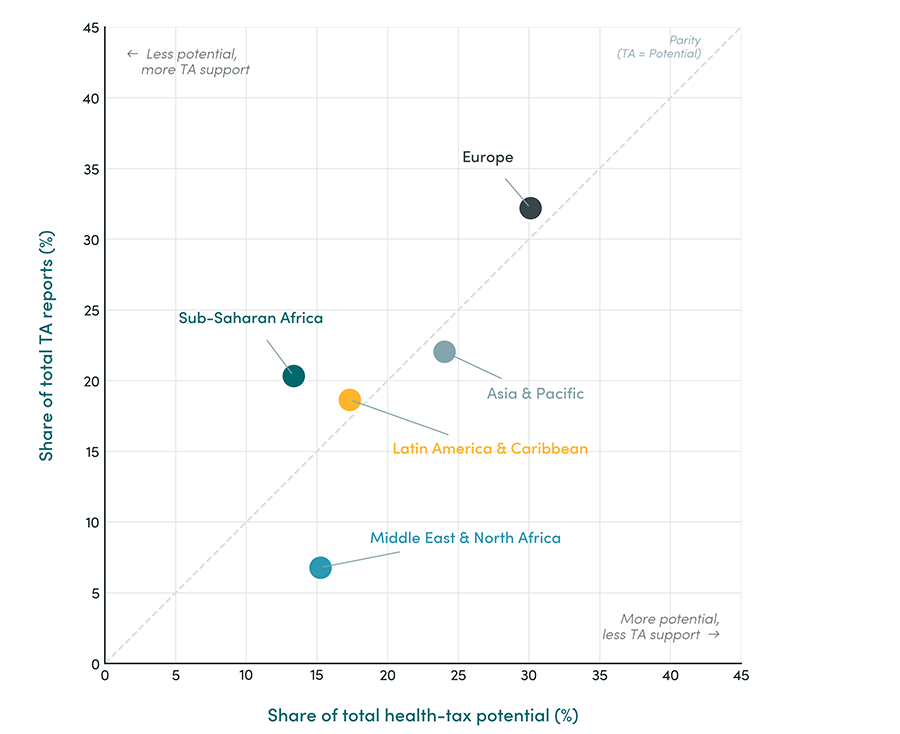
Note: Each dot represents a region. The x-axis shows the region’s share of total estimated health-tax potential (composite median across tobacco, ssbs, beer, spirits), and the y-axis shows its share of publicly available IMF Technical Assistance Reports mentioning health taxes. Regions below the 45° parity line receive a smaller share of TA than their share of unrealized tax potential would suggest. Tax potential estimates from Gupta, Jalles, and Petri-Hidalgo (2025); TA data from Gupta and Petri-Hidalgo (2025). Center for Global Development.
Figure 3 shows that published TA on health taxes is broadly distributed in proportion to estimated revenue potential, with most regions clustering near the 45-degree line. SSA actually receives a somewhat larger share of published TA (20 percent) than its share of estimated potential (13 percent) would predict. The Middle East and North Africa, by contrast, receives notably less.
The disproportion emerges on the conditionality side: SSA’s 45 percent share of conditionality far exceeds both its potential share and its TA share, while Europe, which accounts for 30 percent of estimated potential, represents just 21 percent of conditionality. This suggests that across regions, reform commitments are driven in significant part by the fiscal pressures that lead countries to seek IMF-supported programs, not by the availability of technical support or the scale of revenue opportunity.
These patterns are consistent with the notion that program-driven reform commitments and demand-driven capacity development operate on partially different logics—one shaped by fiscal need and lending relationships, the other by country demand and consent to publish.
The bottom line
Health taxes remain one of the clearest opportunities for countries to raise revenue while improving public health. Yet this analysis suggests that how these reforms are supported matters as much as whether they are adopted.
The current pattern—where reform commitments are concentrated in lower-income countries, while technical support is more visible elsewhere—raises a practical concern: complex excise reforms may be pursued without commensurate design and implementation support. Given the technical demands of these reforms, this gap could affect both their durability and effectiveness.
Better alignment between IMF-supported reform commitments and capacity development could help close this gap. Strengthening support—particularly in countries undertaking reforms under IMF programs—would increase the likelihood that health taxes deliver sustained revenue gains and meaningful health outcomes.
Topics
DISCLAIMER & PERMISSIONS
CGD's publications reflect the views of the authors, drawing on prior research and experience in their areas of expertise. CGD is a nonpartisan, independent organization and does not take institutional positions. You may use and disseminate CGD's publications under these conditions.
Thumbnail image by: Rod Waddington/Wikimedia