Recommended
Blog Post
Cholera in Africa: Rising Deaths, Shrinking US Aid
Blog Post
The Human Cost of Cholera
Blog Post
How Many Lives Does US Foreign Aid Save?
In October 2025, we published a blog documenting an emerging but as yet incomplete picture: cholera deaths were on the rise across several sub-Saharan African countries as US aid for water, sanitation, and hygiene (WASH) contracts were cancelled across the continent. Angola, the Democratic Republic of the Congo (DRC), Sudan, and South Sudan, alone, had accounted for over 3,500 deaths by mid-year. The full-year data are now in for 2025. The picture is, if anything, worse.
The death toll
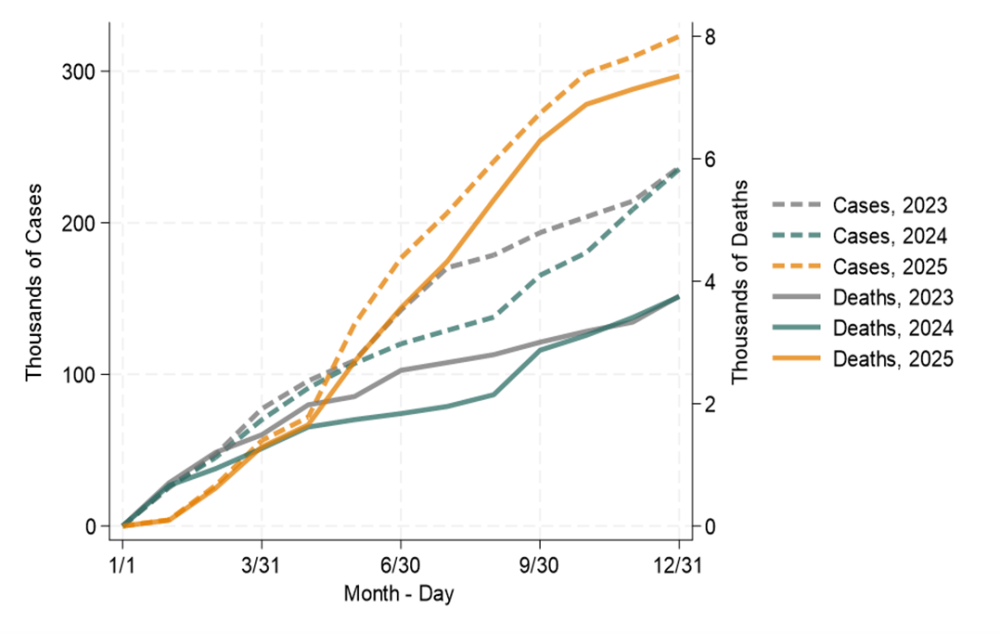
Across the continent, cholera killed approximately 7,500 people in 2025—nearly twice the roughly 3,800 deaths recorded in both 2023 and 2024. And while case counts are somewhat higher in 2025 than in 2023 or 2024, the death count is markedly higher: people who contracted cholera in 2025 were substantially more likely to die from it than in prior years. One likely reason: sick people are not getting the help they need. In 2023 and 2024 there were about 16 deaths per 1,000 cholera cases. In 2025, there were 23 deaths per thousand cases (Figure 1).
Figure 1. Cumulative case and death counts from cholera in sub-Saharan Africa, 2023–2025
Source: Africa Centres for Disease Control and Prevention
A large and ongoing outbreak in DRC
In 2025, DRC recorded approximately 72,000 cases and 2,000 deaths—and unlike Angola, Sudan, and South Sudan—there is no sign the outbreak is decelerating. This is the country's worst outbreak in 25 years. The DRC alongside Sudan have the continent's largest outbreak burden as well as case fatality rates that are well above the World Health Organization’s 1 percent threshold for mounting an emergency response. These case fatality rates may reflect degraded access to oral rehydration and treatment in conflict-affected settings, where existing health systems were already weak and stretched.
The funding side
Our original analysis of the link between cholera mortality and USAID cuts focused on WASH-specific US contract cancellations. This update takes a broader view, using Financial Tracking Service data on total humanitarian funding paid to cholera-affected countries from 2022 to 2025.
The pattern that emerges from the new data is consistent with what we previously reported: humanitarian funding to countries with active cholera outbreaks peaked in 2024 and fell in 2025, with US government contributions, from both USAID and the State Department, declining sharply (Figure 2). For the five countries with the largest outbreaks in 2025 (Angola, DRC, Nigeria, Sudan, and South Sudan), total humanitarian funding support from the US contracted even as deaths rose from roughly 650 in 2023 to nearly 7,000 in 2025. The US share of total support fell from 37 percent to 27 percent.
Figure 2. FTS Paid Humanitarian Funding to Countries with Cholera Activity: 2022-2025
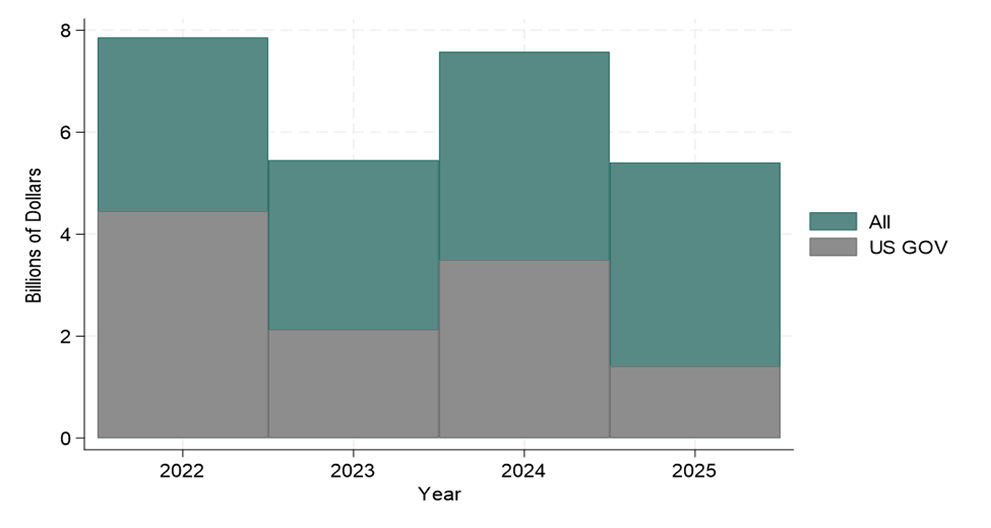
Source: Financial Tracking Service data
A preventable crisis
A rising cholera death toll reflects failures in both sanitation systems and health response. Cholera is among the most cost-effective diseases to treat. The US and other donors should respond before the death toll mounts further.
Topics
DISCLAIMER & PERMISSIONS
CGD's publications reflect the views of the authors, drawing on prior research and experience in their areas of expertise. CGD is a nonpartisan, independent organization and does not take institutional positions. You may use and disseminate CGD's publications under these conditions.
Thumbnail image by: USAID/ Flickr