Recommended

Blog Post
Bridging the MDB Shareholder-Management Divide

The leaders of multilateral development banks (MDBs) have committed to achieving development impact at scale, through presidential statements, strategy documents, and—more importantly—global and regional investment programs such as Mission 300 or Water Forward.
Yet the newly published Mainstreaming Scaling in Funder Organizations: A Synthesis Report gave MDBs (grouped with major bilateral donors) the lowest rating in transformational scaling relative to other donors—despite substantial comparative advantages.
The binding constraint, I argue, is not capability or will, but incentives. The MDB business model rewards finance volume and project-by-project delivery rather than the deeper structural changes needed for sustainable transformation and impact. Changing instruments—pioneering a new “scaling impact loan”—is the lever that can alter those incentives.
Why MDBs receive a low score in transformational scaling
Transformational scaling is about more than just doing larger or repeated projects; it’s about delivering impact at a large scale that persists beyond the conclusion of a specific project, through a viable funding model and systemic change of policies or institutions
Instances of MDBs operating at scale exist, but they represent a small fraction of operations, and scaling impact is not incorporated into organizational goals, policies, resource allocation, or the mindset of management and staff. When implemented, scaling is managed as transactional, focusing on larger or repeated one-off projects while neglecting the financing and institutions needed for sustainable scaling.
Figure. Mainstreaming score chart by funder type and factor
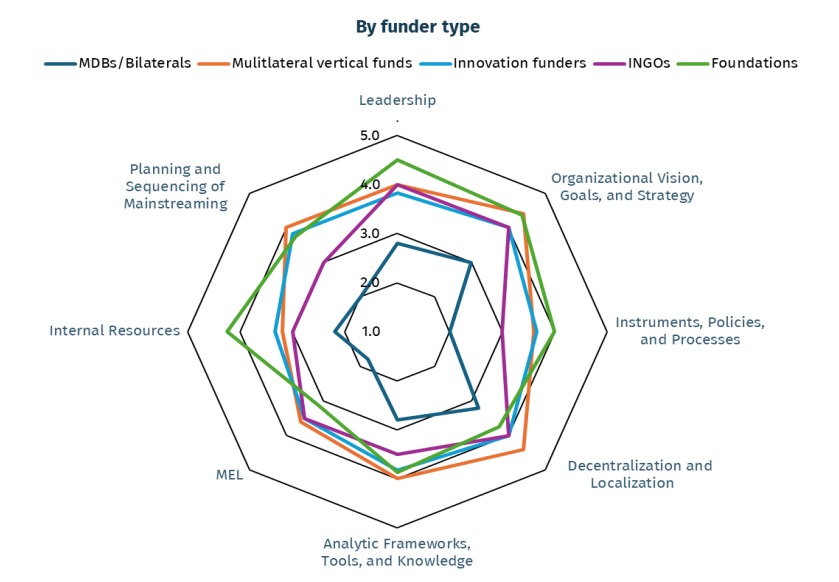
Source: Mainstreaming Scaling in Funder Organizations: A Synthesis Report, Scaling Community of Practice.
The report’s low score for MDBs is unexpected considering those institutions’ comparative advantages: capacity to deliver financial resources on a long-term basis; global and regional expertise to complement funding; capacity to work with governments and private-sector entities; and convening power to assemble relevant national and international stakeholders. But what the MDBs lack is appropriate incentives to work systematically. Indeed, current incentives may be a double-edged sword, undermining transformational scaling, as MDBs are pulled between fulfilling short-term financial goals (e.g. countercyclical funding during shocks) and long-term development goals (e.g., adding to fiscal space for public investment).
Why institutional incentives have been misaligned with scaling impact
MDBs pursue many financial and developmental objectives, which are not entirely harmonious. They operate within politically charged contexts and utilize legacy instruments conceived for a far simpler mission than scaling impact. When finance volume is either implicitly or explicitly prioritized (by the recipient, the MDB, or both) and the operational framework allocates resources on a fragmented project-by-project basis, the institution will struggle to systematically pursue large-scale impact.
This misalignment in incentives shows up in what MDBs evaluate and reward, the tools they use to move resources, and the capacities left underused, like knowledge and convening power:
- MDBs have made more progress in measuring corporate outcomes than in setting outcome targets. The aggregate results that MDBs increasingly emphasize emerged out of the lending they already do—they were essentially created by mapping exercises from allocated resources. That gives them little relevance as incentives to scale up, which requires changing how the institutions work. Programs like Mission 300 may alter that dynamic if they establish country outcomes at an appropriate scale, and are not limited to achieve progress over baselines defined on a project-by-project basis.
- The methodologies or practices of MDB independent evaluation bodies do not include an explicit focus on scaling performance in country strategies, programs, or projects. Standard MDB evaluation policy is limited to assessing whether objectives have been achieved, and scaling is only considered as part of the evaluation if it was included in the design. These evaluations are accountability tools used by MDB governing bodies to track development effectiveness, with significant implications for institutional incentives.
- MDB programming is mostly driven by factors other than long-term scaling. The financial requirements of borrowing countries, as well as of the MDBs themselves, take precedence, prioritizing programming toward fast-disbursing operations (mostly policy loans). The remaining funds are allocated to investment projects through sluggish approval and disbursement processes. Envelopes for investment seldom adhere to a scaling impact rationale and are the result of bargaining among MDB sectors and national authorities. Private-sector operations are opportunistic, seeking agreements with reputable investors. Synergy between public and private operations would require a long-term strategy underpinned by policy reforms and pre-investment resources aimed at the project preparation.
- The existing lending instruments complicate the formulation of a strategy for transformational scaling. Policy loans may support systemic reform, but they are normally conceived as one-off operations and are infrequently made in conjunction with investment loans. Scaling impact criteria are absent from design requirements, unmonitored during implementation, and not assessed at project completion and ex post evaluation. Incorporating a country’s own resources as part of the intervention could substantially improve long-term sustainability but has largely been abandoned to simplify implementation. Programmatic and results-based instruments, which could merge liquidity needs with incentives for long-term scaling, are constrained by prerequisites that limit their use.
- A better balance of expertise is needed to ensure that MDBs can maximize their knowledge contribution to impact scaling. In addition to knowledge on what interventions work according to evidence, successful scaling requires expertise on how to do it, which is based on a deep understanding of specific context conditions. On the process side, MDBs knowledge support mostly focuses on the policy dialogue and project preparation phases. Personnel assigned to supervise projects prioritize procedural requirements, mostly related to fiduciary and reporting obligations. Scaling interventions necessitate a more balanced distribution of expertise throughout the project cycle from preparation to implementation and evaluation.
- Transformational scaling is feasible only if it is institutionally and financially owned by national stakeholders. MDBs work through temporary project structures that often overlook the shift to permanent delivery systems that guarantee sustainability. As project funding diminishes, maintaining services requires permanent structures and funding from taxes, markets, or other sources. Navigating that funding and institutional transition is difficult unless it is integrated into the core planning.
- The convening capacity of MDBs can support mobilizing collective action for scaling, but only if the focus expands beyond just financial coordination. MDBs have traditionally concentrated on co-financing with multilateral and bilateral partners. However, additional resources need to be channeled through a strategic and operational framework that goes beyond larger projects. Enhanced cooperation includes joint analytical efforts, commonly adopted metrics, reciprocal acknowledgment of standards, and perhaps unified country strategies and projects. Recent emphasis on country-led platforms can be useful to align incentives in this regard.
How can these incentive issues be overcome?
Global and regional programs may facilitate scaling provided implementation incentives are aligned
Recently announced programs, such as Mission 300 or Water Forward, incorporate outcome targets, financial commitments, joint involvement of donors, and execution through country platforms, offering the potential for scaling impact.
However, the emphasis on relatively straightforward targets might create incentives for scaling short-term solutions that can be inefficient and unsustainable over time. The temptation could be to emulate vertical funds, whose well-defined mandate and accountability frameworks have proven highly appealing to donors but limit their engagement on the systemic change essential for sustainability. Country compacts, with comprehensive sector diagnosis and a robust theory of change, are designed to overcome these problems. This will require going beyond a compilation of pre-approved or desired investment projects and taking an in-depth look at the long-term fiscal, market, or institutional prerequisites for scaling.
Internally, MDBs must enhance institutional incentives for delivering large-scale impact. This does not mean a complete overhaul of the MDB business model. In the past, successful changes have been brought through a process known as institutional layering: Innovative selective practices are introduced to complement the old ones. New instruments, financial innovations, knowledge products, and accountability measures are adopted incrementally in response to external demands with varying degrees of institutional influence.
A new instrument could realign incentives
Among the set of changes to align incentives with scaling, the introduction of a novel lending instrument could be useful. New instruments have been effective in changing incentives when there have been strong external and internal demand for their use. A scaling impact loan should attract borrowers by providing expedited approval and disbursement processes within a long-term programming framework aligned with a scaling trajectory. It should also be appealing to MDB staff to meet corporate and country outcome objectives while streamlining procedural design requirements and offering substantial implementation flexibility. The idea is to offer an instrument capable of covering all the policy reform and investment needs of a sector compact while providing fast budget support.
The design of a scaling impact loan would benefit from the following characteristics:
- applicability to global and regional programs where corporate outcome targets have been established and country compacts and platforms have been adopted;
- a programmatic approach, covering several cycles of lending operations with streamlined approval procedures;
- a hybrid nature, including policy-based and investment lending linked to results in the same loan;
- a link with private-sector operations through public financial intermediaries in the same loan or through facilitating separate non-sovereign guaranteed operations through pre-investment and de-risking facilities; and
- criteria for program preparation, implementation, monitoring and evaluation in accordance with sustainable scaling guidelines.
Observers of MDBs might assert that all these mechanisms are already in place separately and available for deployment. That is accurate, but making them work together is prohibitively difficult under current policies and guidelines. An innovative instrument indicating how these tools could be utilized jointly would be useful to align incentives with scaling outcome targets.
Topics
DISCLAIMER & PERMISSIONS
CGD's publications reflect the views of the authors, drawing on prior research and experience in their areas of expertise. CGD is a nonpartisan, independent organization and does not take institutional positions. You may use and disseminate CGD's publications under these conditions.
Thumbnail image by: Trinn Suwannapha / World Bank