Recommended

The AI boom could see anywhere from $37 billion to $100 billion in annual philanthropic spending over the next few years. The question is, how can this money be spent effectively? A new blog series from CGD makes the case for highly cost-effective areas that philanthropists may want to consider funding. This first blog in the series looks at large-scale implementers, the role of intermediaries, and quick wins philanthropists may want to consider supporting.
On a recent trip to the Bay Area, many people we met shared the same concern: how can we effectively spend the wave of new philanthropic funding which is about to hit? Which organizations can absorb this amount of money?
Nan Ransohoff estimates a “third wave of American philanthropy” will generate $37 billion to $100 billion per year in intended philanthropic spending. Not all of it will be spent on global poverty, but we think a lot of it should be because the impact per dollar is high.
Figure 1. $50 billion a year is large, but hardly unprecedented
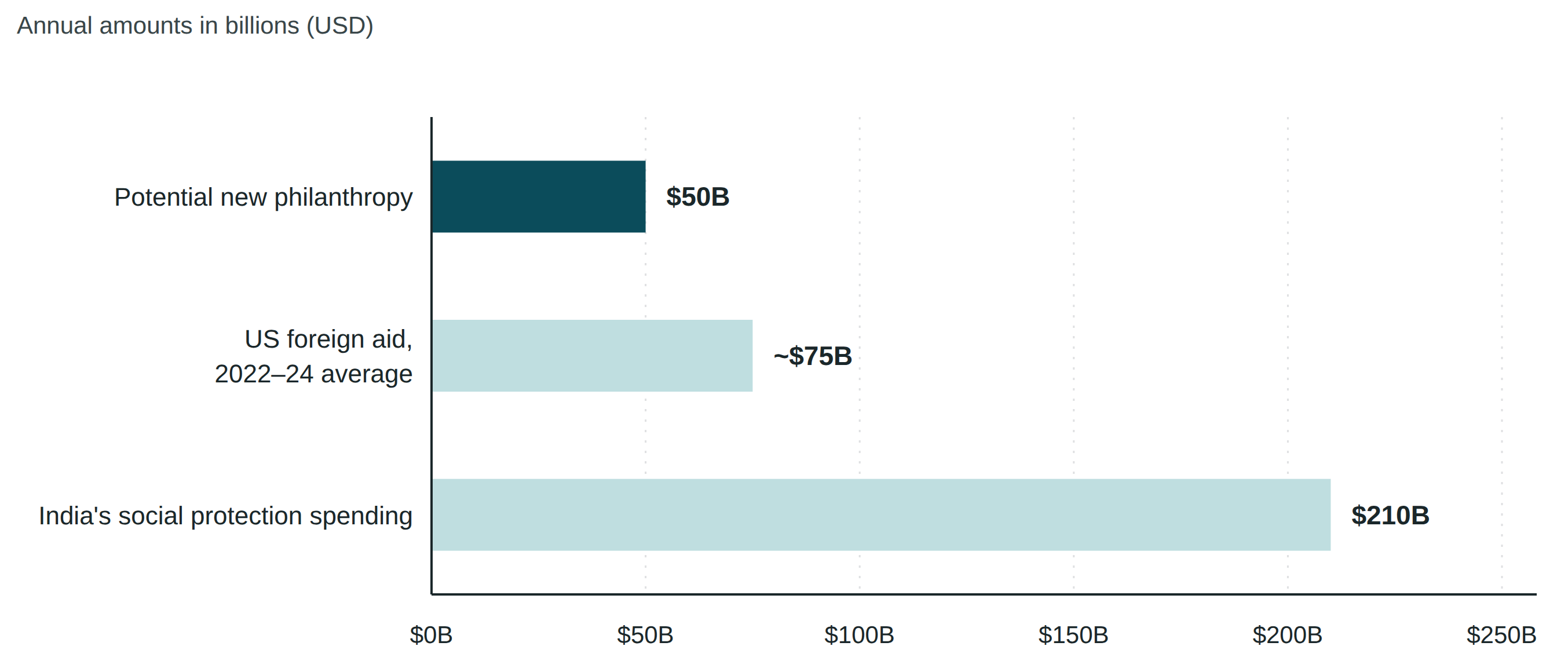
Sources: foreignassistance.gov (US foreign-aid disbursements, 2022-24 average);
ILO World Social Protection Report 2024-26, Asia-Pacific companion report (India: 5% of GDP, 2023 or latest available year; ≥$210B at India's =$4.2T GDP, IMF 2025).
$50 billion a year is a very large number, but far from unspendable (see Figure 1). It is what the US government disbursed in foreign aid in 2025 (down from an average of ~$75 billion from 2022 to 2024). It is also hardly unprecedented in low- and middle-income countries (LMICs): India alone spends 5 percent of its GDP, or roughly $210 billion annually, on social protection. But this new philanthropy is not interested in simply filling gaps left by declining aid or LMIC country budgets—it rightly wants to support well-evidenced, highly cost-effective programs.
In this blog, we discuss how the new philanthropy could (1) leverage and shape the work of existing large-scale implementers, (2) draw on existing intermediaries who have expertise in evidence and cost-effectiveness, and (3) fund some potential quick wins, based on our own experiences and areas of expertise.
Rigorous implementers with the ability to absorb large funding
Several very large nongovernmental organizations (NGOs) know the evidence well, can target the poorest, think carefully about cost-effectiveness, and already spend $1 billion or more per year. Funding could be earmarked to these organizations’ most cost-effective programs, including BRAC’s ultra-poor graduation and the International Rescue Committee’s (IRC) severe wasting treatment, through delivery infrastructure that already exists. We have worked closely with these organizations, so may be biased, and there are undoubtedly others that currently spend less but could expand with funding.
It would also be possible to shape the work of international organizations like Gavi, the Vaccine Alliance or even the World Bank with large enough funding. For example, a donor could provide funding tied to the rollout of the malaria vaccine through Gavi (see below), or set up a trust fund at the World Bank. A trust fund can be earmarked for particular cost-effective programs, delivered through government systems, and used to leverage the Bank’s own lending. These funds are often constrained by what donors contribute, rather than what the Bank can move: trust fund disbursements rose 42 percent in a single year, to $26.6 billion in 2025.
Not everything these organizations currently do would meet high cost-effectiveness standards, but it would be relatively easy to shape their incentives with considerable capital.
Intermediaries with the right skills
A key constraint is the limited capacity of intermediaries who can help philanthropists pick the best programs and implementers. In her blog, Nan points out that existing intermediaries trusted by new philanthropists, like GiveWell and Coefficient Giving (and we would add Founders Pledge), would have to grow perhaps five- or ten-fold in size to accommodate the increased giving. But there are other organizations that are used to evaluating proposals for the rigor of the evidence, are experts in cost-effectiveness and targeting, and have experience in what can and cannot be scaled given the realities of implementation in low-income countries. The Abdul Latif Jameel Poverty Action Lab (J-PAL), the Development Innovation Ventures Fund (DIV Fund), the International Growth Centre, Project Resource Optimization (PRO), and even some parts of our own organization (the Center for Global Development) all fit these criteria. They have mainly evaluated proposals from researchers (with the exception of the DIV Fund and PRO), but they have strong experience evaluating the scalability and cost-effectiveness of programs and have worked to scale programs to millions of people. Some of these organizations would likely take on evaluating proposals for funders if asked.
New philanthropists could work with these intermediaries to put out competitive calls for large scale-ups of highly cost-effective interventions (like those listed below). Those with a track record of cost-effectively scaling could compete and intermediaries would judge. Implementers would need to be given multi-year contracts to allow them to get the economies of scale of running large programs over several years.
Specific quick funding wins and future prospects
The following is not an exhaustive list of funding areas that are highly cost-effective and could be scaled. Most of the topics we list are well known to the evidence community. We put forward alternative ways to think about scaling them that would be much faster. Current assessments of how much these areas can absorb focus on startup organizations that specialize in the specific programs. But the right large organizations could also scale these, including through competitive bidding or World Bank trust funds.
Cash transfers and graduation/“ultra-poor” programs
Currently, 847 million people live in extreme poverty (less than $3 per day), and only a fraction are reached by programs proven to lift them out of it. GiveWell now estimates GiveDirectly’s unconditional cash transfer program is three to four times as cost-effective as its original cash benchmark. GiveDirectly spent about $100 million on international programs in 2024, but says it could deliver $1.4 billion within a few years. Graduation programs that simultaneously offer a productive asset like livestock, food or cash support, livelihood coaching, health education, and access to savings are also cost-effective. These programs generate $1.30 to $4.30 of increased consumption per dollar invested in most settings and the benefits persist and even grow a decade later. BRAC, Village Enterprise, Raising the Village, and five other implementers reach only a fraction of the ultra-poor in the 18 countries where they work. Closing this in-country gap alone would cost roughly $13 billion (about 52 million reachable people x $250 per person—our calculation from the six-country trial costs, delivered over two years). The total problem is much larger: graduating every extreme-poor household worldwide would cost roughly $212 billion once (847 million people x $250 per person), while continuously providing cash would cost $268 billion a year in the countries holding half the world's poor, roughly $500 billion globally. The World Bank already runs large-scale cash and graduation programs with governments. Philanthropic cofinancing through a trust fund could deepen coverage where the Bank already works and extend it to countries that can't fund these programs at scale.
Getting vaccines to those who don’t currently get them
Vaccinating 500 million children over the next four years could save eight to nine million lives. This can be done in three ways. First, subsidize more countries to include HPV, malaria, rotavirus, RSV, and typhoid vaccines in their existing immunization protocols. Depending on the vaccine, this would be somewhere between one and ten times more cost-effective than giving cash directly to people in extreme poverty, which is GiveWell’s benchmark for comparing programs. Roughly $4 to $5 billion could be absorbed by Gavi just to scale up malaria vaccination by 2030.
Second, take existing vaccines to places that governments don’t reach. The IRC and partners have immunized more than a million ‘zero-dose’ children across six crisis-affected countries at less than $2 per dose (internal IRC estimate). While a smaller funding opportunity than others mentioned here, these vaccines reach children at the highest risk of dying from vaccine-preventable diseases.
Third, provide small incentives for the 7.3 million children who start the vaccine schedule but drop out before the measles shot. This has been evaluated at a very large scale and is highly cost-effective. Existing NGOs, like New Incentives, do this, but funding governments to add incentives to existing government electronic vaccine registries could scale much more rapidly. One advantage of these registries is that they can be used to target parts of the country where vaccination is low. Rachel evaluated a government program of this kind in Pakistan. Countries with high coverage by electronic registries where incentives could be added include India, Indonesia, and Tanzania. Together, these countries have a birth cohort of about 30 million. If there was a $2 incentive for 10 vaccine visits this could cost up to $600 million a year.
Severe wasting treatment for children
Severe wasting—the most dangerous form of malnutrition—kills more than one million children annually. But treatment is cheap and well-proven. The IRC estimates that at least 20 million children annually suffer from severe wasting in the countries where they do nutrition interventions. However, they can only treat 600,000 of these children due to recent aid cuts. With new funding, they could reach 10 million per year within five years, at a cost of $450 million annually. There is some debate about the precise level of cost-effectiveness as this varies by location and delivery challenges, but the cost per child would fall from $67 to $44 to implement this at scale (internal IRC estimate). Similarly, maternal and newborn health is a severely underfunded area where hundreds of thousands of women and millions of newborns die each year from preventable causes. Our colleague looks at this issue in a forthcoming blog.
Improving teaching
Hundreds of millions of children sit in classrooms but are not learning. About 70 percent of 10-year-olds in LMICs cannot read and understand a simple text. The Global Education Evidence Advisory Panel (GEEAP) recommends structured pedagogy, targeted instruction, and information on the returns to education (which improves student effort) as highly cost-effective and proven at scale. Pratham and TaRL Africa are NGOs that specialize in Teaching at the Right Level, a highly evidenced version of targeted instruction that groups children by ability rather than age (for transparency, Rachel is chair of the board of TaRL Africa). TaRL works through existing schools and teachers and costs less than $10 per child per year. A catch-up program for every child in school but currently unable to read would cost roughly $2.5 to $3.5 billion (262 to 340 million children in school are below minimum reading proficiency), with about $600 million a year thereafter to reach each new cohort. Pratham and TaRL Africa were finalists in The Audacious Project, suggesting they could absorb $50 million today. A forthcoming blog will flesh out more ideas on education.
Gavi, World Bank trust funds, and competitive funds evaluated by intermediaries could absorb tens of billions a year between them in areas like those we’ve listed above. See Figure 2 for a sample of how to spend $50 billion.
Figure 2. $50 billion: one way to spend it
A sample allocation that adds up to $50 billion, routed through organizations that already operate at scale.
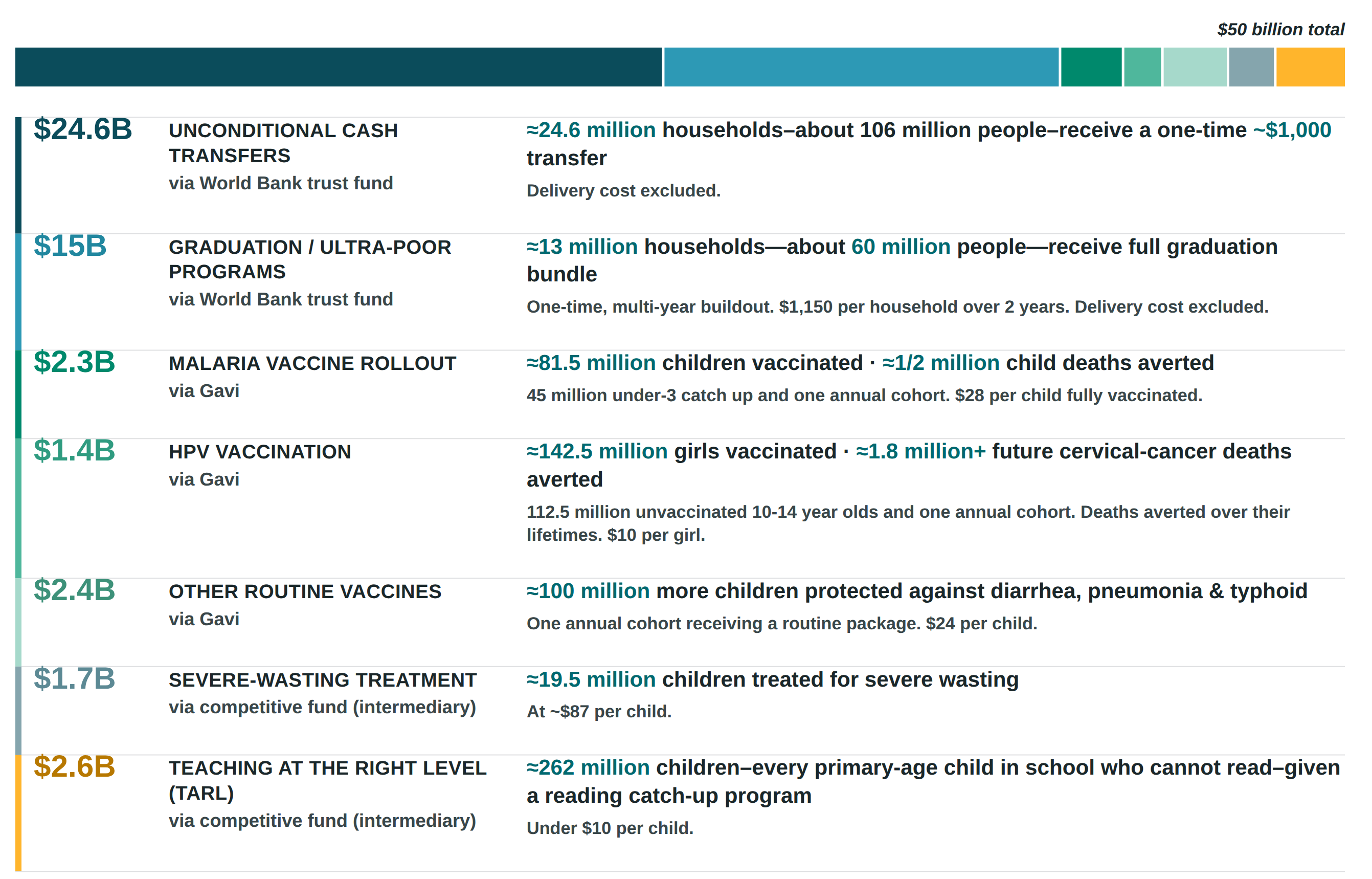
Note: Very rough, illustrative calculations. Each impact is simply the allocation divided by the program's unit cost. Unit costs differ in that some cover targeting and full program delivery, others the intervention alone, so impacts are not comparable across rows. Unit costs may decline further at scale, though reaching the hardest-to-reach populations can cost more. Several allocations are one-time or multi-year rather than annual allocations.
In addition to funding for the extreme poor, investing in innovation where the social benefit far outweighs the private return to companies, is also among the highest return opportunities for the new philanthropy, and creates the next generation of quick wins. We explore the potential of market shaping to unlock valuable innovations in a forthcoming blog.
Conclusion
We are in a new world of philanthropy which requires different responses if it is to meet its potential. No doubt, new startups will be part of this change, but building them will inevitably be slow. Leveraging the existing skills and networks of large organizations will deliver impact faster and more durably, provided the funding comes in multi-year commitments and is earmarked to cost-effective interventions screened by intermediaries. We have an opportunity now to push existing institutions toward cost-effective and scalable solutions. Let’s not miss it.
The authors thank Arthur Baker for brainstorming scaling ideas, Sebastian Quaade for research assistance, and Siddhartha Haria, Janet Hodur, Charles Kenny, Morgan Pincombe, and Sara Viglione for helpful comments.
Topics
DISCLAIMER & PERMISSIONS
CGD's publications reflect the views of the authors, drawing on prior research and experience in their areas of expertise. CGD is a nonpartisan, independent organization and does not take institutional positions. You may use and disseminate CGD's publications under these conditions.
Thumbnail image by: kehinde / Adobe Stock