Recommended
Project


Executive summary
Neonatal sepsis kills one newborn every 45 seconds. Defined as a bloodstream infection in the first 60 days of life, it is responsible for 400,000–700,000 deaths per year—more young lives than malaria claims across all ages combined.
Early treatment of neonatal sepsis is highly effective, but no rapid diagnostic exists to identify infections early. The only available tool—blood cultures—takes more than 48 hours, by which time the window for life-saving intervention has passed. As a result, clinicians must rely on nonspecific signs such as fever, lethargy, and poor feeding to decide whether to treat. This imprecise approach leads to the dual problem of preventable deaths from missed infections and unnecessary antibiotic use, which fuels antimicrobial resistance.
An accurate and rapid point-of-care test would transform neonatal care by enabling timely and appropriate treatment. We estimate that such a test could save 100,000–280,000 newborn lives in low- and middle-income countries (LMICs) while cutting unnecessary antibiotic prescribing for neonates by more than half.
We have coordinated and aligned with the World Health Organization (WHO) Target Product Profile (TPP) on the diagnostic supported by NeoTest. It calls for a rapid, low-complexity, point-of-care or near-patient triage test for newborns and infants up to 59 days old to rule in or rule out sepsis at the first clinical decision point.
Despite its transformative potential, no such rapid diagnostic exists for neonatal sepsis—not because developing one is scientifically infeasible but because the commercial incentives to do so are insufficient. Market frictions occur for four reasons:
- Commercial returns to innovation are limited. Although LMIC health systems may be able to afford paying a price equal to the marginal cost of producing tests (or a small margin above), this price does not cover firms’ research and development (R&D) costs. Firms therefore do not have the profit incentive to innovate for these markets.
- First-movers face copycat competition. Diagnostic tests are particularly vulnerable to imitation products that evade intellectual-property protections, narrowing the window during which first-movers can recoup R&D costs.
- Diagnostics face adoption risk. A diagnostic generates returns only when clinicians use it, requiring guideline integration, clinical utility evidence, and securing reimbursement. As institutions to support adoption are not in place and adoption infrastructure built by one firm benefit all, such institutions are systematically underprovided.
- Antimicrobial resistance and health-system benefits are undervalued. Diagnostics create value beyond improving the care of the tested neonate. They reduce antimicrobial resistance by curbing unnecessary empiric antibiotic use, lower long-term healthcare costs, and improve population-level surveillance. Because procurers do not factor these broader benefits into purchasing decisions, they do not factor into firm development decisions.
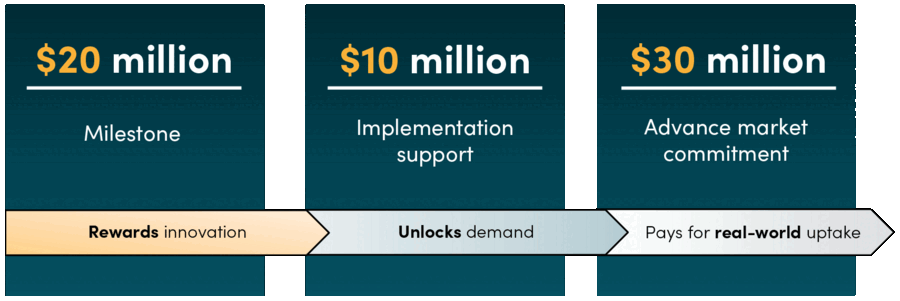
To address these market frictions, funding must come from public and philanthropic sources, as available commercial returns do not justify private investment. NeoTest is a proposed $60 million funding facility designed to accelerate the development, commercialization, and adoption of rapid triage diagnostics for neonatal sepsis in LMICs. It plans to deploy this capital across three components (Figure ES.1):
- A $20 million milestone payment that rewards the first firms to bring a qualifying test meeting the TPP to market;
- A $10 million implementation support fund that builds the country-level infrastructure needed for adoption;
- A $30 million advance market commitment (AMC) that pays a per-test top-up on qualifying tests used.
Figure ES.1 Mechanism design of the NeoTest fund
Together, these components create a pay-for-success mechanism that addresses each of the market frictions cited above. The fund includes three critical features:
- It pays only for progress. All three incentives are paid only upon the successful invention of the target diagnostic test. If no successful test is developed, no funds are disbursed.
- It lets healthcare workers pick the winners. Instead of paying innovators upfront, the AMC rewards the tests clinicians actually use. This feature encourages quality, efficiency, and real-world fit.
- It invites competition. By rewarding any firm that meets the defined performance bar, the mechanism encourages diverse approaches—including AI–based solutions—and lets competition sort out which firm succeeds first.
Innovation also requires upstream, early-stage R&D funding. Accordingly, we are working in partnership with the Combating Antibiotic-Resistant Bacteria Biopharmaceutical Accelerator (CARB-X), a global nonprofit partnership focused on supporting the development of new antibacterial products, which has committed early-stage R&D funding to support neonatal sepsis diagnostics.
With $60 million in funding, the NeoTest facility has an estimated return on investment of $39 per disability-adjusted life year (DALY), equivalent to $1,271 to save a newborn life. Its benefit–cost ratio (78:1) is considerably higher than that of other global health investments (Figure ES.2).
Figure ES.2 Return on investment of the NeoTest Fund and other global health investments
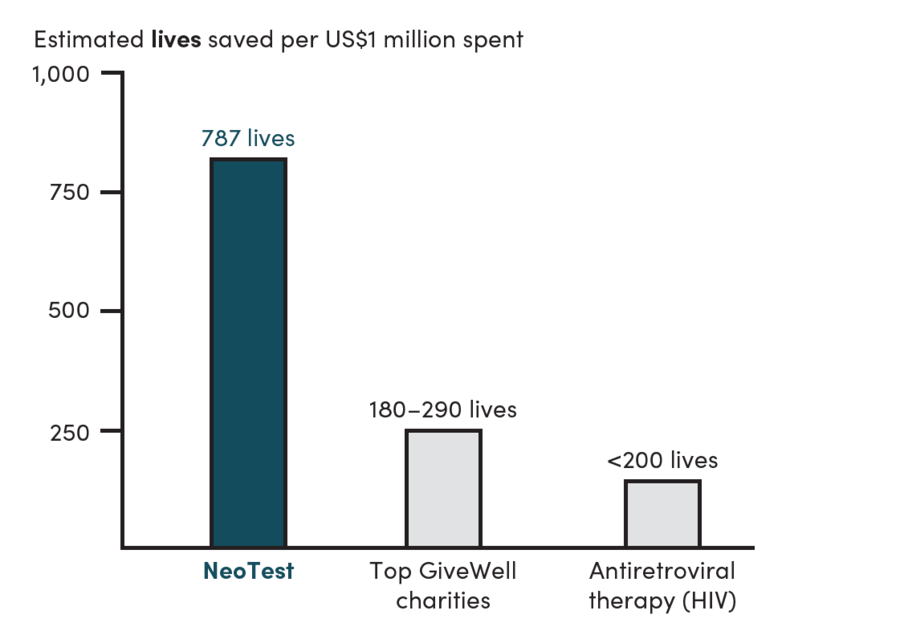
Sources: GiveWell top charities and a meta-review of antiretroviral therapy cost-effectiveness.
Note: Based on our adoption modelling and estimated per-test mortality reduction, described in Appendix H of the full report.
Topics
CITATION
Bansal, Akhil, Georgia Bradley, Neeraj Sood, Christopher Snyder, and Jim O'Neill. 2026. NeoTest: Accelerating Neonatal Sepsis Diagnostics. Center for Global Development.DISCLAIMER & PERMISSIONS
CGD's publications reflect the views of the authors, drawing on prior research and experience in their areas of expertise. CGD is a nonpartisan, independent organization and does not take institutional positions. You may use and disseminate CGD's publications under these conditions.
Thumbnail image by: Adobe Stock