Recommended

WORKING PAPER
The Returns to Education: A Comment

Blog Post
How to Spend Your AI Philanthropy on Education

A new paper by Gregory Clark and Christian Nielsen makes the bold claim that the true average increase in earnings for each extra year of school is somewhere between 0 and 3 percent. Not the 9 percent from over a thousand observational estimates, or the 8–9 percent that dozens of quasi-experimental studies report. If the true number were close to zero, that would undermine much of the case for spending public money on schools at all. But I don’t think it is.
In a new comment forthcoming in the same journal, Kyklos (CGD working paper version here), I replicated Clark and Nielsen’s analysis. Their core argument is that the numbers are inflated by publication bias. None of the methods for detecting publication bias are perfect. Clark and Nielsen report some, but not all, of those methods. So I ran the full suite of methods recommended in the latest “practitioner’s guide” for economists on how to do meta-analysis on their replication data. All of the standard methods produce a number around 5–6 percent, suggesting that there may be some publication bias, but not nearly enough to push it all the way to zero.
Figure 1. Every standard correction puts the return near 5–6 percent, not zero
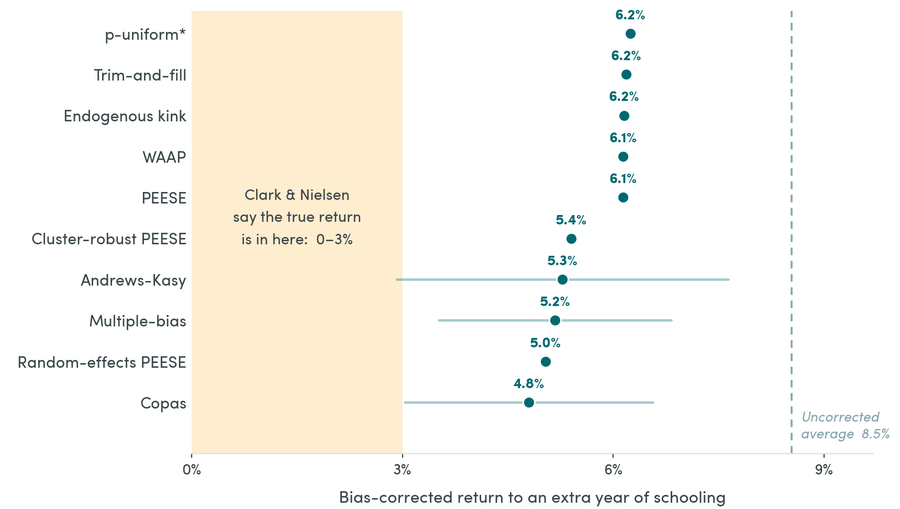
Notes: Ten publication-bias corrections applied to Clark and Nielsen's own replication data (79 estimates, 48 papers). Bars show 95% confidence intervals where the method provides one. Source: Crawfurd (2026); data: Clark & Nielsen (2026).
Clark and Nielsen also run their own bespoke curve-fitting procedure. They assume that because of the shape of the distribution of returns, there must be studies finding negative returns that are not published. With that bold assumption, you can get a mean effect close to zero. But that finding is entirely driven by an un-evidenced assumption. I ran a simulation using their approach on a simulated dataset I created with a known return of 6 percent. Running their procedure on this simulated dataset produces an average estimate of 2.75 percent, suggesting the approach is biased.
Publication bias is an important concern in social science, and it’s good that we check for it. But Clark and Nielsen’s conclusions are too pessimistic here.
I’m grateful to Clark and Nielsen for publishing their replication data and for engaging constructively with a draft of my comment. You can read their original paper here, my comment here at Kyklos and here at CGD, and a reply by Clark and Nielsen to my comment here.
Topics
DISCLAIMER & PERMISSIONS
CGD's publications reflect the views of the authors, drawing on prior research and experience in their areas of expertise. CGD is a nonpartisan, independent organization and does not take institutional positions. You may use and disseminate CGD's publications under these conditions.
Thumbnail image by: paltu/ Adobe Stock