At October’s Annual Meetings of the IMF and World Bank in Bangkok, World Bank Group President Ajay Banga repeated the World Bank Group’s September headline: private capital mobilization had tripled, from $35 billion in fiscal year (FY) 2022 to $112 billion in FY 2026.
Before anyone else uncorks more champagne, know this: mobilizing private capital becomes easier when public institutions absorb more risk without charging the full economic cost of the protection. The mobilization announcement could be interpreted as declaring that the World Bank Group cajoled firms into hiring a million young people, without mentioning a subsidy of $50,000 per job. Worse still, suppose the new hires already had jobs elsewhere. Even if the jobs were additional, would $5,000 per job have been enough?
The $112 billion total covers several instruments, and the announcement does not show how much was mobilized through guarantees. In 2024, the World Bank Group combined its guarantee products in a single platform. In FY 2026, the Guarantee Platform issued nearly $18 billion in guarantees. Another $7.4 billion in IFC commercial trade guarantees brought the World Bank Group’s total above $25 billion. These figures measure guarantees issued, rather than private financing mobilized. The full amount of private financing backed by a qualifying guarantee is counted as mobilized, including the guaranteed portion, based on the 2026 joint methodology of the multilateral development banks. The figure gives no measure of the exposure private lenders retain to a default by the borrower.
The platform’s guarantees also support sovereign borrowing. The World Bank and the Multilateral Investment Guarantee Agency (MIGA) combine their guarantees to back commercial loans for budget support and debt refinancing. The amount lent does not indicate the financing savings or development gains achieved. The Private Sector Investment Lab has recommended improving the efficiency of guarantees. Testing whether competitive bids reduce the public cost of supporting investment would help assess progress toward this objective. As the guarantee business grows, shareholders need to know how much protection firms require.
How much protection is enough?
Guarantees are useful when the World Bank Group is better placed than private lenders to manage a risk holding back a viable investment. For example, a power producer might struggle to obtain financing because lenders doubt whether the public utility will pay for the electricity it has agreed to purchase. A guarantee against the utility’s nonpayment would protect lenders from that specific risk. The producer would remain responsible for delivering the electricity.
A guarantee does not necessarily involve a subsidy. Premiums might cover its full economic cost, including the opportunity cost of the public capital backing the guarantee. MIGA also transfers substantial exposure to reinsurers, so assessing the public cost requires accounting for reinsurance costs and recoveries as well as the risk retained. Shareholder governments have other uses for their money. If the World Bank Group reduces the underlying risk, its protection might cost less than commercial alternatives even when premiums cover the full economic cost.
If the benefits of added protection, such as lower-cost financing, are greater than the additional fees and other costs, then the firm has reason to ask for more protection than necessary to make its investment. If the added protection is sold for less than its full economic cost, the public pays the difference. Managers know more about the firm’s cost structure, sources of finance, and capacity to bear losses than the institution knows. Since the added protection benefits the firm, its managers have little reason to inform the institution that the firm would still invest with less protection.
Suppose there are two firms considering the same project in the same country. Both face the risk of unpredictable currency restrictions, violent conflict, or nonpayment by a public buyer. One firm already does business in the country, has an established supplier base, and uses a diversified balance sheet to fund its investments. The other would be entering the country for the first time and using expensive outside financing. The firms may require distinct levels of protection because their financing structures and capacity to bear losses differ. Without knowing the level of protection each firm requires, the institution may end up offering the established firm the protection the entrant needs.
The International Finance Corporation (IFC) requires concessionality, the subsidy measured against a reference price, to be no greater than necessary to attract investment. IFC takes this price from the market, its pricing model, or negotiations with the client. Review by IFC’s Blended Finance Committee and market comparisons, where comparable market prices exist, help enforce this limit.
When assessing the International Development Association’s Private Sector Window, the Independent Evaluation Group (IEG) found IFC and MIGA adhered to this minimum-concessionality principle. The IEG assessment notes most MIGA guarantees had no market price for comparison. So IFC or MIGA pricing models supplied the benchmarks. These benchmarks alone do not establish how little support a firm would accept to invest.
Let firms bid for support
For projects suitable for a common tender, the institution has an alternative to negotiating protection with one firm: invite competing offers. A firm bidding for more protection risks losing the project to a rival willing to accept less. Firms would bid a cap on total payouts under the guarantee, with future payments discounted to today’s value. The premium rate and all other contract terms would be fixed for every bidder. A qualified firm with the lowest cap would be selected for the project. A Rule for Private Sector Subsidies develops the broader case for competitive allocation.
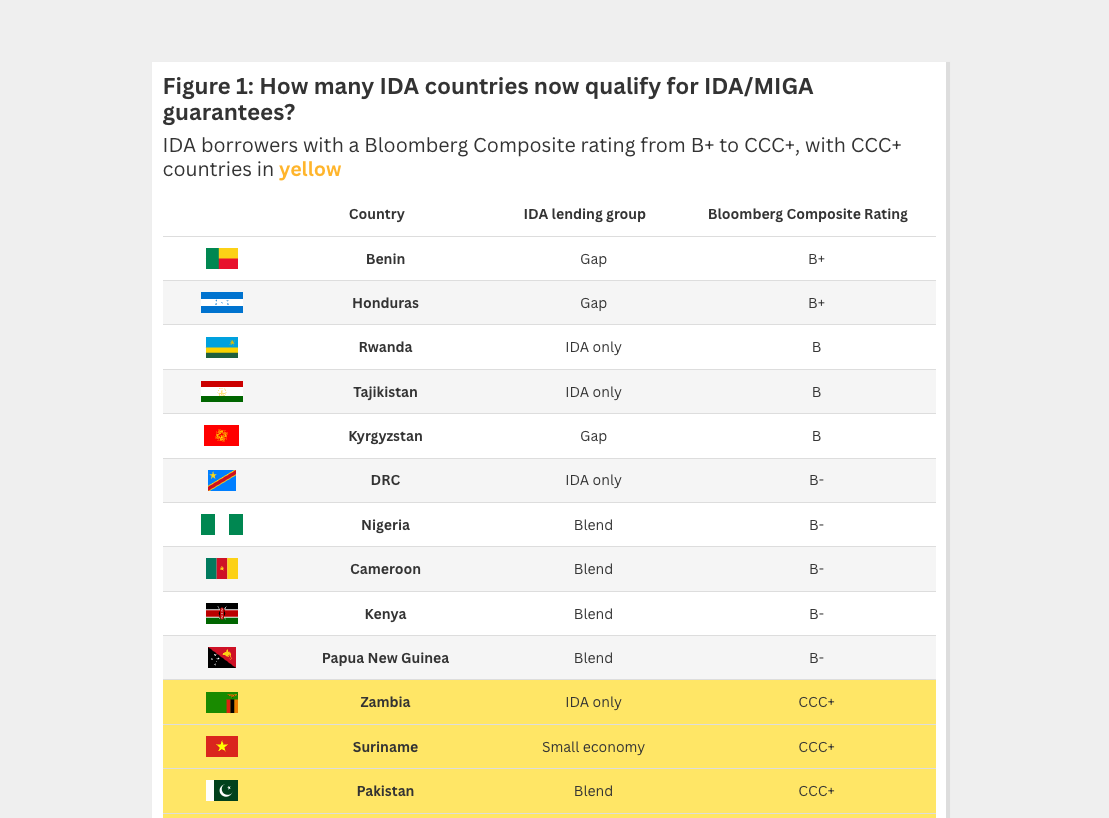
The World Bank Group supported a competitive tender for Zambia’s Scaling Solar program. The guarantee terms appeared in the tender documents, and bidders could choose whether to use the guarantees. Firms submitted bids on electricity tariffs. A pilot would instead invite firms to bid for protection on projects with tariffs or other payment terms already fixed.
Tender rules must hold firms to their bids. Under the awarded contract, the firm would be responsible for any losses due to acts or omissions within its control. Payment under the guarantee would require an independent third party to verify the firm’s performance and claimed revenue shortfall.
On its own, a lower cap does not establish savings or better service. To test this, the pilot would compare service quality and the institution’s expected costs, net of premium income, under contracts awarded by bidding and negotiation. Contracts in both groups would carry identical service and payment terms.
Bids would also help assess the need for a guarantee: a binding bid of zero would show willingness to invest without one under the tender’s terms. A positive winning bid would leave the question unanswered.
When there is only one credible firm willing to invest, the fallback is negotiation. Negotiation is also the fallback when investment projects are too different for a common tender.
In September, President Banga said that “the number only matters if the capital goes where it can create opportunity and jobs.” Before the next announcement, shareholders should ask the World Bank Group to test competitive allocation. The Group should report how much public support accompanied the financing and what additional employment and earnings resulted. Until then, hold the champagne