Recommended


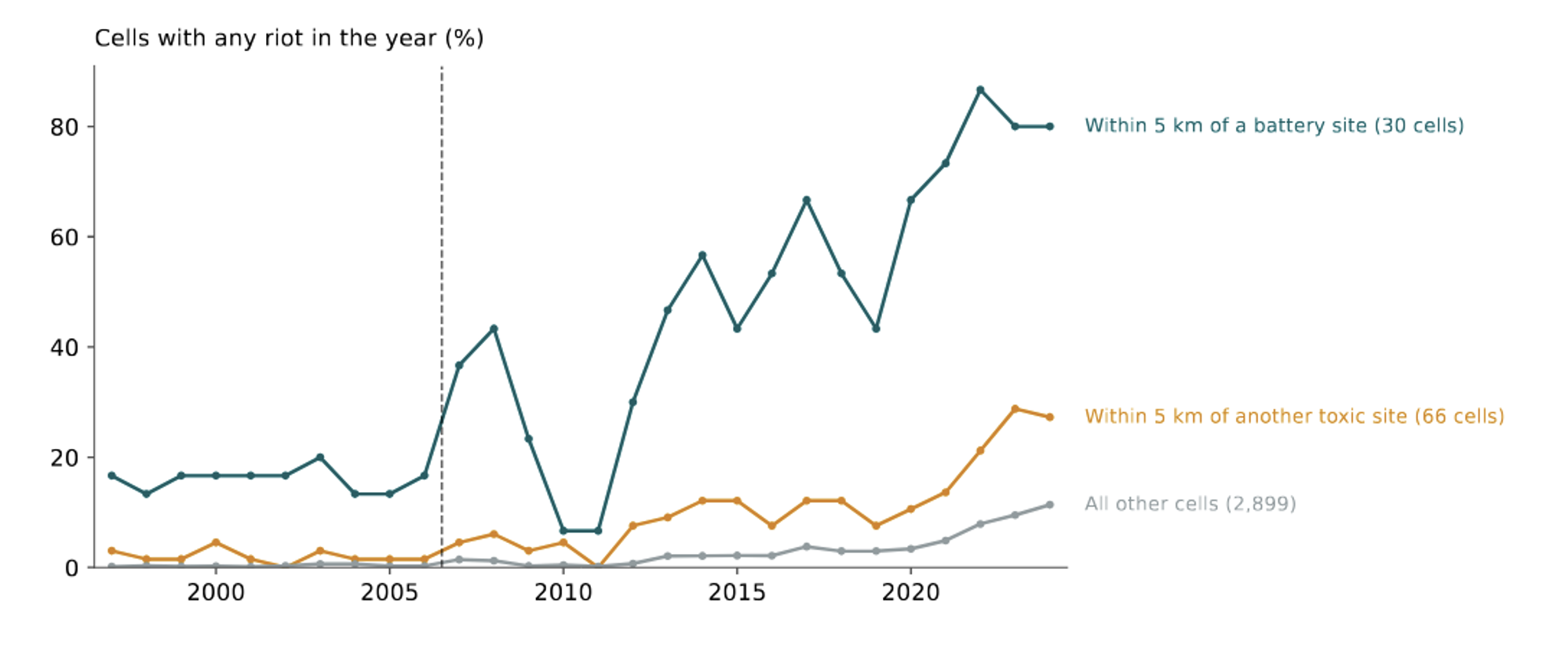
Does lead make people more violent outside of rich countries? Most of the evidence that lead raises crime comes from the United States. I looked at informal lead battery recycling sites in Kenya, Ghana, and Senegal, and the answer seems to be yes. In 2007 the world lead price nearly doubled, from $1,434 to $2,704 a tonne (in 2010 dollars). After that, the chance of a riot near battery sites rose 27 percentage points more than in places farther away.
Figure 1. Trends in riots near lead battery recycling sites
Obviously a riot isn’t exactly the same as generalised crime, but we have much better data on collective violence than individual crime. The Armed Conflict Location and Event Data (ACLED) project records all reported incidents from the media. Riots are plausibly affected by lead in a similar way to crime. The effect of lead on IQ and the development of the brain is well documented. This includes damage to the prefrontal cortex, which makes people more impulsive and reduces self-control, and so plausibly more likely to engage in opportunistic violence.
Somewhat to my surprise, the effect seems to line up well. I borrow a design from Gerald Ipapa, who studied test scores near battery recycling plants in Kenya. Pure Earth's Toxic Sites Identification Program lists 76 battery sites in Africa, 67 of them are in just three countries: Kenya, Ghana, and Senegal, so this is where I focus (the dataset is far from exhaustive, there are many other undocumented sites in other countries). I count riots near each site using ACLED conflict data, and compare before and after 2007.
When contamination started at these sites is not always well documented. Ipapa uses the documented 2007 opening of the Owino Uhuru site near Mombasa, a smelter in an informal settlement which later became Kenya’s best-known case for industrial lead poisoning, leading to a landmark ruling. That year lines up with a general increase in vehicle usage across the continent, and across the world, which led to a sharp spike in the global lead price in 2007. So I start with using the year 2007 to mark the intensification of lead contamination at all the sites.
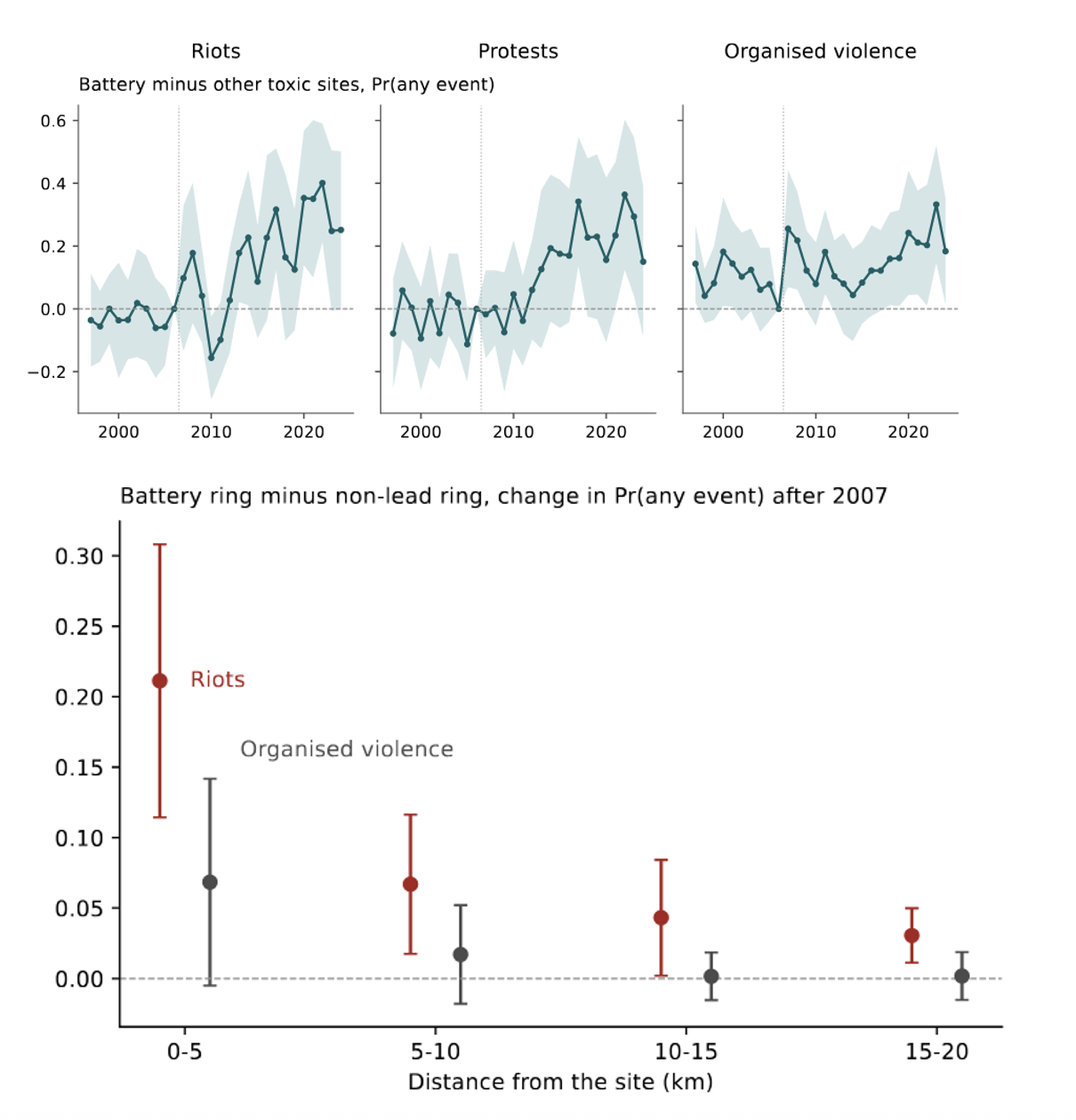
So now we have a difference-in-difference approach, comparing differences across space (near versus far from sites) with differences across time (before versus after the 2007 intensification). But we still might expect some confounding if trends were different in these sites. Thankfully, trends prior to 2007 do in fact look roughly parallel for these places. But we can also go further, adding triple and quadruple differences. First comparing lead contaminated sites to sites contaminated with other non-lead pollutants. Second, we can compare the outcomes we expect to be affected by lead (spontaneous action such as riots) with the outcomes we don’t (organized violence, such as battles that take some planning).
All these results seem consistent, from just looking at the raw data, to adding in as many controls as possible. After the intensification of lead recycling in 2007, there was an increase in riots in places near to recycling sites. This increase was specific to lead recycling and not other contaminated sites, and was specific to spontaneous violence such as riots and not organised violence. Violence is more likely at closer distances to the battery sites, and drops off with increasing distance, in a similar way to direct measures of lead in the soil. Violence increases over time, consistent with a growing number of affected cohorts reaching adolescence.
Figure 2. Effects of proximity to lead battery recycling sites on spontaneous and organised violence
How much does all this matter? Ultimately the social cost of violence and crime caused by lead is probably dwarfed by the costs of lead from heart disease and cognitive impairment. But these are still important effects, and ones that might be salient to a different set of decision-makers. Cleaning up a contaminated site costs thousands of dollars, but could easily pay for itself through the averted cost of crime and violence alone.
The paper is Lead Exposure and Collective Violence: Evidence from Informal Battery Recycling in Africa. The code and data are on GitHub.
Topics
DISCLAIMER & PERMISSIONS
CGD's publications reflect the views of the authors, drawing on prior research and experience in their areas of expertise. CGD is a nonpartisan, independent organization and does not take institutional positions. You may use and disseminate CGD's publications under these conditions.
Thumbnail image by: ToRyUK/ Adobe Stock