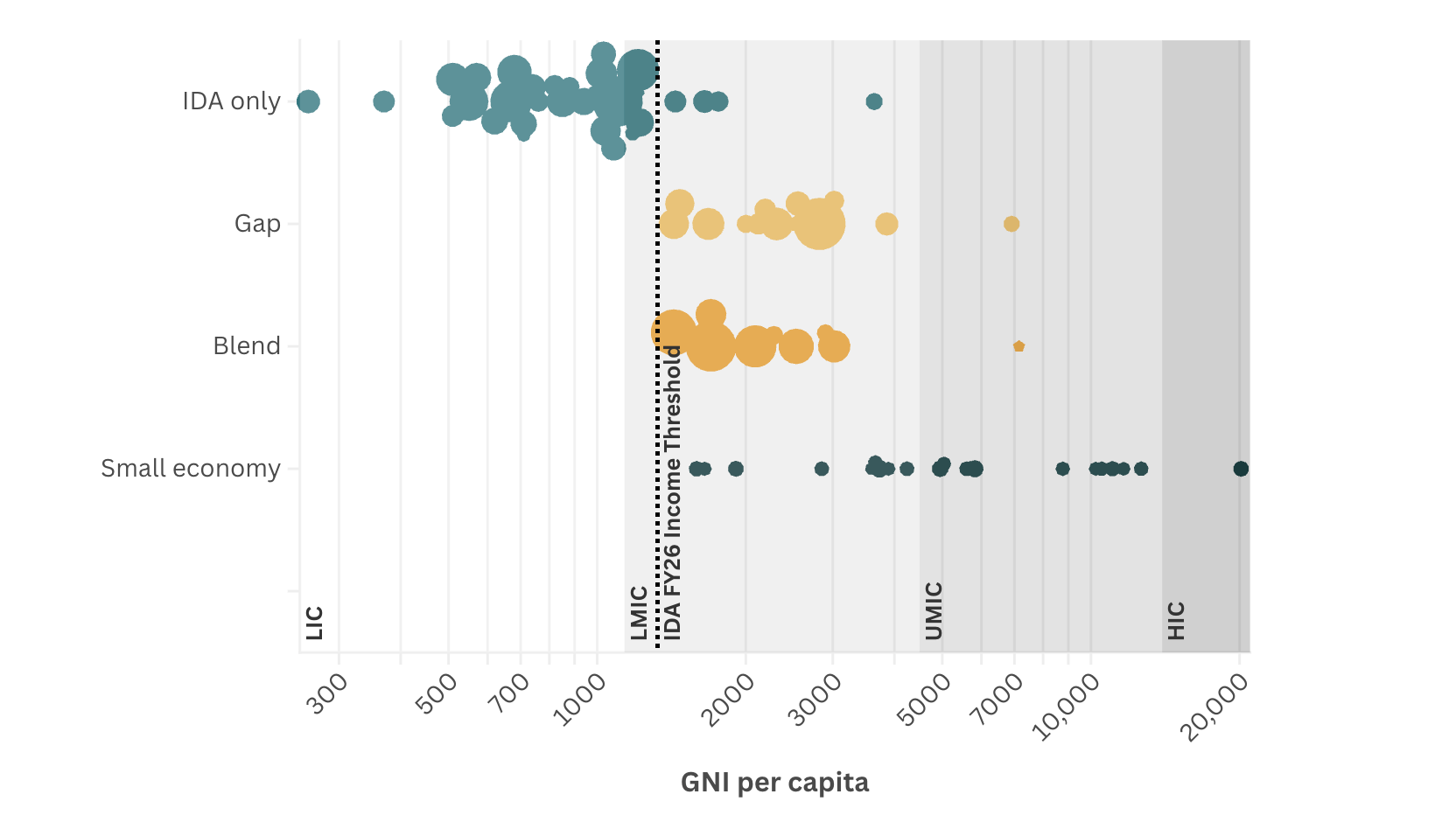
Shareholders are in the early stages of thinking about the next replenishment of the World Bank’s International Development Association (IDA). In a new CGD note released today, I suggest how to refocus IDA on what it is best designed to do: support broad-based development in the world’s poorest countries. An accretion of formula tweaks, policy exceptions, and term adjustments now means more than 40 percent of all IDA flows go to countries above IDA’s income-based graduation threshold (as demonstrated by my colleagues Karen, Nico, and Clemence) and that money often flows as grants. One (small) reason for that is the “small states exception,” which provides IDA support to small economies far above the IDA graduation line. Precisely because these states are small, the sums involved are limited, so this isn’t a huge deal in terms of skewing overall IDA allocations away from the poorest, and there are good reasons to treat these states differently when it comes to development finance. Nonetheless, it matters how policies meant to favor small states are designed, not least because of the spillover effects on larger countries. And there is scope to do it better.
Small states get special treatment from a range of multilateral institutions and development agencies. IDA’s policies give highly concessional and grant resources to economies on average four times richer than other IDA recipients, with about seven times the commitments per person. The Asian Development Bank has introduced similar terms. Multilateral climate funds also favor small island states, and bilateral donors follow suit.
That’s why small countries get more aid per capita and comparatively rich small countries sometimes get a lot more than bigger poor countries. Of the eight countries with 2023 data that received official development assistance (ODA) worth more than 20 percent of GNI, five were small states (Tuvalu, Marshall Islands, Micronesia, Kiribati, and Tonga). In the period 2019–23, only seven economies above $10,000 GNI per capita received net ODA above 2 percent of GNI. All had populations under 1.5 million.
The Marshall Islands (Atlas GNI per capita $9,710) got $3,248 in ODA per person. Burundi (Atlas GNI per capita $240) got $45 in ODA per person. The Marshall Islands has forty times the income per capita of Burundi and yet gets seventy-two times the ODA per capita.
The Marshall Islands gets a lot of ODA from the US in particular and surely deserves recompense for having been used as a nuclear testing site and for hosting US ballistic missile defense testing. But is the special treatment of small states more broadly justified?
Small economies certainly do face real challenges. There’s probably a minimum viable size for government, for example, which might help explain why small countries see larger public consumption as a percentage of GDP. It costs more to provide government services when you can’t exploit economies of scale. And similar problems affect the private sector: for a lot of services the choice will be private or public monopoly, taking away the benefits of competitive provision. Because these economies are small, they are very reliant on trade, while their exports tend to be concentrated in a few products and services. That leads to volatility from terms-of-trade shocks. Small states are also more prone to a single natural disaster turning into a crushing macroeconomic shock. And because they’re simply too small to interest institutional investors, they have trouble accessing international credit markets.
But many small states need special treatment to access IDA resources precisely because they’re too rich to be eligible for those resources under the standard rules. Indeed, there’s no evidence of a “small state penalty” in terms of income per capita. Most “Small Island Developing States” that are ODA-eligible are upper-middle-income countries. One reason may be that while small economies see less portfolio investment, they get their fair share of foreign direct investment and benefit a lot more than the average from remittance flows, linked to large diaspora populations. And the idea that small economies are particularly climate-vulnerable is oversimple. While a single storm can devastate a small economy, it is the poorest countries that face the greatest climate challenges over the long term.
That all suggests small economies do need special treatment: they are likely to need more access to official finance, ideally with debt-pause clauses alongside pooled insurance. But there is no particular reason to think that this finance, when provided to upper-middle-income economies, should be subsidized, let alone provided as grants. Grant resources have their largest impact in the poorest economies and should be reserved for them.
That said, you might argue this is neither a big problem nor one easily fixed. These are small countries, so even though they get outsized assistance, they take a comparatively small share of global concessional financing: small states get only about 3 percent of IDA resources and small island states about 2 percent of total ODA. And there are strong geopolitical reasons for their outsized take: many, like the Marshall Islands, are strategically placed, or are (again like the Marshall Islands) former trust territories or current dependencies to which donors have special obligations. And however small they are, countries get a UN General Assembly vote worth the same as China’s or the United States’.
Perhaps so, but it is at least a problem that shouldn’t keep getting bigger. IDA keeps moving the goalposts on graduation: it first created a graduation exception for six island economies in 1985, and the number covered has risen since. In 2017 it extended better terms to non-island small states; in 2019 it allowed small island IDA graduates to re-enter the program; and in 2023 it extended the graduation exception itself to non-island small states. Twenty-three countries are now covered, up from six in 1985, and they get larger shares of the IDA pot thanks to changes including larger fixed allocations per country. This shift away from the focus on the poorest countries has spilled over into an increasingly lackadaisical graduation policy for larger countries as well.
Meanwhile, the OECD’s Development Assistance Committee is reconsidering ODA eligibility criteria with the intent of keeping a number of small island states ODA-eligible as they become high-income. It is examining several ways to do this, including metrics of climate vulnerability. As we’ve seen, such measures aren’t closely correlated with small island status, so any such exception could also apply to much larger countries as they graduate. (China is at the high-income line and has more flood-exposed people than any other country, for example.) At that point the idea that this is a small problem with little spillover harm will be firmly (if belatedly) dispelled.
The economics of small countries suggests they should have greater access to official finance. It does not suggest they deserve significant grant finance as upper-middle-income economies, let alone as they graduate to high-income status. But if politics dictates that it will happen, at least limit the sums involved and design the exceptions tightly: define them around (very small) scale, not an indicator that might also apply to larger countries.