Recommended
The early period of China’s Belt and Road initiative involved significant sovereign lending, much of it directed to poorer developing countries, with considerable support for major infrastructure projects. A number of those projects generated healthy economic returns, but the lending was comparatively expensive and non-transparent, and so increasingly financially unsustainable. The Belt and Road model evolved partially as a result, with new sovereign lending focused more on restructuring, while new investment projects are increasingly ‘private’ and frequently linked with extraction. Again, many of these deals may be economically valuable, but they remain both opaque and may generate contingent liabilities. Traditional donors might respond to the changed direction of BRI by (i) better filling the public sector gap: offering the finance China was offering for public infrastructure projects, but doing so transparently and ensuring financial sustainability; (ii) providing private finance through development finance institutions using competitive and transparent approaches that contrast with current practice in both Chinese and traditional donor financing; and (iii) providing support to developing country governments and state-owned enterprises regarding infrastructure planning, competitive selection of private sector partners, and negotiation support.
China’s sovereign lending in the first two decades of the twenty-first century
During the first two decades of the twenty-first century, China became a major source of finance (and contractors) for infrastructure across the developing world, including in Africa, much of it through sovereign financing. By 2020, China's state-owned creditors had issued over $800 billion in sovereign loans to more than 150 countries.
Some marquee projects included Pakistan’s Gwadar Port, the Addis-Djibouti railroad and Ghana’s Bui Dam. Many projects generated significant economic returns. China’s construction firms are quite capable of building quality infrastructure, as their domestic record as well as their record on World Bank-financed projects demonstrates.
Chinese finance for public infrastructure also helped fill a growing gap in financing by traditional donors. Their official development assistance (ODA) for energy in particular fell from 8 percent of total ODA in the period 1980-99 to 6 percent in 2000-2022. Instead, donors increasingly promoted finance for private sector projects through development finance institutions, despite the fact that the considerable majority of infrastructure worldwide remains in public hands, and the financing costs of private infrastructure especially in low-income countries often remain prohibitively expensive. A 2023 estimate suggested that compared to a cost of debt for private solar projects below 5 percent in countries with strong credit ratings, costs can rise above 20 percent for those with low ratings.
At the same time, Chinese sovereign lending was increasingly expensive: the percentage of China’s overseas lending and grant portfolio that qualified as ODA fell from 22 percent in 2000 to 1 percent in 2023. China's sovereign lending has consistently been less favorable than multilateral alternatives, with an average interest rate nearly double the World Bank's 2.10 percent and with shorter grace periods.
The lending also came with terms including the use of specific Chinese contractors for construction rather than competitive bidding and enforced secrecy clauses. Analysis of 100 Chinese debt contracts points to frequent use of escrow accounts and broad cancellation terms, and contracts often prohibited "comparable treatment" in Paris Club restructurings. Scale, cost, and little flexibility on rescheduling and write-downs especially for poorer debtors meant that Chinese lending played a role in the recent spate of debt crises. By 2018, developing countries owed more than $350 billion to China—more than to all 22 Paris Club members combined or to the World Bank. And by 2022, much of the debt was owed by borrowers in distress.
As these problems emerged, China’s sovereign lending program has declined. Since 2023, new Chinese sovereign loan commitments reported in the World Bank debtor reporting system only reached about $7 billion annually in 2023, about a quarter of the level in the 2010s, and net flows were negative $34 billion in 2024. The percentage of support going to poorer countries has also collapsed. In 2000, 88 percent of China’s overseas lending portfolio supported low- and lower-middle-income countries, with the majority going to low-income countries. By 2023, they accounted for 24 percent of total lending, with the vast majority of that in lower-middle-income countries.
Support for infrastructure in particular has declined. In the 2000s, 64 percent of lending commitments to developing countries was for infrastructure; that fell to 55 percent in the 2010s and 25 percent so far in the 2020s (Figure 1). Similarly, in the 2010s, China’s lending to Africa was still highly focused on infrastructure: it committed over $14 billion a year on average to infrastructure projects in Africa. The bulk of that support—more than two-thirds—was for public infrastructure. But commitments to infrastructure fell to below $5 billion in 2020-2023 (Figure 2). At the same time, the public infrastructure share of infrastructure commitments also fell from 69 percent in the 2010s to 52 percent in the years 2020-3 inclusive.
Figure 1. Chinese lending commitments to developing countries: Total, to infrastructure (constant $bn 2023)
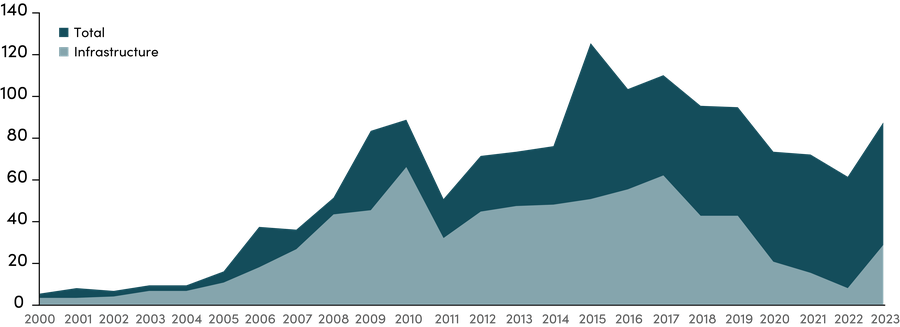
Data Source Parks, B. et al. 2025. Tracking Loans and Grants from China to Low-, Middle-, and High-Income Countries: An Application of AidData’s TUFF 4.0 Methodology. Williamsburg, VA: AidData at William & Mary.
Figure 2. Chinese lending commitments to Africa: Total, to infrastructure and to public infrastructure (constant $bn 2023)
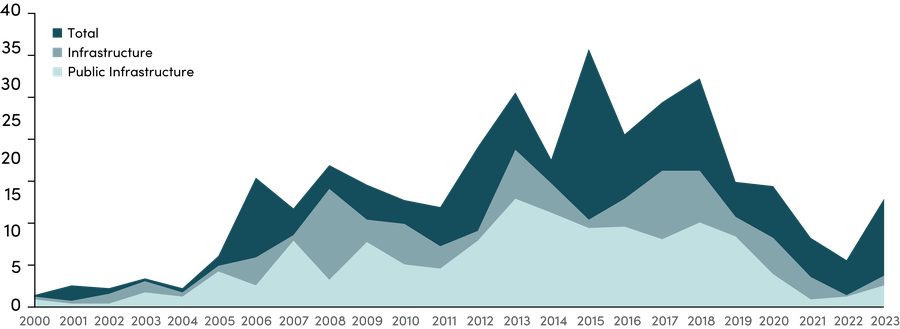
Data Source Parks, B. et al 2025. Tracking Loans and Grants from China to Low-, Middle-, and High-Income Countries: An Application of AidData’s TUFF 4.0 Methodology. Williamsburg, VA: AidData at William & Mary. ‘Public’ = Direct_Receiving_Agencies_Type includes Recipient Government Agency
BRI’s private turn
This decline in sovereign lending has been accompanied by growth in other forms of investment and engagement under the BRI. Indeed, the initiative may be bigger than ever, involving $128 billion in construction contracts and $85 billion in investments in 2025. But this is mostly badged as “private sector.”
The line between “public sector” and “private sector” deals is blurry. Chinese state-owned commercial banks are increasingly responsible for lending, often to a recipient country state-owned enterprise (SOE) or special project vehicle part-owned by an SOE, frequently with conditions that involve payment guarantees (explicit or implicit) from government. Adding to the confusion, confidentiality clauses hide many of these terms from scrutiny. But China government-backed support for lending is moving closer to a development finance institution portfolio than an aid agency portfolio.
And infrastructure projects, once accounting for 75 percent of China’s state-owned bank overseas lending portfolio, now account for less than 25 percent. Not least, there has been a notable shift in BRI countries out of electricity production into “private” fossil fuel extraction, collateralized against oil or mining payments. In 2025 Chinese entities agreed $71.5 billion in oil and gas projects, for example. Major projects include a $23 billion oil/gas development in Republic of Congo and a $20 billion gas industrial park in Nigeria (metals and mining were also significant, worth $32.6 billion in 2025). This suggests a turn towards supporting the investments that will meet Chinese domestic demand for minerals and metals imports.
In Asia, these trends away from Chinese public infrastructure finance are somewhat mitigated by a growing role for the Asian Infrastructure Investment Bank (AIIB), with China as the largest shareholder. The Bank committed $8.4 billion in 2024, primarily to the public sector and primarily to infrastructure, and much of AIIB investment is cofinanced with other multilateral development banks.
How traditional donors could respond
The withdrawal of China from financing public infrastructure, especially in the poorest countries outside of Asia, and its movement into private and quasi-private lending and investment provides an opportunity for traditional donors to do three things. First, fill the public infrastructure finance gap, but do it better: offer the finance China is no longer offering, but on transparent terms, with sustainable costs, and using competitive approaches. Second, provide a better product on the private sector side by reforming their own development finance institutions. And third, provide support for sectoral investment planning, project award and negotiation support to help ensure strong economic returns to financed infrastructure investments.
Regarding the public infrastructure financing gap, a first-best strategy would be to increase the size and reach of multilateral development banks to provide public infrastructure lending to support projects likely to generate a high financial return (this could include supporting projects cofinanced with the AIIB). In the case of such lending, it may be appropriate to provide financing on non-concessional terms to countries currently ineligible for lending support as long as they have a sustainable debt burden.
The short-term political problem with such an approach is that increasing the size of multilateral bank balance sheets would likely force confrontation with the fact that China should have a greater ownership and voting share in some of those MDBs based on shareholding formulae. Capital adequacy reforms have helped make that issue somewhat less pressing over the past few years, but any significant increase in volumes, especially if it involves less creditworthy countries, would reignite urgency.
Given that, a second-best approach would be to increase bilateral support for public infrastructure finance. In the case of the US, this could use the sovereign loan guarantee program. The SLG supported $23.8 billion in borrowing between 1993 and 2022 by providing a US government guarantee to sovereign borrowing by client countries, which allows them to borrow at near-U.S. Treasury rates (eliminating an average of a 367 basis point spread in the period 2008-22). Partners repay markets directly, and the US only pays if default occurs. Recipients have included Israel, Ukraine, Jordan, Tunisia, Egypt, and Iraq, and there have been no defaults to date. The instrument is attractive from a budgetary perspective because only the insurance cost of the guarantee (payments minus expected repayments) is recorded as a budgeted expense. Alternatively, the US could reactivate its moribund sovereign lending program to provide support.
To improve the impact of either multilateral or bilateral approaches, any borrowing should involve a mandatory transparency framework and utilize the IMF-World Bank Debt Sustainability Framework for Low-Income Countries to avoid lending into debt distress. And client countries should commit to use competitive approaches (potentially following World Bank procurement rules) for any contracting or public-private partnerships utilizing loan proceeds.
Regarding the private sector, donor-backed bilateral and multilateral development finance institutions are all too frequently backing the type of non-competitive, secret, unsustainable infrastructure projects that rightly garner criticism when backed by China. Traditional donors should commit their development finance institutions to only finance competitively awarded infrastructure concessions and projects. And transparency should involve mandated use of Open Contracting standards and (where appropriate) PPA Watch standards. More broadly, a commitment to back better PPI projects could build on and considerably strengthen the G7 Blue Dot Initiative.
Finally, donors should support technical assistance for sectoral planning, competitive contract and concession award design, and contract negotiation support to help ensure that externally financed infrastructure has a high economic return, is built and operated to high quality standards, and is delivered at the lowest cost. Institutions including the World Bank have long offered sectoral design, planning and regulatory support alongside bilateral donors including the US. This should be scaled and focused to meet demand, and a more notable gap filled with regard to direct legal support for government negotiating teams on specific transactions (with the IFC a partial exception).
A strategic window
China’s transition from financier to debt collector with regard to public infrastructure lending has left the poorest countries with fewer choices when it comes to funding that infrastructure. Expanding multilateral or bilateral support for infrastructure borrowing would be an inexpensive way for traditional donors to respond. At the same time, they could also set the standard for public investment in private sector infrastructure. It would be a win for developing countries if China followed that lead.
Thanks to an anonymous reviewer for very helpful comments.
Topics
CITATION
Kenny, Charles. 2026. Beyond Belt and Road: Responding to the Evolution of China’s Financing for Infrastructure. Center for Global Development.DISCLAIMER & PERMISSIONS
CGD's publications reflect the views of the authors, drawing on prior research and experience in their areas of expertise. CGD is a nonpartisan, independent organization and does not take institutional positions. You may use and disseminate CGD's publications under these conditions.