Essential medicines are central to quality primary health care, yet availability in public facilities across low- and middle-income countries averages only 8–41 percent. The core problem is not logistics alone but weak supply chain financing: too often, it is slow, unpredictable, fragmented, inflexible, insufficient, and donor dependent.
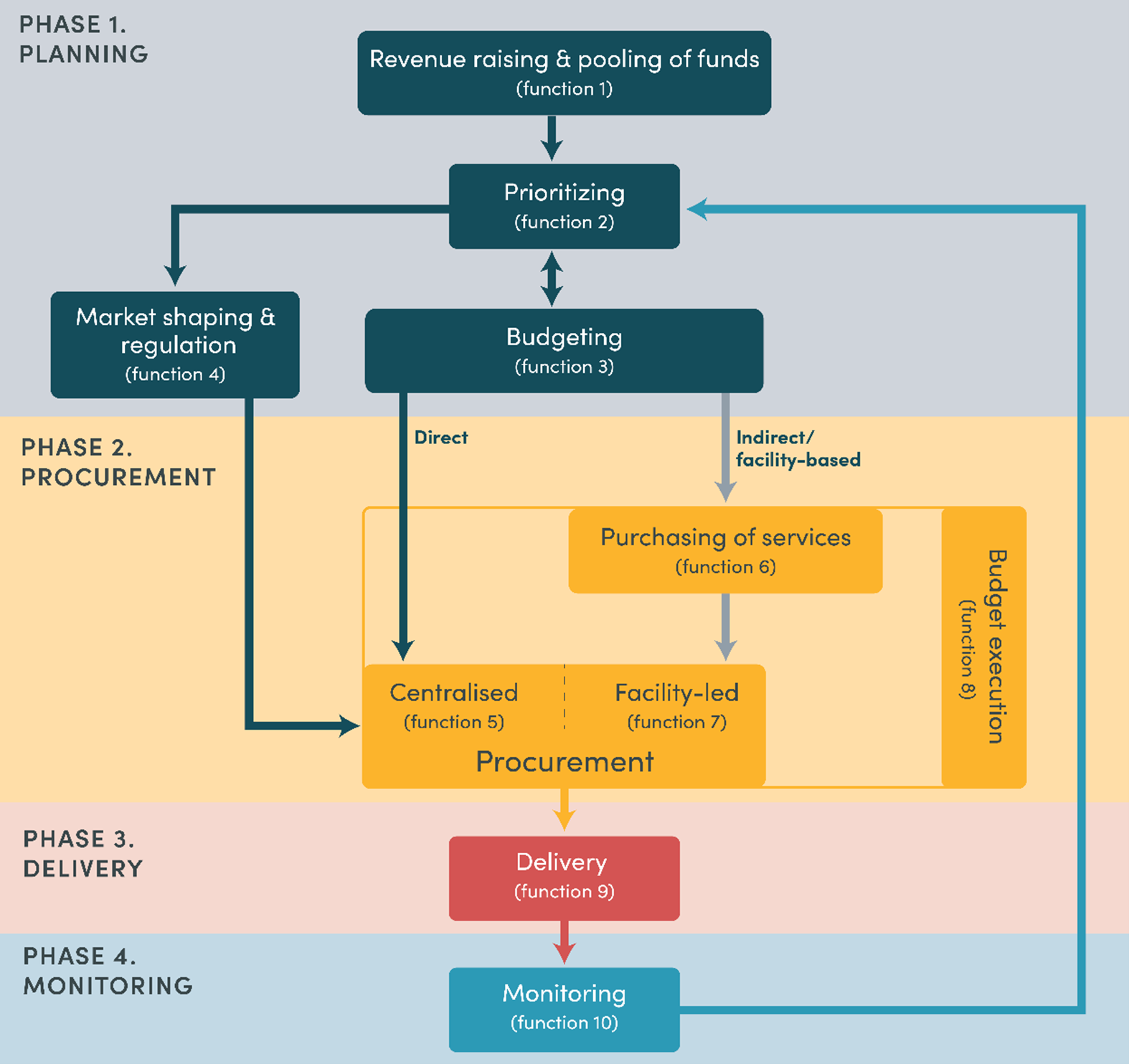
One important decision which impacts the effectiveness of supply chain financing is whether to conduct supply chain financing functions at a central or decentralised level. This paper uses country evidence, literature review, and expert consultation to consider this question for each of the functions identified in the conceptual framework developed under the remit of the Center for Global Development’s Working Group on Improving the Financing of Supply Chains.
We find that:
- There is no universally optimal system-wide configuration, but there are function-specific patterns of comparative advantage, and prerequisites determine whether those advantages are realised.
- Functions requiring scale and technical expertise – such as revenue pooling, procurement negotiation and sourcing, supplier prequalification, regulatory oversight, and market shaping – tend to perform better nationally. In contrast, service-delivery functions like ordering and last-mile distribution benefit from decentralisation when capacity exists. However, most functions are hybrid, meaning that all levels have important roles to play, and the focus should be on coherence between these roles.
- Direct facility financing can bypass the most acute supply chain bottlenecks in multilevel systems but requires enabling public financial management legislation, facility governance structures, and prequalified supplier frameworks to work safely and sustainably.
We lay out key prerequisites for successful decentralisation of some of the functions, including to mid-levels such as districts. Chief amongst these is predictable, adequate fiscal transfers. Without these, decentralisation is likely to worsen outcomes.
Overall, governance structure and institutional capacity most strongly determine supply chain financing performance and need to be in place before decentralisation is enacted. Our analysis suggests that reforming the financing conditions upstream of procurement agencies will have greater impact than focusing reform on procurement operations alone.