Recommended

Just before last year’s Annual Meetings, the International Monetary Fund (IMF) approved two sets of seemingly unrelated reforms. The first responded to widespread calls to ease the interest burden on its borrowers by cutting “surcharges” which raise the interest costs of borrowing for larger users of the IMF’s non-concessional lending by up to 3 percent. The second put in place a multi-year strategy to replenish and augment the capacity of the Poverty Reduction and Growth Trust (PRGT), which provides interest-free loans to low-income countries (LICs).
But it was no coincidence that these changes were approved just days apart. Both sets of reforms will have important implications for the evolution of the IMF’s reserves. Cutting surcharges will lower the IMF’s future lending income and thus slow the pace of reserve accumulation in the years ahead, while the approved financing strategy for the PRGT relies heavily on the use of some of these reserves. Given this link, both sets of reforms needed to be closely coordinated to ensure that the financing needs of a revamped PRGT could be met while maintaining an adequate reserve buffer on the IMF’s main balance sheet.
The resulting package of reforms recognized key constraints and trade-offs between competing objectives. After summarizing the reforms, this note discusses their rationale, the linkages between them, and the constraints that had to be addressed. It concludes by noting subsequent progress in implementing the strategy to augment the PRGT’s lending capacity and drawing lessons for future reforms.
Financing a revamped PRGT
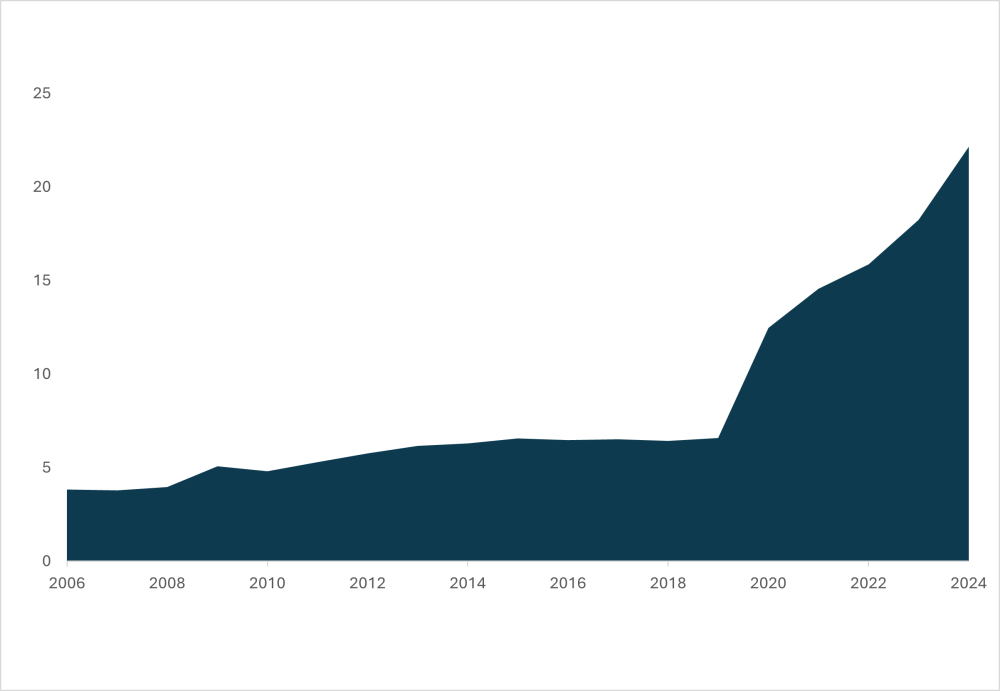
The lending capacity of the PRGT had been severely eroded. Annual lending surged from an average of about SDR 1 billion before the pandemic to over SDR 5 billion in 2020-24, and the stock of PRGT credit outstanding more than tripled. There is no immediate shortage of loan resources provided voluntarily by some 20 advanced and emerging market countries to the PRGT. But subsidy costs covered by the PRGT (the difference between the SDR interest rate paid to the loan providers and the zero interest rate for borrowers) soared as lending surged and then the SDR interest rate rose sharply from near zero in 2020 to over 4 percent in 2023. Fundraising efforts launched in 2021 yielded donations of SDR 2.3 billion from IMF member countries. But even with this support, the self-sustained lending capacity of the PRGT was projected to fall sharply to SDR 1 billion by 2026.
Figure 1. PRGT credit outstanding, in billions of SDRs
A much higher lending capacity is essential to accommodate LICs’ financing needs. The severe setbacks that LICs suffered during the pandemic and the greater magnitude and frequency of adverse shocks that LICs now face will have a lasting impact on financing needs, especially for the most vulnerable countries. Cutbacks in bilateral development aid and large PRGT repayments falling due – an echo from the recent surge in lending – add to these pressures. A fuller discussion of the need for a lending envelope in the region of SDR 2.65 to SDR 3.0 billion can be found here. The IMF’s financing strategy implies a long-term capacity for the PRGT near the bottom of this range but still more than double its pre-pandemic level.
Raising the PRGT’s sustainable lending capacity is costly. The PRGT’s financial architecture includes reserve and subsidy accounts that serve as an endowment generating income so that interest subsidies can be covered, if not in perpetuity, at least over the long run. (A fuller description of the PRGT’s financial structure can be found here). The recent unprecedented surge in lending ate into this endowment which now needs to be replenished and augmented to raise its depleted lending capacity. The IMF estimated that without changes to the PRGT’s lending policies an injection of SDR 9.1 billion in new subsidy resources would be needed to yield a long-term annual lending capacity of SDR 2.7 billion.
Faced with tight financing constraints, costs were lowered by about a quarter by focusing limited interest subsidies on the most vulnerable LICs. The estimated cost of SDR 9.1 billion included maintaining a zero interest rate for all PRGT borrowers. In the approved package the cost was reduced by SDR 2.3 billion by targeting the zero-interest subsidy on the most vulnerable countries. The differentiated structure in which higher income LICs will receive a limited subsidy of 30 or 60 percent of the prevailing SDR interest rate (see below) was justified by an observed heterogeneity of economic developments across PRGT eligible countries. The 31 poorer LICs that would continue to pay no interest have typically seen weaker growth and greater setbacks than other 38 PRGT-eligible countries in recent years.[1]
The new structure of PRGT interest rates
- LICs with lower incomes and no capital market access would pay zero interest (31 countries)
- LICs with higher incomes but no access to international capital markets would pay 40 percent of the prevailing SDR interest rate 18 countries)
- LICs with higher incomes and market access would pay 70 percent of the prevailing SDR interest rate (20 countries)
Almost all the remaining financing will come from IMF “internal” sources. The large needs of the PRGT ruled out reliance on donations from member countries. The fundraising exercise launched in 2021 – which was seen as a first phase before internal resources could be used – took over two years and raised the equivalent of only about a third of the SDR 6.8 billion now needed. Drawing on the IMF’s own resources also avoids competing with IDA allocations for funding. The financing package thus includes only SDR 0.5 billion of anticipated donor contributions. An additional contribution of about SDR 0.4 billion will come from a further suspension of the annual payment that the PRGT normally makes to the IMF’s General Resources Account (GRA) to cover the administrative costs of the PRGT.
The approved strategy relies heavily on financing from reserves. In the absence of gold sales—we return to this issue later—most of the financing need will be met by using some of the IMF’s reserves. The total to be financed via the use of reserves is SDR 5.9 billion in end-2025 PV terms (see below). Getting these reserves to the PRGT is a cumbersome process, as we will explain after looking at the changes in surcharges.
Table 1. PRGT financing need (SDR billions, end-2025 PV terms)
| Cost of raising annual interest free lending capacity to SDR 2.7 bn | 9.1 | ||
| Savings from providing interest free loans to only the most vulnerable | -2.3 | ||
| Additional bilateral contributions | -0.5 | ||
| Savings from suspending reimbursement of the GRA | -0.4 | ||
| Residual to be financed through distributions of reserves/net income | 5.9 | ||
Reform of surcharges and charges
Surcharges raise the interest cost of larger loans from the IMF, giving an incentive for borrowers to repay early. Surcharges are not levied on lending from the PRGT. When countries borrow on non-concessional terms from the IMF’s GRA, they pay a basic rate of charge (IMF terminology for an interest rate) equal to the variable SDR interest rate plus a margin which before the reforms was set at 1 percent. Larger borrowers from the IMF also pay (interest) surcharges over the SDR interest rate. Depending on the duration of borrowing, surcharges increase the marginal interest rate payable on larger loans from the GRA by 2 to 3 percent. A level-based surcharge of 2 percent is applied to loan amounts above a threshold level. A time-based surcharge of an additional 1 percent is levied on the loan amount that has exceeded this threshold for three years (or, in the case of borrowing under an Extended Arrangement that has a longer maturity, after 4¼ years).
Surcharges also allow the IMF to accumulate reserves. These so-called ‘precautionary balances’ are an important element of the IMF’s risk management, protecting the balance sheet and members’ quota resources that are, in effect, on-lent to the IMF’s non-concessional borrowers. Since the present structure of level and time-based surcharges was introduced in 2009, surcharges have been a significant driver in reserve accumulation. In the 10 years to April 2024 precautionary balances doubled from SDR 12.7 billion in 2014 to just over SDR 25 billion with surcharge income contributing over SDR 9 billion to this increase.
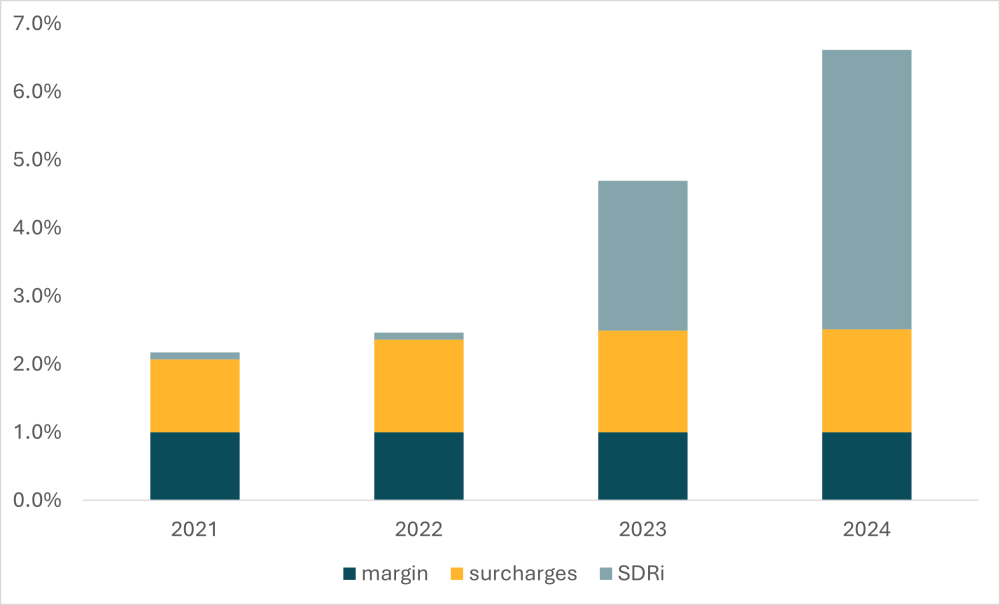
There were numerous calls to reduce, suspend, or eliminate surcharges. Many observers argued that surcharges placed onerous and counter-cyclical costs on borrowers who lack the market access that would allow them to repay early. The recent sharp rise in the SDR interest rate put further pressure on borrowers, adding to calls for relief. For most of the period since 2009, the SDR interest rate had remained unusually low, often well below 1 percent. As a result, even for countries subject to the highest rate of surcharges the marginal cost of borrowing was typically under 4 percent until 2023. But at end September 2024 these borrowers faced a marginal interest rate of 7.5 percent (the SDR interest rate of 3.5 percent, a margin of 1 percent and surcharges of 3 percent). Similarly, the average interest rate paid by all borrowers (including those not subject to surcharges) more than tripled to 6.6 percent between FY 2021 and FY 2024.
Figure 2. Average charges and surcharges on IMF non-concessional loans
Although surcharges only apply above a threshold level of borrowing, for some countries the bulk of their borrowing was subject to surcharges. At end Sept 2024, 52 countries had outstanding IMF credit from the GRA totaling almost SDR 90 billion and of these, 19 countries were subject to surcharges with borrowing averaging 385 percent of quota – more than double the threshold for surcharges. The 9 largest borrowers (as a percent of quota) paid surcharges on more than half of their loans. Argentina’s and Ecuador’s credit outstanding was 5 times the threshold, so that 80 percent of their borrowing was subject to surcharges.
The 2024 reforms lowered surcharges and charges. The surcharge threshold was raised so that fewer borrowers will pay an unchanged level-based surcharge of 2 percent. Time-based surcharges were lowered by 0.25 percent. And costs for all borrowers, whether subject to surcharges or not, were lowered by reducing the margin for the basic rate of charge by 0.4 percent. These changes which came into effect on November 1, 2024, were estimated to reduce the costs of surcharges and charges by about a third on average, lowering the IMF’s projected lending income from GRA loans in FY2026 from SDR 2.6 billion to SDR 1.7 billion. Before the reforms the number of countries subject to surcharges was expected to rise to 20 in FY 2026 but at the time of the reforms was projected to decline to 13.
The new structure of charges and surcharges
- Margin over the SDR rate for all GRA borrowing lowered from 1 percent to 0.6 percent
- Threshold for surcharges raised from 187.5 percent quota to 300 percent of quota
- Level-based surcharge (for borrowing above this threshold) remains at 2 percent
- Time-based surcharge lowered from 1 percent to 0.75 percent
Combining the reforms
Despite lower lending income, reserves are expected to rise substantially. Over the five years to April 30, 2029 (FY 2025-2029) reserve accumulation is projected to be about SDR 4.7 billion lower than without these cuts to charges are surcharges. (Lending income will be lowered by about SDR 4 billion and the total cost includes the resulting loss of investment income on these reserves). But even with these cuts, total net operating income in the next 5 years is projected at about SDR 8.5 billion which would yield precautionary balances of about SDR 33 billion before any use of reserves to support the PRGT.
The financing needs of the PRGT would then be met by drawing on these reserves. Since the longstanding reserve target of SDR 25 billion was met in 2024, some of the expected accumulation above this level can be used to support the PRGT. Indeed, the financing strategy implies that the bulk of the expected net income of SDR 8.5 billion that would otherwise add to reserves will be used to support the PRGT. The strategy envisages annual distributions from reserves or net income over the period 2025-2029 totaling SDR 6.9 billion. The size of each distribution will be determined annually but is expected to average about SDR 1.4 billion a year.
Table 2. PRGT financing needs and projected reserve movements
| PRGT financing needs (SDR billions, end-2025 PV terms) | |||
|---|---|---|---|
| Cost of raising annual interest-free lending capacity to SDR 2.7 bn | 9.1 | ||
| Savings from providing interest-free loans to only the most vulnerable | -2.3 | ||
| Additional bilateral contributions | -0.5 | ||
| Savings from suspending reimbursement of the GRA | -0.4 | ||
| Residual to be financed through distributions of reserves/net income* | 5.9 | ||
| Projected reserve movements and end-year stocks (SDR billions) | ||
|---|---|---|
| FY 25-29 (flows) | End-FY29 (stocks) | |
| Reserve increase and stocks without cuts in charges and surcharges | 13.2 | 38.3 |
| Reserve increase and stocks with the cuts in charges and surcharges | 8.5 | 33.6 |
| Reserve/net income distributions to finance the PRGT* | 6.9 | … |
| Reserve increase and stocks after surcharge cuts and distributions | 1.6 | 26.7 |
| Reserve (precautionary balance) target first attained in FY 2024) | … | 25.0 |
*SDR 6.9 bn (in cash terms) would meet the residual financing need of SDR 5.9 bn (end-2025 PV terms) if 90 percent are returned to the PRGT.
Source: Adapted from IMF publications dated October 2024
The total use of reserves will be higher than the estimated financing needs of the PRGT for two reasons. The first is a technicality. The PRGT needs SDR 5.9 billion in end-2025 present value terms, but the corresponding inflows will be phased over a 5-year period so their total cash value will need to be a little higher than SDR 5.9 billion. The second and more important factor is that some reserves will, in effect, be lost in transit. Under the IMF’s Articles of Agreement, reserves (or net income) cannot be simply transferred to the PRGT. They can, however, be distributed to the membership pro-rata to quota shares. (Distribution of net income requires a simple majority in the Board while a distribution of reserves requires a 70 percent majority). In principle, it would then be up to each member to agree to use their share of the distribution to support the PRGT. To minimize the ‘leakage’ that could occur from countries not agreeing to support the PRGT, the strategy requires that before any distributions are made to the PRGT assurances are first attained from member governments accounting for at least 90 percent of the planned distributions that their shares can be used to support the PRGT.
The strategy is also designed to bridge the gap between the PRGT’s urgent needs and the possibly lengthy process of attaining the required 90 percent level of assurances. To streamline the process, the IMF is seeking up front assurances that would cover the full amount to be distributed over the next 5 years, rather than seeking separate assurances for each annual distribution. But the experience with similar distributions in 2012 and 2013 suggests that it could take a year or more to reach the 90 percent threshold. And as noted earlier, the lending capacity of the PRGT could fall to just SDR 1 billion by 2026. Two policy choices will help to bridge this gap. First, the new interest rate structure, which came into force in May 2025, will slow the depletion of existing subsidy resources. More importantly, annual distributions of net income will be placed in an interim account until the required assurances have been attained. And in this interim period, this account will be adding to the PRGT’s lending capacity as if it were part of the PRGT’s “endowment” because all interest earned on the account (at the SDR interest rate) will be transferred to the PRGT’s subsidy account.
Constraints, trade-offs, and possible pitfalls
Why didn’t the IMF sell gold to meet the PRGT’s needs? In principle, sales of a small proportion of the IMF’s gold could easily have met the full cost of replenishing the PRGT –and even provided for a lending capacity of over SDR 2.7 billion. Selling just 5 percent of this gold, which is held on the IMF’s main balance sheet at a fraction of the current market price of over $3,300 per troy ounce could generate profits of over SDR 10 billion.[2]
The next (second) best option of using reserves to support the PRGT was complicated by the urgency of reducing surcharges. Any use of reserves had to preserve an adequate reserve buffer on the IMF’s main balance sheet. Cutting surcharges and thus future reserve accumulation would lower the scope for meeting the PRGT’s needs from reserves. Conversely, the higher the financing of the PRGT from reserves, the lower the scope for cutting surcharges.
The resulting solution involved trade-offs on all sides:
- Surcharges were not eliminated. Borrowing costs were reduced significantly and the benefits were spread more evenly by also lowering the basic rate of charge that all non-concessional borrowers pay. But the resulting structure of surcharges still retains a price-based incentive to repay and reserve accumulation will still be significant. (See the box below on how a higher SDR interest rate also contributes to reserve accumulation)
- Financing needs were reduced by targeting PRGT subsidies on poorer LICs. Focusing scarce subsidy resources on the most vulnerable was a better choice than reducing subsidies for all PRGT users. The adverse implications of this move for higher income LICs who would face higher interest costs were also tempered by grandfathering existing commitments. Only lending disbursed on commitments made after April 30, 2025 (the end of FY 2025) will be subject to the new interest rate structure.
- Precautionary balances are expected to remain above the target level of SDR 25 billion but only by a small margin, with most of the projected reserve accumulation being used to support the PRGT. The use of reserves will also be limited by requiring assurances that 90 percent of the distributions are provided to the PRGT.
Despite accommodating numerous constraints, the financing strategy for the PRGT still faces some risks:
- There is no guarantee that 90 percent of the membership will provide the necessary assurances. However, the financing strategy, including the framework for distribution of reserves, was approved unanimously. The initial response for assurances also seems to have been positive. In the five months following the approval of the strategy, assurances equal to 25 percent of the total distribution were provided. If the 90 percent threshold is not attained within 5 years, the amounts held in the interim account would be returned to the GRA, unless a majority voted to extend the period for seeking assurances.
- The IMF’s income and reserve position needs to remain strong enough for annual distributions to be approved. The bulk of projected net income in the next 5 years is expected to be used to support the PRGT and the actual income position is subject to many uncertainties, including the vagaries of interest rates and loan demand. Adverse developments could also prompt a decision to build up greater reserves, derailing or at least delaying distributions. However, developments have so far gone to plan. The IMF’s net income in the year to April 2025 was broadly in line with earlier projections, and a distribution to the interim account of SDR 1.4 billion was approved.
- The PRGT’s long-term lending envelope of SDR 2.7 billion may not be adequate to meet the needs of LICs. In the early years, lending could exceed SDR 2.7 billion a year without seriously affecting future capacity. But a sustained higher level of demand, which could, for example, arise from the severe cuts in development assistance seen after the financing strategy was approved, would need to be offset by additional financing or policy changes.
The impact of a higher SDR interest rate on IMF income
The recent sharp rise in the SDR interest rate added to the subsidy needs of the PRGT and increased the urgency of cutting non-concessional borrowing costs. However, the higher SDR interest rate has also boosted the IMF’s investment income.
In the next five years, the pace of reserve accumulation is expected to be roughly in line with that of the previous five years. This projection is not driven by an assumption of higher lending; average credit outstanding in the five years to 2029 is projected to be close to its level in the previous five years. Instead, this reflects the return to more normal interest rates after a long period in which the IMF’s investment income was constrained by very low interest rates. Assuming the SDR interest rate averages just over 3 percent, higher investment earnings are expected to broadly offset the decline in lending income stemming from the reduction in charges and surcharges.
| IMF income and change in reserves (SDR billions) | ||
|---|---|---|
| Fiscal year averages | ||
| 2020-24 | 2025-29 | |
| Operational income | 2.7 | 3.0 |
| Lending income | 2.4 | 1.8 |
| Investment and other income | 0.3 | 1.2 |
| Expenses | 1.1 | 1.3 |
| Net income/change in precautionary balances | 1.6 | 1.7 |
| Memo items: | ||
| Precautionary Balances at end of period | 25.1 | 33.6 |
| Precautionary Balances after distributions | … | 26.7 |
Source: Adapted from IMF publications dated October 2024
Lessons for future reforms
The two sets of reforms will enhance the IMF’s operations. The PRGT will be better placed to meet LICs’ needs, and reducing surcharges that had long been a major concern for borrowers will help to bolster the legitimacy of the organization.
But many other reforms recently proposed by outside commentators and stakeholders to improve the IMF’s effectiveness and legitimacy are not currently feasible. The very high majorities needed to move forward give ample scope for blocking coalitions. (For a summary of reform proposals and the obstacles they face see here). For example, a quota increase that could raise the IMF’s lending capacity and improve legitimacy by redistributing voting shares to underrepresented countries requires an 85 percent majority and would thus need the support of countries that would concede voting power.
In contrast, the reforms discussed here succeeded in combining complementary changes that each had supporting constituencies and did not face such high thresholds for approval. The strategy that was put together was clearly second best. Stripped of all complexities it implies that subsidies for LICs under the enlarged PRGT will in part be covered by charges and surcharges levied on middle income borrowers. Using gold sales or relying on donations from rich countries would have been preferable, avoiding cross-subsidization from middle- to low-income borrowers, but neither were politically feasible. In the absence of these first best options, the strategy that emerged was preferable to the alternative of the PRGT falling woefully short of countries’ needs.
And, at the same time, middle income borrowers gained significant relief from lower charges and surcharges. Difficult trade-offs were entailed. A 70 percent majority was needed to change surcharges and creditor shareholders had to be assured that reserves would remain adequate despite lower lending income and the expected use of net income or reserves to support the PRGT. Shareholders cannot have been happy will all aspects of the reforms, but there was broad support for both packages. The second best was, in practice, the first best.
The PRGT and surcharge reforms thus provide a model for future action. They were developed in explicit recognition of constraints that ruled out “easier” options. And despite an environment of geopolitical divisions, compromises were found to engender the necessary broad support of the membership. It is crucial that the IMF continues to demonstrate its value for the membership by responding to their changing needs and concerns. As in the case of the reforms discussed here, this may well entail a focus on reforms that improve operations using only existing resources.
[1] The IMF policy paper for the reforms covered 69 PRGT eligible countries. Including Syria there are now 70 eligible countries.
[2] In early July 2025 the market value of the IMF’s gold holdings was just over US$ 300 billion (about SDR 210 billion)
Topics
CITATION
Andrews, David. 2025. The Anatomy of a Successful Compromise at the IMF. Center for Global Development.DISCLAIMER & PERMISSIONS
CGD's publications reflect the views of the authors, drawing on prior research and experience in their areas of expertise. CGD is a nonpartisan, independent organization and does not take institutional positions. You may use and disseminate CGD's publications under these conditions.
Thumbnail image by: International Monetary Fund/ Flickr