Recommended
Blog Post
How Many Lives Does US Foreign Aid Save?

Project
The abrupt terminations of USAID programming around the world will have profound long-term consequences—some of which will take years to fully materialize. However, the immediate loss of life is already falling disproportionately on low-income countries, primarily in Africa, that are least able to ramp up their own spending. Despite what administration officials have claimed about preserving life-saving work, many of the programs delivering interventions known to save the most lives per dollar spent have not received the funding promised in their agreements and contracts. And it is not just the huge reduction in foreign assistance that may ultimately prove most damaging: Even if US aid budgets are restored in a few years, the chaotic and unpredictable dismantling of USAID will have permanent consequences on the capacity to deliver aid around the world.
Among the many efforts needed to mitigate this harm, our team at Project Resource Optimization (PRO) is working to rapidly mobilize private funds for the most cost-effective, life-saving programs affected by USAID cuts. The PRO team, now hosted at CGD, is collaborating with CGD fellows to deepen its analytical work and develop policy and program recommendations for the future. In addition, PRO is conducting independent work matching philanthropic donors with priority projects.
Project Resource Optimization’s approach
The PRO team, made up of former USAID staff and aid effectiveness experts, has spent the last few months screening publicly available data to identify USAID projects that were deploying evidence-based interventions to cost-effectively save lives or lift people out of extreme poverty—and which could most effectively be continued by private philanthropy. In late February, the PRO team—Rob, Caitlin, and others—began analyzing public data, comprising nearly all USAID fiscal year 2024 obligations, to identify a tractable set projects that could be suited for philanthropic funding. We started by looking at 22,700 projects that cost a combined $35.5 billion in value. As a first step, the PRO team filtered out sectors, countries, and types of obligations that were less likely to be cost-effective at saving lives or eliminating extreme poverty. Read more on our methodological approach here.
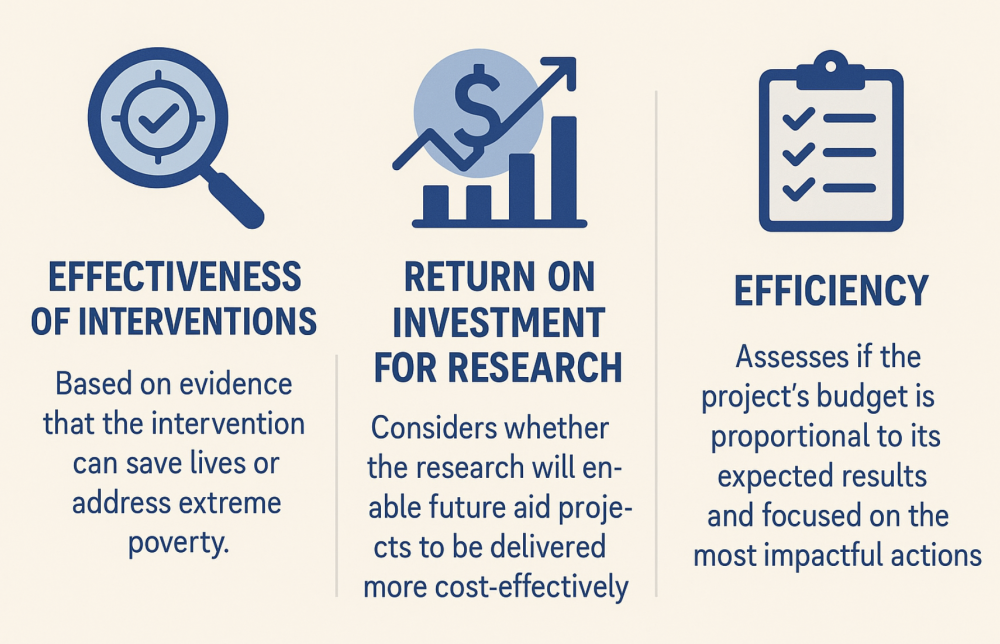
From the 2,000 projects left—still representing almost $9 billion in former USAID obligations—we triaged down to what we call a “First Cut List” of around 600 projects that we wanted to investigate further. This triage process was based on project descriptions, a media review, and structured interviews with experts and implementing partners across the sector. Then we began engaging directly with the implementing NGOs to determine: (1) whether the listed project still needed funding; and (2) what the most cost-effective core components were to prioritize for private funding. We asked partners to suggest “radically simplified” versions of their programs, often many times smaller than the originally approved USAID award, concentrating resources on a smaller set of highly effective interventions. We also targeted highly leveraged research projects that could inform future cost-effective programming, which we included alongside implementation work. The PRO team then further reduced that list based on three key criteria—effectiveness, research return on investment (ROI), and cost-efficiency.
Our “Urgent and Vetted List” is the result of that process—the (currently) 55 former USAID projects that we found to be the most lifesaving, cost-effective, and feasible for private donors to pick up right now. Collectively, they are short $98.5 million, and nearly all of them are facing funding cliffs—after which it won’t be feasible to quickly and cost-effectively restart the project—in the next few months. Encouragingly, 14 of these “Urgent & Vetted” projects have now received full funding from private donors, totaling $12 million in funding mobilized.
PRO focuses on cost-effectiveness, but that does not imply that projects screened out of our process are necessarily “cost-ineffective”—they were largely screened out because they are targeting objectives other than saving lives or lifting households out of extreme poverty. Therefore, our assessment is not what we believe to be an optimal level of funding, but what our analysis shows could save the most lives per additional dollar of aid and be reasonably covered by private philanthropy. When budgets get smaller, the bar for cost-effectiveness necessarily gets higher. Moreover, conscious of the massive contraction in funding for international aid, we have chosen to optimize only around saving lives and reducing extreme poverty. This inherently excludes other important, impactful, and cost-effective work in sectors such as education, democracy, human rights, and economic growth.
A lab for more effective aid in the future
The experience of the PRO initiative has been a laboratory for what a cost-effectiveness focused approach to aid can look like—one focused on improving impacts, not just slashing costs.
The first, and most encouraging, thing we are seeing is that private actors are stepping up and saving lives. Take the example of the JSI project in Mozambique, where a set of four separate donors has pooled their funds to enable an investment of $2 million. That funding will prevent an estimated 550 deaths among children under 5 and allow for the smooth transition of vaccine rollout planning to the Mozambican government and GAVI, the Vaccine Alliance in these areas, rather than the sudden “hard landing” that would have put over 700,000 children at risk of missing their routine immunizations.
Second, we are seeing the way in which redefining incentives can shift program design. The same actors who have historically delivered “kitchen sink" projects—containing many activities unrelated to the core focus, dividing up resources and undermining economies of scale—have been willing to focus on a smaller set of services when money is on the line. Our experience suggests that many critiques of large US-based contractors miss major causes of complexity and inefficiency. The USAID design process often focused on identifying barriers to development and directing resources towards those barriers. Given the complex challenges USAID grappled with, this led to a tendency to add more interventions to the same program—often “attributing” the same funding to multiple outcomes—with less attention to the consequences of dividing the available budget into ever smaller slices. We are not suggesting that programming should be boiled down to vertical, parallel delivery systems. Our “Urgent & Vetted” projects include bundled packages of services, systems strengthening investments that drive greater scale or quality of service delivery, and more. There is a middle ground between “kitchen sink” and “vertical delivery,” and the right incentives can help get us there.
Despite the meaningful success we have seen at PRO, we are conscious that private philanthropy can’t do everything USAID used to do. The Gates Foundation, and others, are right when they say that private foundations cannot replace US government funding. PRO has had to exclude incredibly important investments such as the Famine Early Warning System that facilitates collective action on famine data (FEWS NET), or global procurement of pharmaceuticals and food supplements (such as Ready to Use Therapeutic Food), because the scale or nature of these investments can only be taken on by governments or the multilateral organizations they support. Private philanthropy is not a substitute for US foreign assistance, at least not in anything approximating the full scope of what is needed to preserve the most number of lives, but it can play a critical role in this current uncertain time.
As many in this field begin envisioning the future of foreign aid, it is important not to lose sight of the immediate suffering taking place. The urgency to act now will not only preserve the lives and programs to deliver that aid, it can also help shape how future programs are delivered. Indeed, “the future of aid” is already being built by the actions people take amidst the chaos.
Topics
DISCLAIMER & PERMISSIONS
CGD's publications reflect the views of the authors, drawing on prior research and experience in their areas of expertise. CGD is a nonpartisan, independent organization and does not take institutional positions. You may use and disseminate CGD's publications under these conditions.
Thumbnail image by: Arnaldo Salomão Banze, ADPP Mozambique via USAID Flickr