Recommended
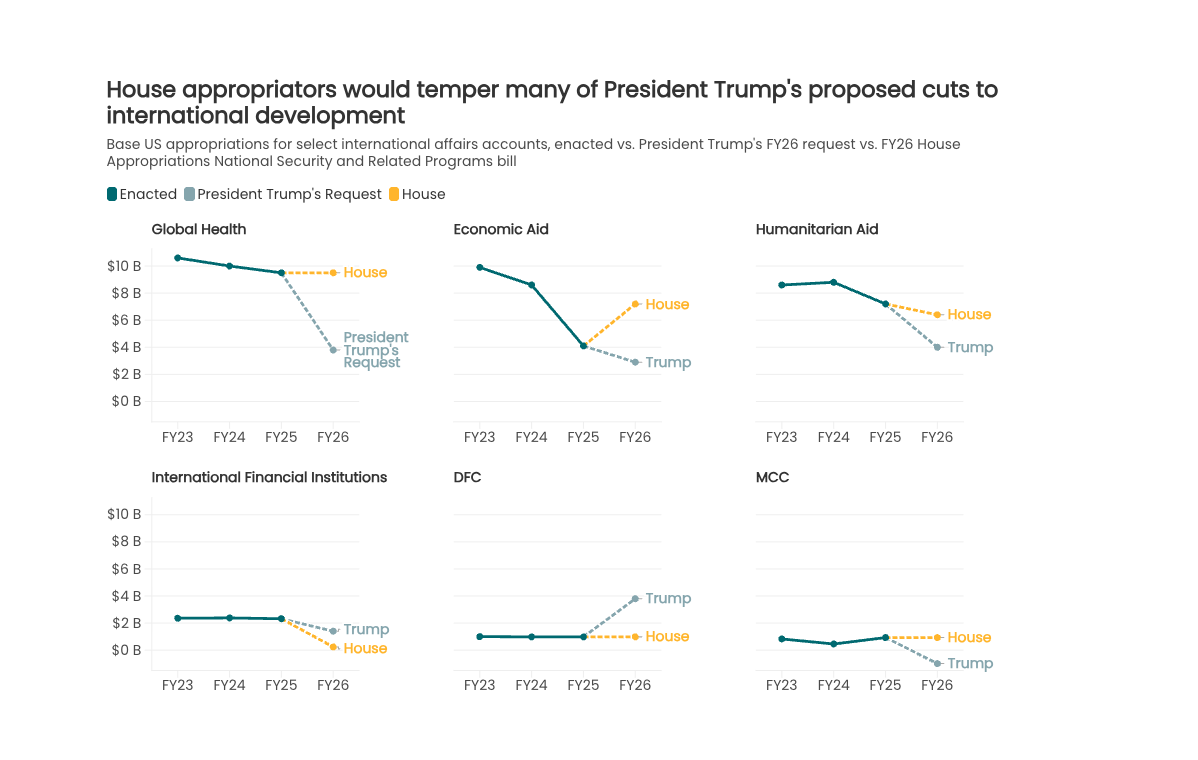
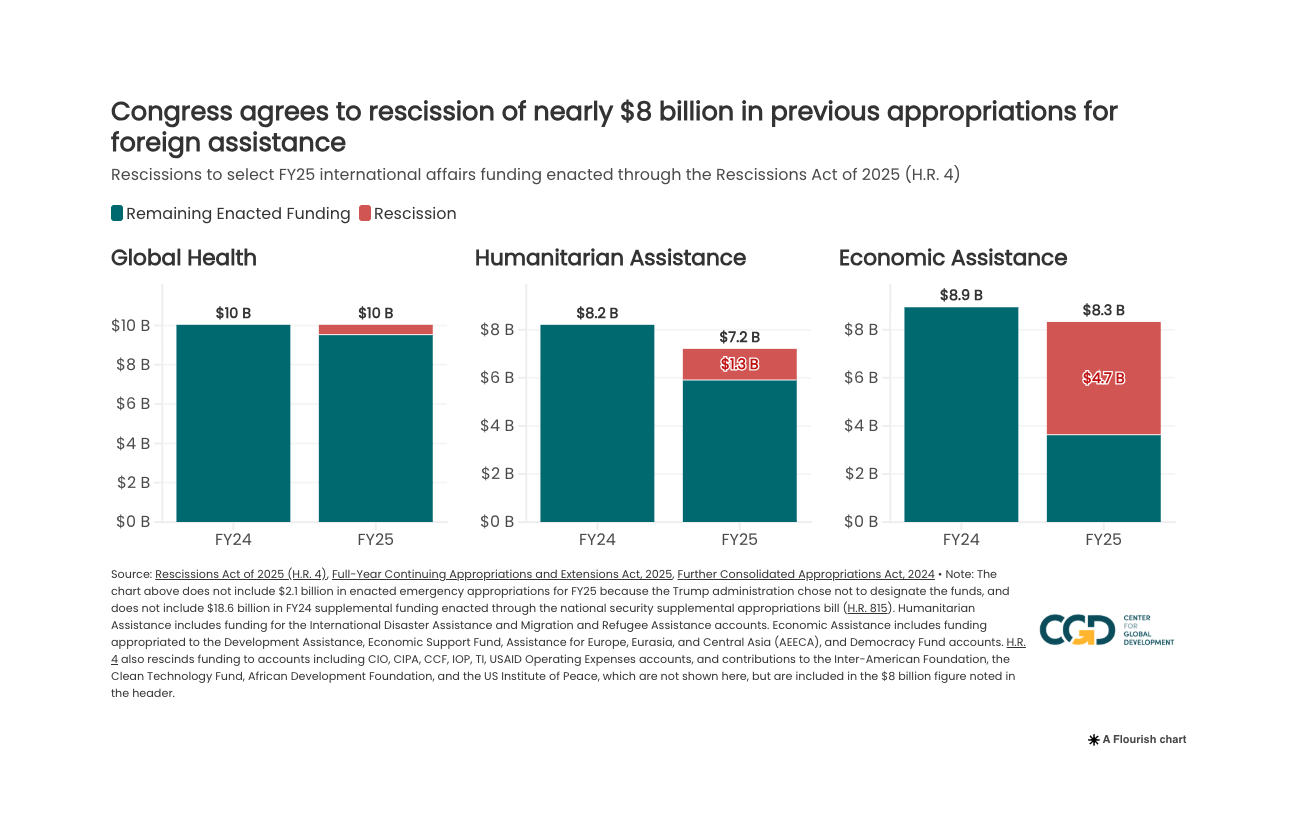
While the recent rescissions process cut about $8 billion in foreign assistance funding, there is still approximately $21 billion in FY25 budgeted foreign assistance to be obligated (used to make binding agreements to spend), alongside many billions more from previous fiscal years. Regarding global health in particular, funding is still available to avoid perhaps the considerable majority of the half million deaths potentially associated with award cancellations and disruption due to the foreign assistance freeze. Congress included specific language related to preserving that funding for HIV/AIDS, tuberculosis, malaria, nutrition, and maternal and child health as part of the rescissions package. The House Appropriations Committee has advanced a spending bill that suggests bipartisan support for continuing a similar level of global health funding next fiscal year. If realized that could help preserve the great majority of the million lives potentially at stake from the administration’s budget proposal. But all of this depends on the ability to execute the lifesaving support that is still funded. This speaks to two linked challenges facing the State Department in the next two months: obligating funds and delivering services.
The obligation challenge
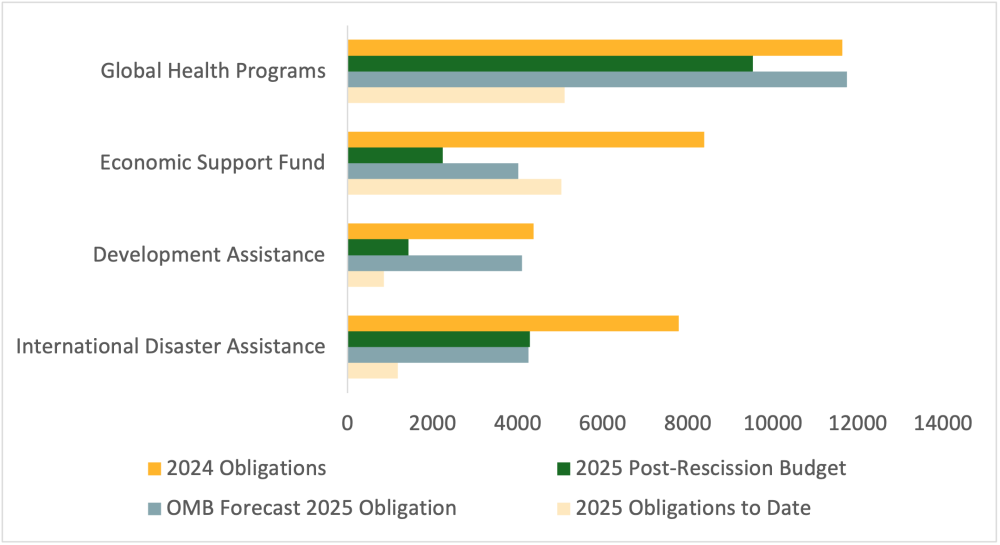
Looking at four major foreign assistance budget accounts covering global health, disaster assistance, development assistance, and economic support, only in the case of the Economic Support Fund are FY25 obligations clearly on track to meet the levels of spending suggested by the FY25 post-rescissions budget. Across the Global Health Programs, Development Assistance, and International Disaster Assistance accounts, FY24 obligations totaled around $24 billion, the remaining post-rescission FY25 funding for these accounts hovers around $15 billion, and the budget appendix released with the White House FY26 budget requestestimated $20 billion in FY25 obligations. Meanwhile, actual FY25 obligations to date are around $7.5 billion—one half of the FY25 budget, and a little more than one third of total forecast obligations.
Main foreign assistance accounts, budget and obligations FY24-25 ($m)
Sources: USAspending; OMB/White House; Congress.gov
It isn’t straightforward to calculate how much of the approximately $42 billion in budgetary resources under these four accounts, made up of unobligated balances from previous years and (post-rescission) FY2025 appropriations, needs to be spent by the end of the fiscal year or it will expire. In recent fiscal years, funds appropriated for State Department global health activities have a five-year availability for obligation; Economic Support Fund, Development Assistance, and USAID global health activities funds have a two-year availability; and International Disaster Assistance funds do not expire. At the same time, across these accounts, obligations usually follow appropriation with a significant lag, appropriations have been agreed late in the fiscal years under continuing resolutions, and funds “de-obligated” by the contract cancellation process will almost certainly be of FY24 or earlier vintage (some may be complex to re-obligate as a result).But in an ongoing legal case, the State Department has accepted that it is currently under a court order that all Congressionally “appropriated funds must be spent or lawfully rescinded by, for many of the funds at issue, September 30, 2025.”
The State Department has also argued “the historical experience of the agencies” suggests that were a decision that budgeted funding should be spent made on August 15th, there would still be time to obligate all funds appropriated, and that they have “have already undertaken preparations to be ready to obligate expiring foreign assistance funds on a short timeline as necessary.” The case is currently with the court of appeals, which is reviewing it on an expedited basis.
Whatever the funds involved in the potentially-court-ordered spending, the White House FY2026 budget suggests the administration expected to obligate about $15 billion more across these major foreign assistance accounts this fiscal year (FY2025). And under standard procedures, most new obligations require a fifteen-day Congressional notification period. That puts the date to complete the awards process back to mid-September, or about six weeks from now.
The crisis of delivery
The lack of new obligations reflects a growing challenge of delivery (even) for Congressional priorities, including global health. FY2025 outlays (actual payments to providers) under the Global Health Programs account are at about $6.5 billion to date, compared to a full-year total of $10.9 billion in FY2024. That so much less is being paid for delivery suggests a lot less is being delivered—far less than might be expected given the bipartisan commitment to lifesaving assistance. (For International Disaster Assistance the same numbers are $4.9 billion in FY25 to date compared to $6.4 billion in FY24, for Development Assistance $2.3 billion compared to $3.6 billion.)
There have been limited new obligations since the funding pause (a net total of $2.1 billion across Global Health, Disaster Assistance, Economic Support and Development Assistance in the third quarter of 2025, for example—although the picture for global health is notably more positive than the rest.) And there has been an almost-complete new award issuance freeze since January. The Global Health Programs account has seen new awards since the January 26th funding pause that have obligated a total of less than $5 million. New awards in the Development Assistance and International Disaster Assistance accounts have obligated a combined $2.8 million over the same period.
There remains extremely limited capacity in the State Department to obligate remaining foreign assistance funding. The 718 Department of State staff tasked to support programming formerly managed by USAID equal about six percent of USAID staffing, while they are managing programming still worth about 62 percent of the total from FY24, which is considerably behind in obligating funds because of the freeze. To add to the problem, about 500 out of the remaining 836 USAID awards transferred to State are set to expire by September 30th.
The obligation problem feeds an ever-greater issue of ensuring continuity of lifesaving support even within award activities that were not cut at the start of the year. There is not the space to finance more services under the dwindling number of existing awards because few have received new obligations and there are hardly any new awards to obligate funding to in order to finance services previously provided under expired contracts. This will help explain the ongoing evidence of lives lost due to the absence of US assistance despite the bipartisan conviction to preserve and continue that lifesaving assistance.
How to fix spending
One way to “fix” any FY25 spending problem would be a further rescissions package this year, focused on prior-year approriations. The Administration has also proposed a further $20 billion in rescissions as part of its FY26 budget proposal. But it is worth noting that the last rescissions package faced bipartisan opposition in Congress alongside the insertion of language specifically preserving a considerable part of global health activities. Furthermore, House appropriators (at least) appear keen to boost some funding from post-rescission FY25 levels in FY26. And, obviously, further rescissions would do nothing to deliver on the bipartisan commitment across arms of government to sustain lifesaving assistance. Given that, a more constructive step might be for Congress to extend the period of appropriated fund availability—preventing fund expiry.
To fix the fund utilization challenge, one comparatively bureaucracy-light approach would be to obligate more funding to existing awards, but the cancellation process has narrowed the scope for that approach. Total estimated costs of all active awards before the cancellation process was approximately $36 billion above already-obligated amounts on those awards, but total estimated costs on contracts reported as being transferred to the State Department and expiring after August 1st are closer to $9 billion above amounts obligated to those awards.
Still comparatively bureaucracy-light would be restarting cancelled contracts. Indeed, there are 462 contracts, grants, and cooperative agreements that were terminated between January 20 and February 13, 2025, that are currently under court order to be re-activated.
But while this might be one place to start, and as with obligating more to remaining awards, it would not prioritize according to large and lifesaving activities that should be the most immediate concern. A partial list of such large awards, with a total estimated cost that is $1.7 billion above obligated cost at the time of cancellation, includes projects delivering supplies and services for maternal and child health, nutrition, TB and HIV, and neglected tropical diseases.
In that regard, it is good news that the administration has made assurances to Congress to release a modest amount of funding for the World Food Programme and the International Organization for Migration in Haiti and Nigeria. Other WFP and IOM awards that could be reactivated and extended include IOM’s lifesaving support for displaced and vulnerable populations in DRC, Yemen, and Somalia (also this), and World Food Programme projects supporting humanitarian assistance in DRC and Yemen.
With new awards, working through trusted international organizations including the World Food Programme and the International Organization for Migration would again allow for large-scale and comparatively easily agreed obligations that (hopefully) could fairly rapidly translate into the revival and extension of humanitarian support in particular. The State Department might also set up Development Objective Agreements with countries or multilateral banks like the (cancelled) agreement with the African Development Bank. Development Objective Agreements count as obligations but do not demand individual contracts or awards to be signed.
But this does not tackle the need to restart local service delivery in areas including support for HIV care in countries such as Uganda and Kenya. This frequently involved many comparatively small contracts, sometimes with local suppliers. Perhaps the best way to rapidly recreate those networks would be to provide one large master contract or award to a large local USAID contractor on the assumption that it would rapidly issue sub-awards to local suppliers. A lot of delivery capacity has already been lost, but hopefully enough remains to ensure lifesaving support can restart in time to avoid (even more) widespread mortality.
Such actions will not reverse the deaths and disruption that have and will happen thanks to the funding pause, the inoperative waiver system for lifesaving support and the (at least temporary) breakdown of payments and delivery systems, nor the deaths linked to lifesaving awards that were terminated in health or humanitarian activities in March even if some of terminations are now reversed. And because some lifesaving awards will not be restarted or replaced, deaths will continue. Furthermore, the likely solutions to the funding and delivery challenge will rout the bipartisan foreign assistance localization agenda and may well damage oversight and reporting. The broader exercise has denuded American influence and respect in international organizations, and left the government with a limited capacity to respond to global health and humanitarian emergencies effectively and at speed.
But it is still a considerably better outcome than looked all too likely in March—if it is delivered. During the next two months, Congress should be keeping constant watch to ensure it happens.
Topics
DISCLAIMER & PERMISSIONS
CGD's publications reflect the views of the authors, drawing on prior research and experience in their areas of expertise. CGD is a nonpartisan, independent organization and does not take institutional positions. You may use and disseminate CGD's publications under these conditions.