

Several major donors have recently cut their aid budgets and refocused attention on how development spending benefits their own populations and economies. There are some development priorities—providing humanitarian aid, reducing hunger, improving water and sanitation—in which this approach could compromise aid effectiveness. In others—namely, expanding legal managed mobility—development and domestic economic interests can align.
Today, CGD and our partners, IREX, are releasing three papers that explore the intersection between legal managed mobility and technical and vocational education and training (TVET). Our proposal is simple. If donors supported some trainees to move to higher-income countries, it would improve TVET outcomes and quality; support employers at home and abroad; and reduce poverty by allowing trainees to access higher incomes and opportunities.
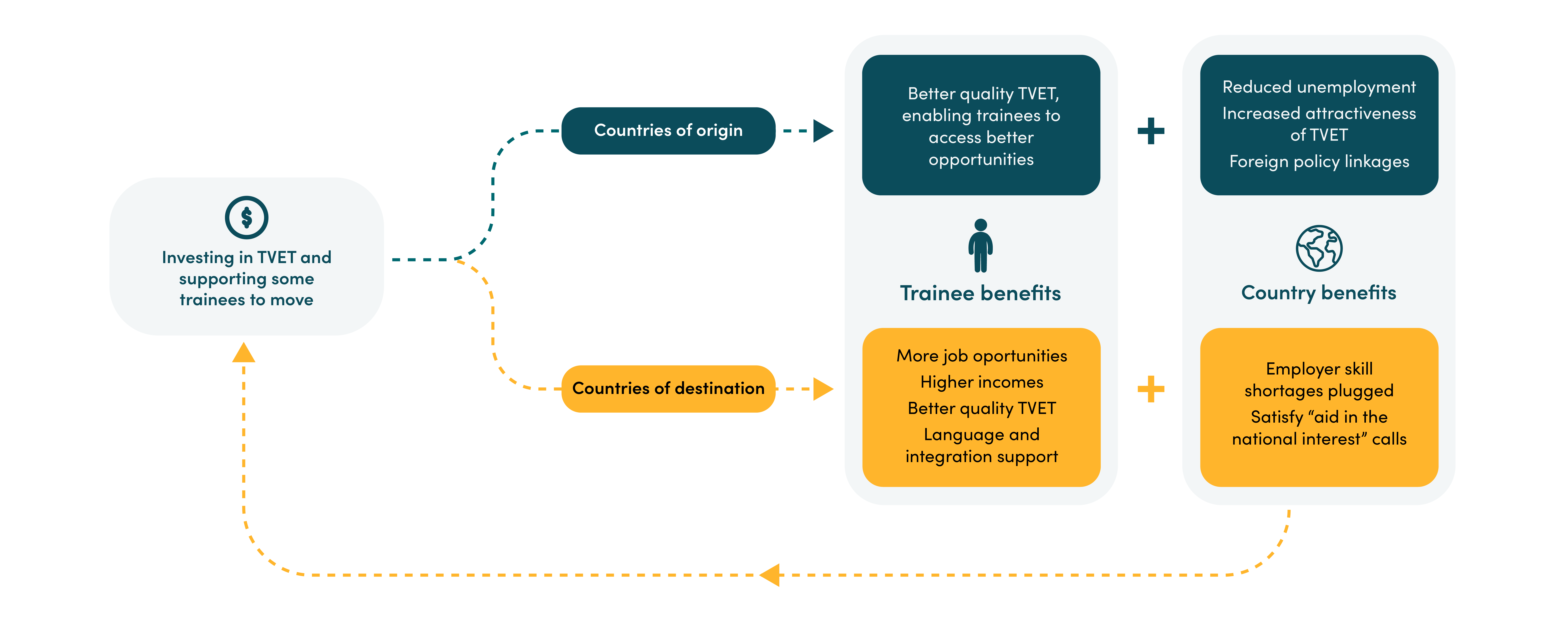
It is one of the best examples we have of a triple win policy; the manifestation of “aid in the national interest.”
Figure 1. The benefits of linking labor migration and TVET
TVET investment and underperformance
The first paper in our series explores the scope of donor investment in TVET. Between 2013 and 2022, the top five donors (Germany, the United States, Canada, Australia, and the World Bank) disbursed US$5.7 billion to support TVET activities. What was surprising was the relative importance attached to TVET; Canada devotes 32 percent of its total education disbursements, and Germany just over 31 percent. Yet as a share of overall aid, TVET remains small, under 2 percent for all donors. This is in line with domestic priorities; on average, low- and middle-income countries only spend 0.2 percent of their gross domestic product on TVET.
Figure 2. TVET spend by the top five donors, 2013-2022
Source: OECD Creditor Reporting System, analyzed in Iqbal and Dempster (2026).
The lack of investment may partly stem from the fact that TVET has largely fallen short of expectations. TVET is often touted as an important tool in low- and middle-income countries experiencing high unemployment, low job creation, and large skill gaps. Yet meta-analyses have found that less than a third of TVET interventions have positive, significant impacts on employment rates and earnings, their key outcome measures. Some interventions yield no returns at all. Given high program costs, this means that many TVET programs may fail the most basic cost-benefit tests.
Three reasons are often given for this lack of impact: (1) challenged learners, in that trainees do not have the foundational skills to make the most of TVET and have little understanding of how to leverage that training in the labor market; (2) unsupported teachers, who have little work experience or formal training, and are largely underpaid and underresourced; and (3) weak incentives for providers and job placement. But there is a more fundamental issue at play. TVET can help address supply-side issues (such as skill shortages and skill mismatches) but it can’t address demand-side issues (such as a lack of jobs).
Linking TVET with labor mobility
The second paper, therefore, argues that donors should link their TVET investments with labor mobility opportunities, supporting some trainees to move to higher-income countries. Doing so could: (1) increase the quality of TVET programs; (2) increase placement rates and income gains; (3) increase investment in TVET; (4) improve TVET revenues; and (5) increase the attractiveness of TVET, especially for disadvantaged groups.
In this current climate, it is even more important than ever that TVET investments are effective and cost-effective. Linking TVET investments with labor mobility opportunities could help improve its impact, and thereby justify continued donor spending.
The paper then outlines two broad ways in which donors could do this. Firstly, align training content and quality with employer needs, including improving the overall quality of a TVET program or provider; providing “top-up” training; and developing a full “away track”. Secondly, recognize certifications or qualifications, including implementing Mutual Recognition Agreements; supporting the individual certification of skills in the country of destination; pursuing accreditation in the country of destination; forming partnerships with country of destination employers operating in the country of origin; and delivering international industry certifications.
The success of these approaches largely depends on the quality of the TVET provider and their graduates. The third paper, therefore, identifies nine high-performing, investment-ready, TVET providers in five African countries—Cote d’Ivoire, Ghana, Kenya, Morocco, and Senegal—which are supporting green skills development. These are all either public-private partnerships, or part of the African Network of Centers of Excellence in Electricity (ANCEE).
Figure 3. Map of identified green skilled TVET providers
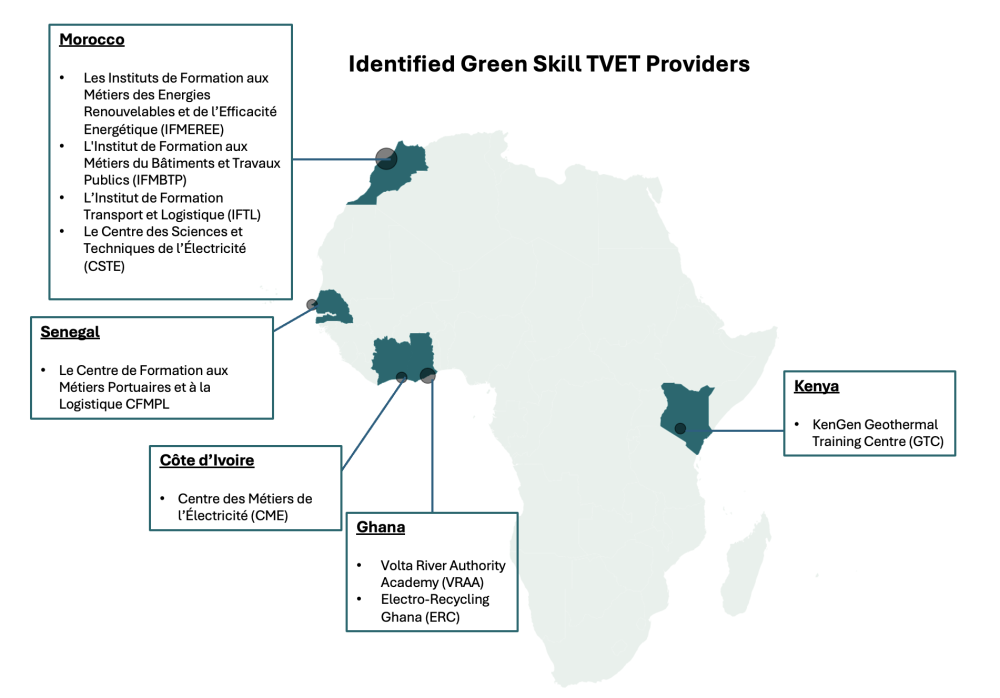
These providers are currently delivering green skills training that is responsive to the needs of local industry; have capacity to engage, or experience engaging with, international networks; and are at (or near) global standards of quality expected in high-income countries. They have active, viable, plans for how they could expand their work and / or represent models that could be readily replicated. With donor support—and concurrent mobility-related investments (such as language training, cultural integration support, and visa facilitation)—these nine providers could scale green skills development to support employers at home and abroad.
In many ways, this approach is the reverse of the current model: instead of providing training as part of mobility-focused projects (e.g., Skills Mobility Partnerships), provide mobility opportunities as part of training-focused projects. It enables donors to distribute aid in a way which supports the economic development of the trainees themselves and their families; employers globally; and TVET providers in countries of origin—a true triple win. To do this, we will need to move away from the “development-in-place” paradigm, recognizing that labor mobility is one of the best economic development tools we have, including to improve the impact of TVET investments.
Topics
DISCLAIMER & PERMISSIONS
CGD's publications reflect the views of the authors, drawing on prior research and experience in their areas of expertise. CGD is a nonpartisan, independent organization and does not take institutional positions. You may use and disseminate CGD's publications under these conditions.
Thumbnail image by: ultramansk/Adobe Stock