Recommended
Blog Post
We Can Spend $50 Billion a Year Effectively
More from the series
Blog Post
AI Philanthropy Is a Chance to Entirely Reimagine Service Delivery
ESSAY
AI, Gender Equality, and Self-Healing
The AI boom could see anywhere from $37 billion to $100 billion in annual philanthropic spending over the next few years. The question is, how can this money be spent effectively? A new blog series from CGD makes the case for highly cost-effective areas that philanthropists may want to consider funding. This fourth blog in the series makes the case for funding country health partnerships, rather than interventions.
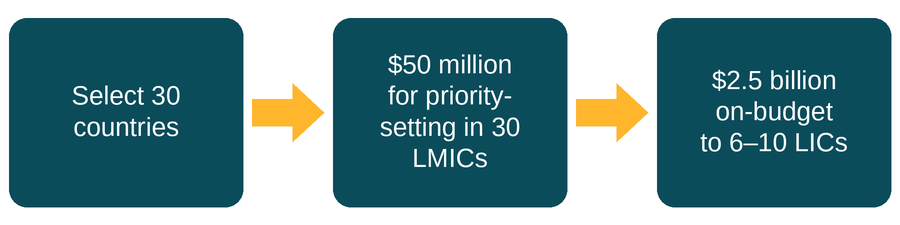
CGD's new series on AI philanthropy focuses on what interventions should be funded. The series has therefore inherited the default frame of the current global health architecture. In this blog, I propose an alternative: that the highest value use of new philanthropic money is country health partnerships, rather than an intervention. Philanthropists should launch a $2.55 billion-a-year programme, which would entail (1) identifying a set of committed governments using transparent and published criteria, (2) launching a $50 million-a-year initiative to support selected governments to build strong institutions to set health priorities to ensure best use of domestic resources, and (3) expand what the lowest-income countries can do with $2.5 billion a year of on-budget finance. This approach plays to philanthropy’s comparative advantage in “picking winners” and produces excellent long-term results. Current disease or intervention specific initiatives buy interventions that stop when the money stops, whereas partnerships build institutions that keep paying out after the funders move on.
Why not simply fund more/bigger vertical initiatives?
The “vertical” model, where donors earmark funding for specific interventions or diseases, is already on notice from its own shareholders. The Lusaka Agenda, agreed by countries and the global health initiatives themselves, and endorsed by the African Union, calls for a shift towards country-led priorities, domestic financing, and integrated services. The World Health Organization-led process on reforming the global health architecture points the same way. New philanthropy should not rebuild what the intended beneficiaries are asking to reform.
There are three further effective altruist reasons to go for country partnerships rather than backing vertical initiatives:
- Verticals limit allocative efficiency. Earmarks route money by disease or intervention, not by pure health per dollar. In essence, they are constraints on optimisation. For example, if gene drives end up more cost-effective than vaccines against malaria, but all your money is earmarked only for vaccines, you have missed a huge opportunity. This inefficiency can also be shown with a thought experiment from an earlier blog. Using DCP3 data, we estimated that a hypothetical low-income country (LIC) primary care clinic delivering the four best interventions regardless of disease averts 117 disability-adjusted life years (DALYs) per $1,000—over double the 52 DALYs for a clinic delivering the four best HIV interventions.
- Verticals prevent economies of scope. Noncommunicable disease are rising across low- and middle-income countries. For example, 20 percent of HIV patients in sub-Saharan Africa also have hypertension. Akhil Bansal’s blog is right to focus on women and newborns, but obstetric and neonatal care is a continuous pathway of care. If the pathway breaks down at any point, the mother’s and baby’s lives are at risk. This includes antenatal care, prevention, diagnostics, referral systems, safe blood supply, treatment, and essential emergency and critical care. Avoiding maternal deaths cannot be achieved with a vertical initiative—it requires a functioning basic platform of care. Investments in any component rely on investments in other components to deliver. For today's complex disease burden, the best returns come from a simple platform that can deliver a basic package of services.
- Verticals don’t secure long-term impact. Earmarked, off-budget finance can fragment systems, displace domestic resources, sidestep public financial management, and undermine the compact between governments and citizens. This prevents the building of health systems over time that can save lives for decades into the future. Verticals also struggle to leave: even while facing sharp budget cuts, the Global Fund does not expect to exit upper-middle-income South Africa until well into the 2030s. When highly earmarked funding withdraws, services risk collapse, as the USAID shutdown showed. When a system investment matures, it no longer needs the donor.
Step 1. Pick partners, not projects
The alternative model is to start with country selection, not intervention selection. I propose focusing on four criteria: poverty and health need; availability of alternative funding; cost-effectiveness, for example, recent research by Jessica Ochalek finds the same dollar can buy up to 200 times more health depending on which country it lands in; and government political will to build the health system.
Effective philanthropy has already proven this model with organisations: identify the strongest performers, back them with unrestricted multi-year money, and give them space to allocate it. Coefficient Giving and many other foundations now work this way, and the returns have justified the trust. A partnership with a committed government is the same bet at national scale: the criteria are the due diligence, and ongoing support follows performance. And it is a bet only philanthropy can make. Multilateral institutions such as Gavi, the Global Fund, and IDA, including the IDA Health Window I have recently proposed, must share resources across all poor countries through an allocation formula. Only philanthropy can concentrate money on the country partnerships that look set to build health systems that really save lives at scale, and double down when they perform.
Two instruments then apply, matched to each partner’s binding constraint:
Step 2. For every country partner: Priority-setting support
For many partners, especially middle-income countries (MICs), the constraint is better allocation, not more aid money. Aid money in MICs rapidly dwindles to being a tiny fraction of domestic expenditure. But the potential for better allocation is vast.
A back-of-the-envelope calculation: a $50 million a year global programme of support on priority setting, modelled on the international Decision Support Initiative (iDSI), could aim to support about 30 partner countries to build national priority-setting institutions. Assuming half fail, but each of the 15 countries that succeeds then spends $2 million a year on running costs (with philanthropic support), and matches India's health technology assessment (HTA) agency, which generated a realised return on investment of 9:1, rising to a potential 71:1 with full implementation, that implies around $270 million to $2.1 billion a year in net monetary benefit. A roughly five-fold to forty-three-fold return on the original $50 million investment. Accounting for the long-term benefits of the institutions would raise it further.
Priority-setting technical assistance is therefore cost-effective, but also scores unusually well on other effective altruism criteria such as tractability and neglectedness. We documented this in a special issue on building priority-setting institutions in health, with eight countries, from India to Rwanda, building stronger, domestically financed priority-setting processes through the iDSI network. It is also now neglected: the UK was expected to take over funding after Gates Foundation funding ended but then its own aid cuts began to bite. This leaves substantial capacity in the technical assistance community, and in partners such as Africa CDC’s Health Economics Programme, ready to deliver a major scale-up.
AI could also improve these returns further. The binding constraint is analyst scarcity (India managed 30 assessments in four years, for 1.4 billion people), and AI-assisted HTA could raise assessment volume substantially at constant cost.
Step 3. For low-income country partners: Add on on-budget finance
A subset of partners will be LICs that are fundamentally constrained by resources, and if they successfully develop priority-setting institutions, they should receive money at scale. As Ochalek showed, their budgets are where the marginal dollar works hardest, and there is no doubt about the depth of the need: LIC governments spend just $17 per person per year on health, roughly $12 billion in total and far below DCP3’s estimate of $79 per capita for an essential universal health coverage package.
A back-of-the-envelope-calculation: The median low-income country in Ochalek's estimates produces health at around $200 per DALY averted at current spending (range $78 to $695). Therefore, $2.5 billion a year to six to ten such partners could avert roughly 12.5 million DALYs annually, allowing for some diminishing returns as spending scales. Support should be capped at a 50 percent uplift on each partner’s own government health spending, so philanthropic money grows only as domestic effort grows. $200 per DALY averted is of course less than you can get by scaling up bednet provision, but this route avoids the harms of the vertical approach mentioned above; it secures the long-term benefits of stronger integrated health systems that will produce health benefits even when the funding dries up, and it can absorb a very large amount of money to good effect.
This actually isn’t that new. Many philanthropies have done this with other donors via World Bank trust funds, and there have even been examples of directly funding on budget, such as recently in Kenya. The two instruments also multiply each other. Budget support raises the volume of spending; priority-setting raises its productivity.
Figure 1. Three steps to funding country health partnerships
Conclusion
New AI philanthropy should use its unique flexibility and scale to develop a country partnership-based approach to global health funding. It should identify countries committed to reform and building their health system and then: invest $50 million a year for a global priority-setting support facility serving up to 30 country partners and $2.5 billion a year for on-budget support to the poorest and most committed six to ten country partners. A twentieth of the potential $50 billion envelope, and the slice that keeps paying out after the givers move on.
Disclosures: I have managed iDSI for many years so this blog argues for funding approaches that I work on. The Ochalek estimates are a CGD-funded preprint, not yet peer-reviewed.
Topics
DISCLAIMER & PERMISSIONS
CGD's publications reflect the views of the authors, drawing on prior research and experience in their areas of expertise. CGD is a nonpartisan, independent organization and does not take institutional positions. You may use and disseminate CGD's publications under these conditions.