Recommended
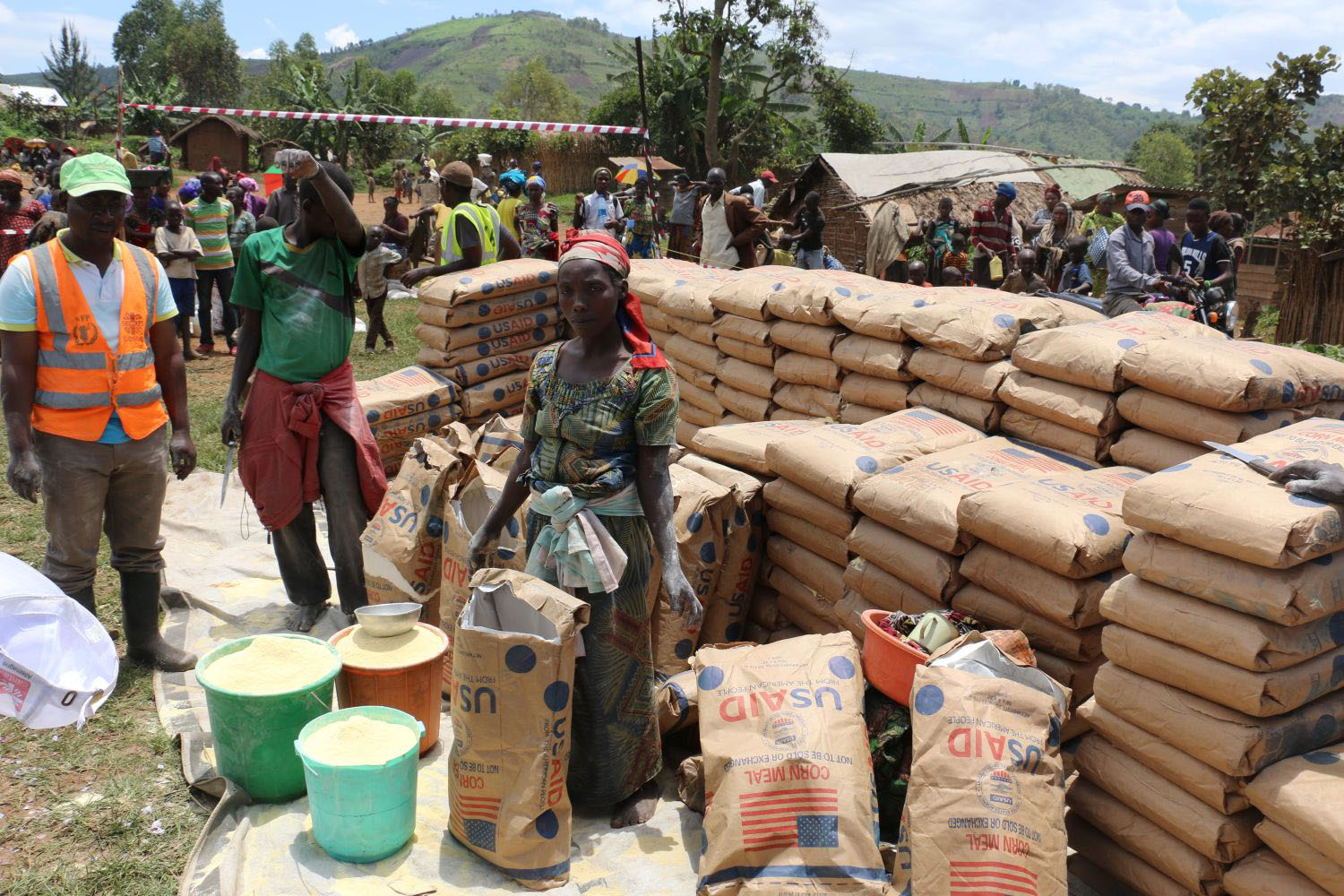
Official word came Friday that the administration would pursue a pocket rescission of $4.9 billion in international assistance funding. The move sets the stage for a larger fight over Congress’s constitutional power of the purse. Here’s a quick rundown on why and what the rescissions mean for US development policy.
What’s a pocket rescission?
Under the process outlined in the Budget and Impoundment Control Act, to legally cancel previously appropriated funds, the White House submits a proposal to Capitol Hill, starting a 45-day clock. During the 45-day window, Congress must act affirmatively, passing legislation to codify the rescissions—though such measures receive expedited consideration and require only simple majority votes in both chambers. If Congress fails to act within 45 days, the administration is required to spend the appropriated funds as originally intended. The administration’s current approach is considered a “pocket rescission” because the funding it’s asking Congress to cancel is set to expire at the end of September—within the 45-day window. By freezing that funding now, the administration all but ensures the money won’t be spent regardless of whether Congress acts, since the funds will expire before the review period ends. The Government Accountability Office has declared pocket rescissions illegal, but the director of the Office of Management and Budget has made no secret of his desire to challenge impoundment restrictions. And recent revisions to OMB guidance appear to assert expansive executive authority to reclaim previously appropriated funding.
The administration’s action appears highly likely to trigger litigation—and is sure to complicate the FY26 appropriations process in the meantime.
What does this mean for foreign aid?
It’s worth putting these additional cuts into context. Since January, the administration has taken a host of actions to constrain the US role in advancing global development, from dismantling USAID and other small agencies to terminating thousands of awards supporting development and humanitarian programming. But because of Congress’s constitutionally strong hand in the budget and appropriations process, permanently cancelling funding is a taller order. Still, the administration has sought to curb spending in several ways.
The administration’s FY26 budget request revealed plans to scale back foreign assistance dramatically. But even predating the release of the president’s budget, the administration opted to designate emergency funding in the FY2025 appropriations measure only selectively—drawing bipartisan criticism from top Senate appropriators—effectively signaling it would not spend $2.5 billion appropriated by Congress for international assistance. Next, of course, came the high-profile rescissions package submitted in late May, which included more than $8 billion in foreign aid cuts. Congress narrowly approved the bulk of the proposed rescissions, and it was signed into law in late July. The dynamics over multiple fiscal years are important because a lot of foreign aid funding takes a while to get out the door, owing to a raft of requirements from congressional sign-off and agency procurement rules. So very often, federal departments and agencies are in the position of spending down funding from the prior fiscal year.
The proposed rescissions unveiled late last week target largely older funding from a limited set of accounts, with Development Assistance—the bilateral economic assistance funding previously managed by USAID—comprising the largest share.
While we focus here on Development Assistance, other accounts would also see significant haircuts, including another $1.5 billion appropriated in FY25 funding for Contributions to International Organizations, which supports US commitments to several UN agencies, and much of the recent funding appropriated for democracy promotion activities, and hundreds of millions of dollars across accounts to fund assessed and voluntary contributions to international peacekeeping activities.
What is Development Assistance, and what happens next?
Historically, Development Assistance (DA) represented one of USAID’s most flexible accounts, thanks to its broad mandate—though it has regularly been subject to a host of congressional spending directives. Among the development priorities consistently funded through DA have been investments in education, agricultural development, and energy access. And while administration officials have called attention to specific projects they considered wasteful or fundamentally unaligned with administration goals, those awards have already been cancelled—along with life-saving programming.
Congressional spending bills dictate the terms of the availability of provided funding. DA funding is most often provided for a two-year window, but for various reasons, funds can remain in play for longer.
As our colleague Charles Kenny pointed out in a post published last Thursday, there had been many lingering questions about whether the Department of State has the interest or capacity to continue foreign aid delivery at the scale suggested by available funding. To better understand the implications for DA funding as a whole, we’ve done our best to piece things together based on data published by OMB (which was last updated in July) and both rescission proposals.
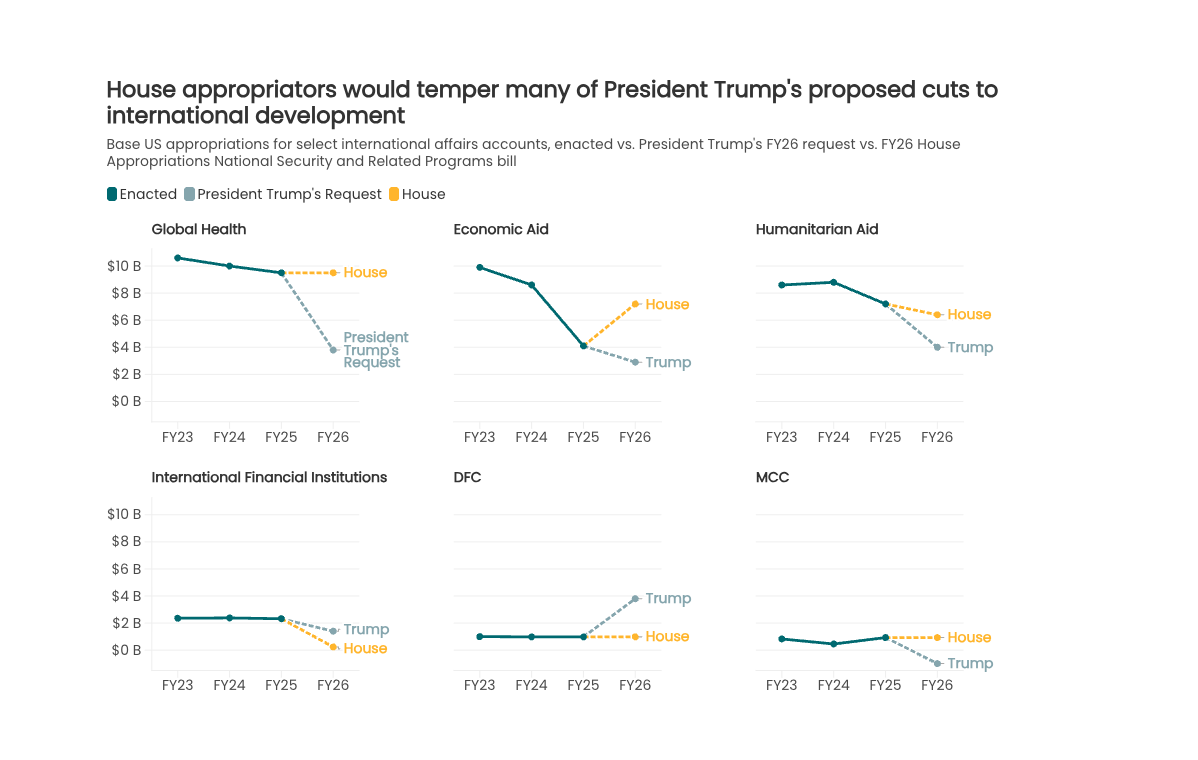
In short, the administration envisions dramatically less development spending in the near future. A looming question is whether the White House will see a challenge to that vision from Capitol Hill. House appropriators recently advanced a development and diplomacy spending bill that sought cuts that, while quite deep, were not nearly as aggressive as the administration proposed. Likewise, lawmakers don’t seem ready to throw in the towel when it comes to development programming as a whole—specifying a desire to see continued investment in agriculture, education, and even women’s economic empowerment abroad. Meanwhile, the Senate Appropriations Committee has signaled plans to move ahead with its own bill markup in the coming weeks.
While the fate of ongoing spending debates remains uncertain, the administration’s continued willingness to circumvent the standard appropriations processes signals the potential for a broader shift in how development policy is executed, regardless of Congress’s intent.
Topics
DISCLAIMER & PERMISSIONS
CGD's publications reflect the views of the authors, drawing on prior research and experience in their areas of expertise. CGD is a nonpartisan, independent organization and does not take institutional positions. You may use and disseminate CGD's publications under these conditions.
Thumbnail image by: Kiyori Ueno, UN World Food Program