Recommended
Blog Post
Is Research on Development Economics Serving Sub-Saharan Africa?

Blog Post
The Future of Research Partnerships
Blog Post
Communicating Migration Research
For over 100 years, think tanks have been instrumental in shaping policy around the world, developing ideas and synthesizing complex information for policymakers, political leaders, and journalists. However, think tanks are now facing a “triple threat”—from a shifting funding landscape; artificial intelligence; and rising polarization—all of which intersect and reinforce each other.
This was our main takeaway from the recent On Think Tanks School, held in Barcelona last month. Given this, you may think it was a gloomy affair. On the contrary. The attendees—representing think tanks of every shape, size, continent, and focus—were passionate advocates for the role of their organizations in shaping society and improving lives.
But they were all acutely aware of this “triple threat” and many of the sessions were focused on what to do about it. This blog outlines some of our takeaways (largely from a development-focused, Global North-based, think tank perspective) identifying ways in which we need to adapt to remain relevant at a time when the public needs us most.
A shifting funding landscape
The “threat”...
Think tanks are facing new funding challenges which threaten their ability to deliver high-quality, essential, research. Many Global North-based think tanks have long relied on substantial unrestricted funding for their core activities, enabling them to develop blue-sky ideas free from logframes and donor reporting (Figure 1). Yet many philanthropic institutions are pivoting to providing smaller, project-based grants, often to organizations based in the Global South. At the same time, traditional donors are reducing their foreign aid budgets and requiring it to deliver local benefits, massively impacting the Global South-based think tanks that rely on such funding.
Figure 1. Main funding type by national income level
This shift poses several questions for development-focused Global North-based think tanks in particular. Should we primarily be an intermediary (identifying and sub-granting to Global South-based think tanks and NGOs)? If so, what tools do we need to be able to do this effectively? How does that affect our ability to construct a long-term organisational strategy? Or should we be consciously doing ourselves out of a job: encouraging our traditional funders to contract Global South-based organisations directly?
… some solutions
If we plan to survive, we need to try and find a balance between project-based work (which ideally aims to influence policies in the short-term) and blue-sky thinking (which proposes the big ideas that could change things in the long-term). To do this, all think tanks need to experiment with approaches to increase core funding—such as membership fees, donations, and selling training courses. As our hosts Fundació Bofill noted, we also need to become more strategic in our research and policy engagement approach (more on this below), demonstrating a track record of impact, to encourage both philanthropic institutions and traditional donors to trust think tanks with core funding.
And while fundraising remains the most-cited capacity gap across think tanks, the objective is not simply to get more funding, but to create a balanced portfolio that provides greater flexibility to pursue long-term policy goals; respond in real time to emerging global challenges; and strengthen both strategic and financial resilience. If that isn’t possible, we need to develop umbrella strategic goals which encompass our existing projects, taking on new projects only if they serve our strategic interests.
If development-focused, Global North-based, think tanks want to play an intermediary role, we need to learn lessons from previous approaches: for example, finding the balance between being too prescriptive and not offering enough clarity on expected outcomes. A community of practice would help here, developing funding guidelines and a center for excellence for continued research and shared learning on best practices.
Artificial intelligence
The “threat”...
Think tanks have always faced competition: from large I/NGOs with research functions; academic institutions with incentives to influence policy; and management consultancies with slick presentations. Yet these competitor organizations all had to be big, well-funded, and have access to qualified staff to be able to expand the field of knowledge production. Both think tanks and their competitors were therefore relied on by policymakers, political leaders, journalists, and the public because they had access to resources that others did not (Figure 2).
But the proliferation of artificial intelligence (AI) has disrupted this balance, rapidly becoming ubiquitous. Large language models can already make a passable attempt at a blog, a literature review, even a policy brief; and their output is improving every day. Some have even argued that ChatGPT could become some kind of think tank on its own. What does valuable work look like when AI capability is distributed to everyone, including our audiences, competitors, and bad actors? And where should we focus our time in a world where AI can do so many of our core tasks?
Figure 2. Think tanks in the social space
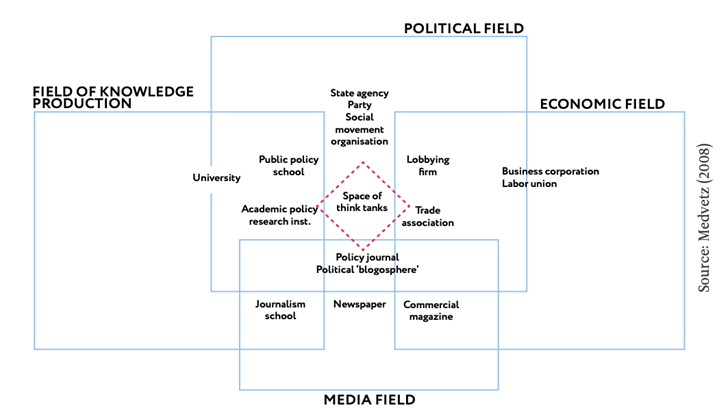
Source: Medvetz (2012)
… some solutions
In an era of AI-generated content, the comparative advantage of think tanks lies not in producing more content but in producing trusted, contextually grounded, and policy-relevant knowledge. But one of our trainers, Nick Scott, made an excellent point: so far, think tanks have been using AI to make micro improvements in existing processes (“draft this LinkedIn post for me”) rather than outsourcing whole tasks. For example, AI could be used to create 50 versions of your policy brief, tailored for 50 different audiences.
To do this well and safely, think tanks need to develop AI use policies—akin to an “AI Constitution”—setting out which tools should be used and how; invest in their own tools and processes to make research more AI-friendly; and set aside budget to ensure staff are thoroughly and consistently trained and supported in using AI tools.
At the same time, as our trainer David Watson noted, think tanks should lean into what AI can’t do: developing real-time political judgement about what’s feasible; curating and convening, building trust with key stakeholders; producing original data and field research; and deciding what actually deserves attention. These tasks (for now) remain human, and become more important as analysis and text production become cheaper.
Rising polarization
The “threat”...
Severe polarization—defined by Varieties of Democracy (V-Dem) as the inability of opposing sides to agree on basic facts—is increasing in 25 percent of all countries worldwide. This has led to the emergence of “post-truth politics”, de-valuing both experts and their evidence. Large sections of the public feel facts and evidence should be less relevant than common sense in policymaking. Many policymakers therefore have no interest in evidence; feel they do not need an evidence-based justification for their actions; or do not feel the “Overton Window” allows them to act on the evidence.
We put this “threat” last, but it is arguably the most important. What good is producing facts and evidence if policymakers don’t want to listen, or can’t act on the findings? Are rigor, credibility, and maintaining a neutral stance important, if think tanks are being incentivized to skew findings to suit a political narrative? Should think tanks focus on influencing the public directly, helping shift the “Overton Window”?
… some solutions
Think tanks need to become much more strategic in their research and policy engagement. As one of our trainers, Krizna Gómez, put it: what do we want the world to look like in ten years? How do we get there? Instead of trying to solve all the world’s problems, think tanks should propose solutions for a small number of specific policy areas. Do less—but better—being bold and propositional. Go beyond producing research to “connect sectors, shape discourse, and anticipate change.”
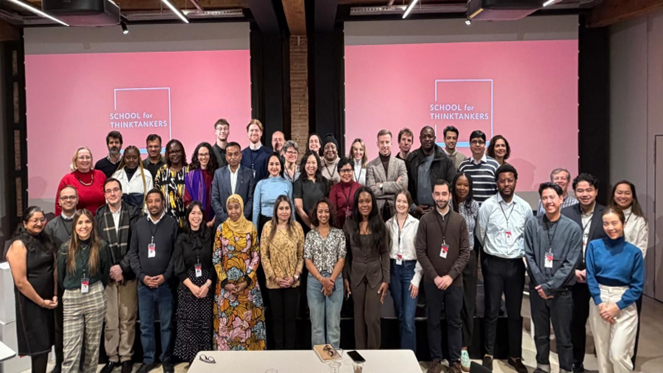
Participants at the On Think Tanks School in Barcelona, 2026
It will also require being clear-eyed about where our interests align with others’ and where they don’t, understanding and clarifying our comparative advantages. What do the other I/NGOs, academic institutions, and think tanks in your space do better than you? What can you not do? Where are the gaps? And can you work more closely with advocacy and civil society organizations, providing them with rigorous insights that they can translate into campaign slogans? This will enable think tanks to directly influence the public and shift the “Overton Window”, without impeding focus on developing evidence-based credibility.
To do all of this effectively, we need to hire people with a strategic, policy impact-focused, mindset—storytellers, networkers, political fixers and engineers—rather than relying purely on academic expertise. They should be supported by a culture that rewards strategic thinking, collaboration, and policy engagement; develops leadership and management capacity; and creates space for adaptation and learning. These are the people who will be able to reinvent think tanks in this increasingly fractious and saturated landscape, cutting through the noise and speaking truth to power.
Many thanks to Vegard Beyer, Janet Hodur, and Kendra White for their thoughtful contributions to this blog.
Topics
DISCLAIMER & PERMISSIONS
CGD's publications reflect the views of the authors, drawing on prior research and experience in their areas of expertise. CGD is a nonpartisan, independent organization and does not take institutional positions. You may use and disseminate CGD's publications under these conditions.
Thumbnail image by: Authors