Recommended

POLICY PAPER
How the Global Fund Can Adapt to a Shrinking Aid Landscape

Blog Post
2024–2025 Replenishment Traffic Jam Redux
Blog Post
Gavi and the Global Fund Replenishments
The Global Fund is heading into its replenishment with a lofty fundraising goal: $18 billion for the next three years (2026–2028). But in today’s world of shrinking aid budgets, that target might already be out of reach. Recent pledges from major donors indicate reduced (UK and Germany) or flat (Gates Foundation) commitments compared to the previous replenishment. The warning signs are already visible: facing delayed donor disbursements for its current cycle, the Global Fund has already reduced approved grant allocations by nearly $1.5 billion.
Since its founding in 2002, the Global Fund has mobilized roughly $80 billion in donor funding. But that success largely hinged on a small group of traditional donors that are now retreating from the development arena. The Global Fund faces an existential challenge: how can it continue to fulfill its mandate in an era of scarcity?
In a new CGD policy paper with our colleague Rowan Rockafellow, we propose an alternative funding path for the Global Fund—and for global health financing more broadly. Drawing inspiration from elements of the World Bank’s model, our approach combines grants for the poorest, highest disease-burden countries with loans on varying levels of concessional terms for middle-income countries.
The headline finding from our projections suggests that a combined grant and loan model at the Global Fund could generate up to $1 billion each year in new financing by 2033—without reducing grants to the poorest countries.
You can read our full paper for a deeper look at the findings, caveats, and unresolved policy considerations. But if you’re short on time, here are the main takeaways.
How the Global Fund can rethink its financial model
We project a forward-looking scenario in which donors continue to contribute to the Global Fund, albeit at a reduced level (we certainly hope to be disproved in our bleak donor funding projections!). Under this approach, the Global Fund would continue to provide 100 percent grants to countries with the lowest incomes and highest disease burdens. But for countries with comparatively greater capacity to self-finance, it would introduce loans on varying concessional terms—low-interest, longer-maturity instruments with longer repayment schedules. These loans would generate reflows—repayments that flow back to the Global Fund and can be used for future disbursements.
Using the Global Fund’s annual disbursement data, we construct a hypothetical cash flow model anchored in World Bank lending terms. We project that if the Global Fund introduced this approach starting in 2026, reflows could reach up to $1 billion annually by 2033, equivalent to around 20 percent of the Fund’s current yearly disbursements, while maintaining full grant support for the poorest countries.
FIGURE 1. Scenario 3 reflow-augmented replenishment volumes, 2001–2060 (USD millions)
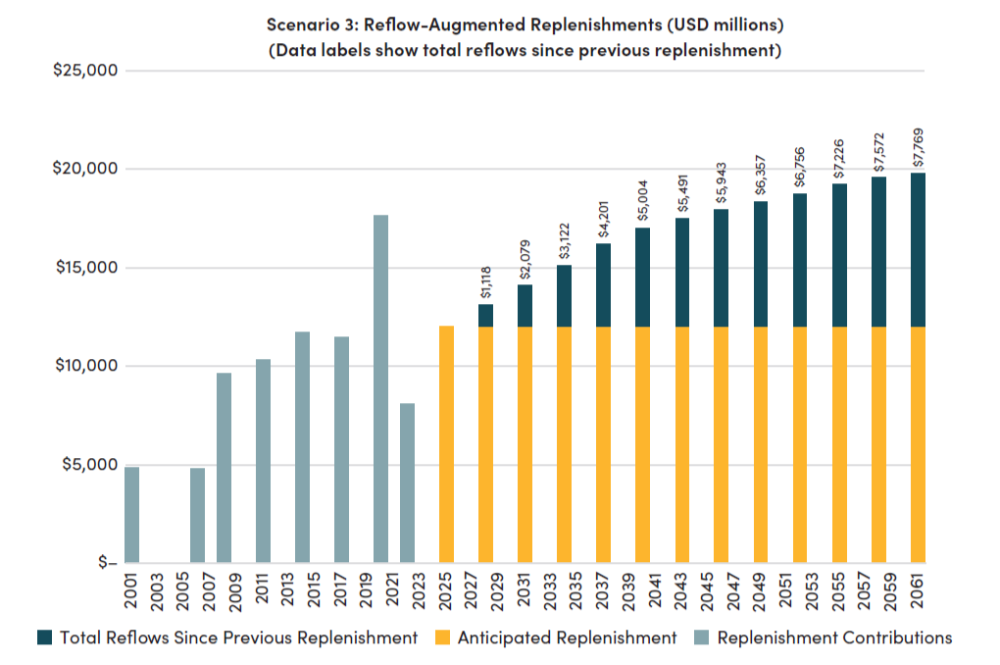
FIGURE 2. Scenario 3 reflows by World Bank lending group, 2026–2060 (USD millions)
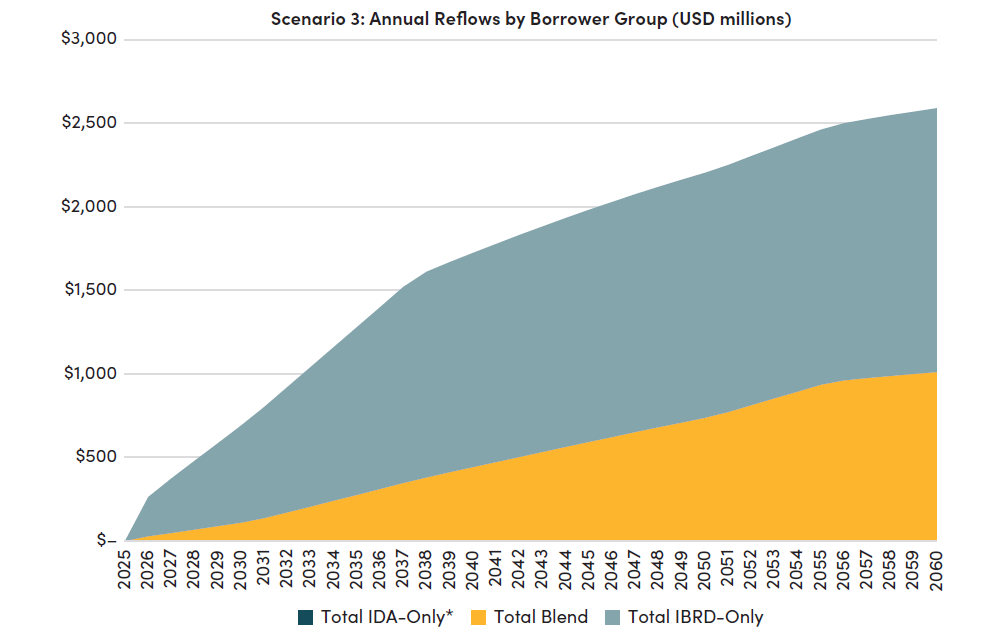
Note: *There are no loan reflows for “Total IDA-Only” in Scenario 3, as this scenario provides IDA-Only countries with 100 percent grants and no loans. Source: Author calculations based on Grant Disbursements – Reference Rate, The Global Fund, https://data-service. theglobalfund.org/downloads (see World Bank Lending Groups in Annex).
This approach is not without trade-offs, but it also offers sizeable benefits that address longstanding critiques of global health financing:
- It builds financial resilience by creating a recurring revenue stream that reduces dependence on traditional donors.
- It provides a tangible pathway for middle-income countries to graduate from grant-intensive support.
- It brings more health spending on-budget, integrating external financing into national systems and strengthening public financial management.
- It represents a more efficient use of scarce aid, stretching donors’ grant contributions further.
Navigating trade-offs and policy implications
This isn’t just a minor adjustment—it marks a significant shift for the Global Fund and for global health financing more broadly. Introducing loans raises important trade-offs and unresolved policy questions.
For example, lending would fundamentally reshape the Global Fund’s relationship with middle-income countries. Would middle-income countries, many of which have high disease burdens and fiscal constraints, borrow for health? Is there an optimal subsidy level? Additionally, there are risks that some governments may be unable or disincentivized to provide health services for vulnerable communities, potentially requiring mitigation measures and protective mechanisms to ensure service continuity. This would also be a departure from the Global Fund’s current operating model, raising policy implications for its future role, mandate, and governance structure. These are crucial issues—and they all warrant further analysis and debate.
Still, this transition, while not a wholesale solution to donor austerity, could serve as a bulwark to maintain financial stability. We caution that the scenarios modeled in the paper are meant to be illustrative, not exhaustive. Further analysis should explore variations, such as different income thresholds for lending eligibility, loan terms, and scenarios for future donor contributions.
Ultimately, the main policy trade-off entails balancing financing volumes against terms, and we aim to prompt further discussion on this within the global health financing community.
Rethinking global health financing for a new era
This debate also relates to a larger reckoning happening in global health. Many commissions and panels are currently proposing new visions for global health, focusing on redefining institutional mandates, improving coordination among actors, and reforming governance structures. But far fewer are asking a critical and urgent question: Are current financing models suitable for a world with limited aid?
Our paper highlights the opportunity cost of maintaining the status quo: sticking with a grants-only model in an era of shrinking aid would compromise long-term sustainability. Importantly, our approach does not replace the Global Fund’s commitment to grants for the poorest countries but instead proposes an evolution in the Global Fund’s financing relationship with middle-income countries.
The key question is not just whether the Global Fund will achieve its $18 billion goal for this replenishment, but how it should adapt its model to put itself on sustainable financial footing at a time of significant funding uncertainty.
Topics
DISCLAIMER & PERMISSIONS
CGD's publications reflect the views of the authors, drawing on prior research and experience in their areas of expertise. CGD is a nonpartisan, independent organization and does not take institutional positions. You may use and disseminate CGD's publications under these conditions.