Recommended

Even when students are in school, they often miss opportunities to learn due to a lack of teacher time on task (i.e., the time teachers spend actively engaged in teaching). We have clear evidence that boosting the quality of pedagogy can boost student learning outcomes, but we also have evidence that boosting teacher time on task—even in the absence of improved pedagogy—can boost student learning outcomes. Here is a round-up of what we know about the link between time on task and student learning outcomes, how much time on task is lost in low- and middle-income countries (LMICs), and ideas on how to boost time on task.
How closely linked are teacher time on task and learning outcomes?
Studies of the relationship between time on task and learning tend to take one of two approaches. Either they examine the association between total hours of instruction and student test scores, or they examine interventions that boost instructional time. In the former case, multiple studies find a positive association between hours of instruction and student test scores. For example, comparing performance of the same student across two subjects with different amounts of instructional time (using the TIMSS data) suggests that “an additional hour of instruction time [per week] leads to an increase of 0.03 standard deviations in students’ test scores.” Studies using other data find similar results. A recurring pattern in these studies is a weaker relationship in middle-income countries or when students have less qualified teachers. (Few low-income countries participate in these particular international assessments and so are outside the sample, but extrapolating the principle that weaker instruction means fewer gains from increased time on task would suggest that the relationship might be even weaker in the lowest income environments.)
Still, there is evidence from middle-income countries that increasing instructional time (and, assuming that the proportion of time that teachers spend teaching does not change, that means an increase in time on task) does increase learning outcomes. This largely comes from evidence on lengthening school days. In Brazil, increasing instructional hours in math and language by 50 percent and 20 percent boosted test scores by roughly 0.2 standard deviations in each subject. A similar expansion of the school day in Mexico boosted both math and language test scores, with impacts growing over time–to between 0.11 and 0.14 standard deviations after five years.
That study also importantly shows that when studies of extending the school day don’t adjust for the fact that some children switch schools in order to access longer school days—e.g., children with resources to move or children whose families are highly motivated by education—they likely overestimate the impact of lengthening the school day. In Mexico, a failure to control would result in overestimating impact on math scores by 20 percent and on language scores by 60 percent.
There is variation in the impact of extending the school day across settings, but almost all studies of lengthening the school day find significant, positive impacts; and a recent review shows evidence that suggests that extending school hours is one of the interventions least subject to diminishing effects as the programs are scaled. Many of these interventions do not improve the quality of instruction; they just add time.
So simply giving children more instructional time often appears to boost their learning outcomes (at least a bit!), but that impact seems to be moderated by teacher quality.
How much time on task is lost in low- and middle-income countries?
Lost teacher time on task can be broken down into three principal sources: teacher absences from school, teachers absences from the classroom conditional on being in school, and lost teaching time conditional on being in the classroom. Self-reported data from teachers across many countries suggest significant losses on all three fronts (Figure 1). Unannounced site visits to schools suggest even higher rates of teacher absence from the school and from the classroom than self-reported data: for example, teacher absences from school in Togo were reported to be 23 percent from site visits versus under 5 percent in self-reported data. (The measures of absence across the two studies aren’t exactly the same, but the differences are still suggestive.) Classroom observations demonstrate significant losses in classroom time even when teachers are present: across six countries in Latin America, as much as 20 percent of time alloted for teaching is lost, the equivalent of one less day of instruction per week. In Senegal, only 40 percent of teachers' time are spent on teaching, another 40 percent on classroom management, and the remaining 20 percent is time off-task.
The short answer is that a lot of time on task is lost, and it is lost on all fronts. The combination can be pretty striking: in Ghana, head teachers reported that pupils received 3.7 hours of reading instruction every week. But when researchers observed classes, it looked more like 2.4 hours. When you factor in both student and teacher absences, the time dropped even further to less than two hours a week, or about 23 minutes a day. This loss throughout the process points to the possibility that the best margin on which to tackle this challenge may be whichever margin offers the most scalable, cost-effective policy levers.
Figure 1: Even self-reports of teacher absences show significant time lost
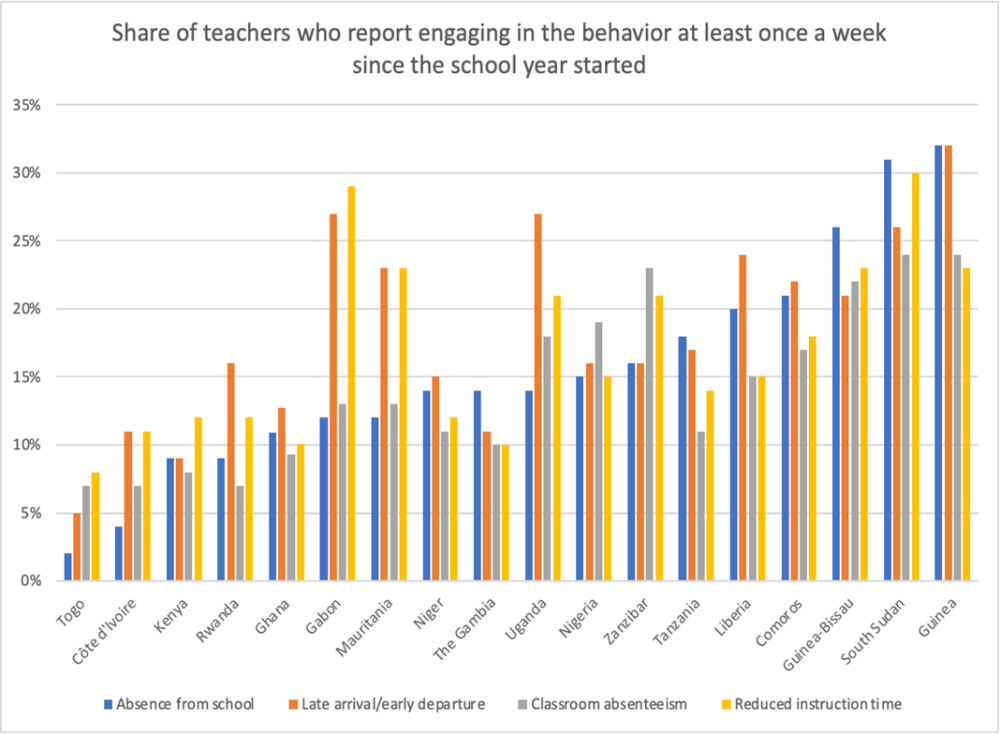
Source: Data are from the papers in the Time to Teach series that covers Côte d’Ivoire (Conto, 2021), Ghana (Akseer & Játiva, 2021), Liberia (Peirolo & Játiva, 2021), Guinea-Bissau (Nugroho, 2021), South Sudan (Târlea et al., 2021), Zanzibar (Han Yue et al., 2021), Eastern and Southern Africa (Karamperidou et al., 2020), and West and Central Africa (Játiva et al., 2022). Note: The Time to Teach series reports survey results from teachers in several Sub-Saharan African countries that capture teacher absenteeism across four dimensions: (i) absence from school; (ii) absence of punctuality (late arrival and/or early departure from school); (iii) absence from the classroom (while in school); (iv) absence from teaching (i.e., reduced time on task while in the classroom).
What tools do education systems have to boost time on task?
First, education systems may lengthen the school day. Lengthening the school day, as discussed above, tends to boost student learning outcomes. But while this is a relatively straightforward intervention, it is also an expensive one. However, it may be more cost-effective than it appears at first glance: longer school days mean households are more able to work and some studies show that longer school days reduced crime and adolescent pregnancy, so the economic and social gains may offset some of the expenditures.
Second, education systems can seek to reduce teacher absences. Teacher absences reflect systemic failures: teachers often report absences due to administrative and political tasks. Even when absences reflect attendance to personal needs, any apparent excess of those reflects a failure in workforce management. If you simply ask teachers how often they’re absent, many report official school business (Figure 2). And yes, one should take the reasons people give for their absences with several grains of salt. But qualitative studies corroborate this result.
Figure 2: While teachers most commonly report health problems as the reason for absence, official school business is the second or third most common reason in most countries
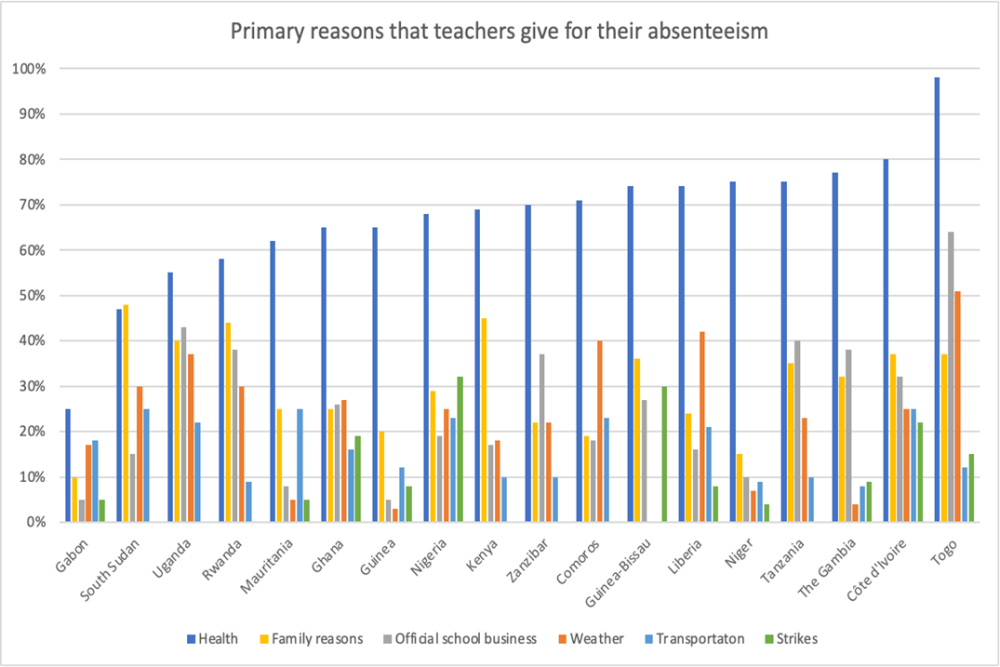
Source: Data are from the papers in the Time to Teach series that covers Côte d’Ivoire (Conto, 2021), Ghana (Akseer & Játiva, 2021), Liberia (Peirolo & Játiva, 2021), Guinea-Bissau (Nugroho, 2021), South Sudan (Târlea et al., 2021), Zanzibar (Han Yue et al., 2021), Eastern and Southern Africa (Karamperidou et al., 2020), and West and Central Africa (Játiva et al., 2022). Note: The Time to Teach series reports survey results from teachers in several Sub-Saharan African countries that capture teacher absenteeism and their reasons for the absenteeism. Each respondent can choose multiple reasons for absenteeism.
How might education systems reduce such absences? A systematic review identified nine interventions. They include the use of cameras to monitor and reward teacher attendance in India or using parents to monitor teacher attendance three times a day in Peru, both of which interventions boosted teacher attendance and student learning outcomes, but neither of which was implemented at any sort of scale. In an effort to understand how this type of intervention might work at scale, researchers tested the use of video dramatizations depicting the problem of teacher absences and how parents could mobilize to address it. In the field, seeing these videos did boost parents’ willingness to take action, but the study did not gather evidence on either teacher absences or student performances, limiting how confident we can be of the approach. Guerrero et al.’s review finds little impact of less direct approaches of boosting teacher attendance—e.g., general efforts to boost community involvement in schools or teacher incentives for student performance.
A third area is whether better teaching tools (such as detailed teacher guides) or better teacher support (such as coaching) boost time on task. This could work either through reducing absences (either because teaching becomes easier or because coaching acts as informal monitoring) or through increased time on task conditional on being in the classroom (again, because teaching is easier with good tools). A superficial examination of evaluations of “structured pedagogy” interventions (i.e., usually a combination of student books, detailed teacher guides, with some training and coaching) shows mixed evidence on this front. One study in Nigeria found that a structured pedagogy intervention boosted teacher attendance. This area merits further exploration.
Other possible tools include school management and leadership interventions to help teachers use their time as effectively as possible, or more adjunct staff to handle non-teaching tasks. We have much more to learn; but we do have some tools to boost time on task with evidence behind them, even as we continue to grow the evidence base.
Topics
DISCLAIMER & PERMISSIONS
CGD's publications reflect the views of the authors, drawing on prior research and experience in their areas of expertise. CGD is a nonpartisan, independent organization and does not take institutional positions. You may use and disseminate CGD's publications under these conditions.
Thumbnail image by: Joa Souza / Adobe Stock