Recommended

Blog Post
2024–2025 Replenishment Traffic Jam Redux

Blog Post
The Lusaka Agenda Financing Alignment Indicators

In the midst of a global health funding crisis, Gavi and the Global Fund are seeking substantial replenishments: $9 billion over five years and $18 billion over three years, respectively (Figure 1). But fundraising prospects look grim amid aid cuts announced by almost all G7 nations—which make up the lion’s share of funding to Gavi and Global Fund.
These replenishments face other headwinds—particularly the widespread perception that global health initiatives (GHIs) are no longer fit for purpose. Major reforms to ensure they are building effective and resilient health systems that can manage the current and future aid shocks, are overdue.
Amid seismic shifts, business as usual is no longer viable. Donor countries, such as the UK, together with partners like the African Union (AU), must use the upcoming replenishments as a leverage point to push for real reform. We argue that donors should call an emergency joint board meeting to steer this process, in turn, tying replenishment pledges to measurable and verifiable progress indicators that build on—but also go beyond—the Lusaka Agenda, and are tracked by an independent observatory.
Figure 1. Gavi and Global Fund replenishment cycles by size (2011–2030)
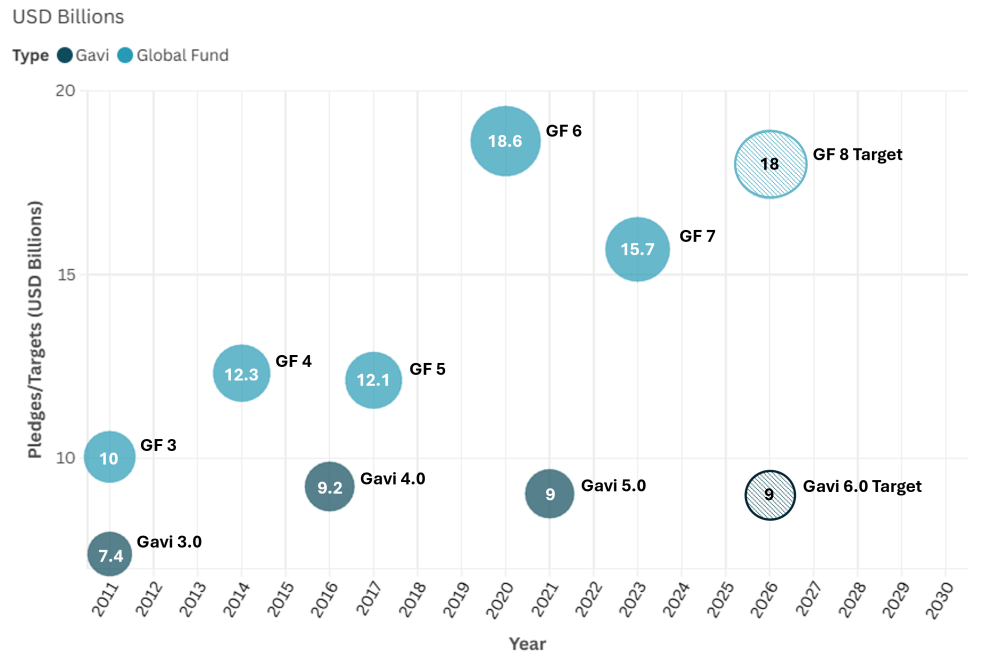
Note: This represents total pledges at the start of each 3-year and 5-year replenishment cycle for the Global Fund and Gavi, respectively. For GF.8 (2026-2028) and Gavi 6.0 (2026-2030), this represents the targets for their respective ongoing replenishments.
Slow progress on reform efforts
“Reform of the global health architecture” has become a popular refrain, underpinning the global health strategies of bilateral donors, such as the UK and France, and motivating a series of aid reviews and declarations about better paths forward. One notable recent effort is the Lusaka Agenda, which represented the culmination of the Future of Global Health Initiatives review. Launched in December 2023, it calls for five shifts to the GHIs’ respective models. The Lusaka Agenda offers a high-level vision for the future, and has gained traction, with the establishment of the Africa Center for Disease Control and Prevention’s Continental Secretariat for the Lusaka Agenda, and support from a World Health Organization (WHO) AFRO Roadmap, a World Health Assembly resolution, a G7 communique, and discussion at the G20.
Actual change, however, has been slow and marginal, covering aspects such as improved operational coherence, pilot projects, and collaboration on malaria vaccines (see Gavi Dec 2024 board annex). Key structures and processes of the GHIs have essentially remained the same, reflecting a lack of real ambition or political will. There appears to be limited board-level buy-in, and neither board has produced a concrete plan to deliver on the Lusaka Agenda, nor have they introduced measurable and verifiable indicators to track progress or otherwise hold their respective organizations accountable for change.
The crisis means we must go faster and further than Lusaka
To navigate an era of heightened donor volatility and uncertainty, the speed and level of ambition must be dialled up. As such, the reforms outlined in the Lusaka Agenda should be seen as a bare minimum, with an urgent need to advance tangible and specific changes in how Gavi and the Global Fund operate and do business. This “Lusaka+” agenda should entail more concrete and transformative options to make services less reliant on volatile donor funds, identify new approaches to mobilize domestic financing for health, and systematically and explicitly prioritize the use of limited resources.
Initial priority areas should include:
- Reviewing allocation models to ensure limited grant resources focus on countries that need them most
- Revising transition and cofinancing policies, including a reimagined transition pathway that combines grants and concessional loans
- Bringing more financing on budget, including by “pooling” grant financing with concessional resources of the multilateral development banks
- Laying the groundwork for a New Compact approach, with governments financing the top priorities, and Gavi and Global Fund supporting the expansion to the next best investment.
Donors must demand more for their money
The upcoming replenishments present a unique window of opportunity for a small, but influential coalition, perhaps led by Lusaka Agenda champions, such as the AU, Norway, and the UK, to ensure an agenda for practical change to the operating models of Gavi and the Global Fund. The UK could be a vital ally to the AU, given its Secretary of State’s commitment to equitable partnerships and global health architecture reform, and its support of the Lusaka Agenda.
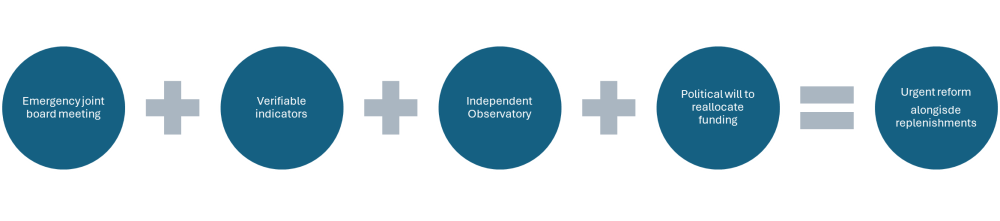
We envision this unfolding as a four-step process (Figure 2):
- The AU and UK should call for an emergency Gavi and Global Fund joint board meeting, possibly on the sidelines of the UK’s proposed development conference. The priority would be to commit to objectives for urgent reforms that build on the Lusaka Agenda. This commitment should be underpinned by agreement around a concrete process and timeline to drive change, with strong ownership and backing from the boards.
- Donor nations should tie funding contributions to verifiable targets. The initial targets could entail establishing a cross-board governance mechanism, developing road maps to implement reforms within each GHI, and agreeing to share data with an independent observatory that would track and verify progress (see proposed Lusaka Agenda indicators that CGD published in 2024).
- Donors should also ensure these commitments are backed by real accountability. To measure and verify progress, donors should establish an independent observatory, potentially at WHO. This will be essential to advance progress towards these targets into business cases, log frames, contracts and/or “performance agreements” of various donors, as the UK has previously done.
- Finally, to incentivize change, donors must be willing to follow through with this commitment. This includes having a fall-back option which should be clearly stated in the business cases. For instance, if specific targets are not achieved, then funding could be diverted to bilateral health programs or another multilateral channel (e.g., World Bank’s IDA). In this regard, the current political appetite for cutting aid should be harnessed to ensure efforts to drive real transformation succeed where others have fallen short or not gone far enough.
Figure 2. Four steps to successful reform alongside the Gavi and Global Fund replenishment
Some may argue that an approach that ties donor contributions to the achievement of progress against explicit targets may be inherently problematic. But the current moment should not be wasted: there is a chance to seize the opportunity to deliver on long-overdue changes, backed by the AU, in a way that meaningfully advances greater country ownership.
These upcoming replenishments, taking place amid an unfolding financing crisis, are a critical moment to define a more realistic way forward on how the functions and ways of working of the GHIs need to improve. The goal must be rapid transformation of Gavi and the Global Fund toward an approach that is more sustainable, more efficient, more empowering, and more resilient to future shocks. It is an opportunity not to be wasted.
With thanks to Rachel Bonnifield for feedback on an earlier draft and Rosie Eldridge for research assistance.
Topics
DISCLAIMER & PERMISSIONS
CGD's publications reflect the views of the authors, drawing on prior research and experience in their areas of expertise. CGD is a nonpartisan, independent organization and does not take institutional positions. You may use and disseminate CGD's publications under these conditions.