Recommended

Executive summary
In early 2025, the Trump administration began making drastic cuts to USAID and other global health programming, including the reduction and/or elimination of long-standing global health supply chain programs. The United States has historically been a major funder of global health supply chains, and so this note aims to briefly characterize the scale and scope of the most recent US global health supply chain program, so as to inform national and global responses to the cuts.
This review is based on the 10 most recent US government (USG) supply chain grants, including the largest, the Global Health Supply Chain – Procurement and Supply Management (GHSC-PSM) project, covering 73 countries around the world, which collectively spent $1.15 billion in 2024 on donated commodities and technical assistance (TA). This grant covered four areas: HIV (71.1 percent); malaria (20.3 percent); family planning (7 percent); and maternal, neonatal, and child health (MNCH, 1.5 percent). For nine countries, this grant expenditure represented more than 10 percent of government health expenditure, making it hard to replace this funding with domestic resources. The broad project scope included procurement and delivery of medicines and other supplies needed to provide a range of health services focused on HIV, malaria, family planning, and MNCH.
The USG provided support across all phases of procurement and supply chain management, from planning to procurement to product delivery. The source of support (Washington, in-country, or mixed) varied by phase but, by design, was predominantly managed by Washington-based staff and contractors. This significant reliance on aid financing, remote support, and international expertise for core procurement and supply chain functions will make a transition from USG support challenging.
Countries and other funders must use this opportunity to take stock of and proactively respond to five immediate risks: gaps in procurement, leading to stockouts; cuts to staffing and TA that may undermine performance; limited visibility into the extent of USG supply chain programs, hindering the ability of low- and middle-income country (LMIC) governments to prepare a response; lack of private-sector readiness to respond; and the loss of globally relevant insights from decades of USAID programming.
While the long-term solution remains building a more resilient country-financed supply chain, this note focuses on three immediate actions to mitigate the risks: ensuring availability of targeted TA to health financing and supply chain plans to support transition planning, proactively engaging with the private sector to steward gap-filling opportunities, and commissioning rapid research on lessons from USG awards and countries currently responding to the crises.
Context, aims, and methods
In early 2025, the Trump administration began making drastic cuts to USAID and other global health programming, including the reduction and/or elimination of long-standing global health supply chain programs. The rapid termination of over 80 percent of USG global health programs created a significant gap in overall financing for global health supply chain functions.[i] To help other funders and LMIC policymakers better understand these gaps and respond to the ongoing emergency, this note aims to briefly characterize the scale and scope of the most recent US global health supply chain program, with a focus on the roles of project and USG staff.
This rapid review is primarily informed by four main inputs. First, the authors reflect their own professional experience working at USAID, JSI, and Chemonics—organizations that served as funders and implementers of prior and current US global health supply chain programs. Second, we held six key-informant interviews with recently furloughed USAID staff and primary implementing partners.[ii] Third, we conducted a literature review of publicly available resources.[iii] Finally, this note is informed by discussions that took place at the first Nexus Working Group on Improving the Financing of Supply Chains meeting convened by CGD and the Africa Resource Centre in April 2025. This working group convenes experts in global health financing and supply chain disciplines to explore opportunities for greater integration to improve supply chain financing.
The paper has three further sections. Section III provides an overview of USG supply chain support. Section IV provides a detailed review by supply chain phase, and section V provides a discussion of the risks to countries and potential short-term actions required to mitigate these risks.
Overview of USG procurement and supply chain support
This section provides an overview of USG support, first by award and health area, and then by country.
Overview by award and health area
The USG has historically been the single largest contributor of global health funding among all sources of foreign assistance. In 2023, the USG contributed $12.9 billion for global health, equating to 42 percent of all international development assistance for health. The supply chain program was the single largest contribution to global health funding from the USG. The USG spent at least $13 billion for both commodity donations and TA to over 100 countries in the last 20 years. The vast majority of this value can be attributed to procured commodities.
The Global Health program within USAID partnered with other parts of the USG, notably the Centers for Disease Control and Prevention, Peace Corps, Department of Health and Human Services, and Department of Defense, for implementation. Since the 1980s, the USG provided support in two ways: direct commodity procurement and technical assistance (TA).
USAID’s most recent global health supply chain program (FY2016–FY2024) encompassed 10 distinct awards, with GHSC-PSM being the largest (accounting for 86.2 percent of total funding), providing direct procurement of commodities that were then delivered to countries as in-kind donations along with TA. Four additional awards provided country-specific TA, and five awards provided specific functional TA or procurement support. Table 1 provides an overview of the 10 projects and their most recent obligations from FY2024.
Together, this suite of programs focused on the four major categories of commodities (see Table 2) within the scope of the GHSC-PSM project for procurement: HIV (71.1 percent), malaria (20.3 percent), family planning (7 percent), and MNCH (1.5 percent).
Table 1. FY2024 USAID obligations to supply chain management by project
| Award Title | Awardee | Description | Total |
|---|---|---|---|
| GHSC-PSM | Chemonics | Procurement and TA | $992,552 |
| GHSC-TA Republic of South Africa | Guidehouse | Targeted TA | $880 |
| GHSC-TA Tanzania | Guidehouse | $2,880 | |
| GHSC-TA Kenya | Chemonics | $3,494 | |
| GHSC-TA Francophone Countries | Chemonics | $32,962 | |
| Project Last Mile | Coca-Cola Partnership | Adopting private-sector supply chain and marketing expertise to advance medicine access | $7,854 |
| Medicines, Technologies and Pharmaceutical Services (MTaPS) | Management Sciences for Health | Regulatory TA | $19,645 |
| Promoting the Quality of Medicines+ (PQM+) | US Pharmacopeia | TA for regulatory agencies | $19,373 |
| GHSC-Quality Assurance | FHI 360 | Assessment of USAID-procured products | $8,220 |
| GHSC-Rapid Test Kits (only for HIV) | RMI | Procurement and distribution | $71,252 |
| Supply Chain Management Total | $1,151,146 |
Table 2. FY2024 USAID obligations to GHSC-PSM by task order focus (all values in 1,000s USD)
| HIV | Malaria | Family Planning / Reproductive Health | Maternal, Neonatal, and Child Health | ||||
|---|---|---|---|---|---|---|---|
$ | % of total | $ | % of total | $ | % of total | $ | % of total |
$706,610 | 71.19% | $201,432 | 20.29% | $69,812 | 7.03% | $14,698 | 1.48% |
Overview by country
The USG’s latest global health supply chain program, known as GHSC-PSM, supported 73 countries from 2016 to 2024, the majority of which received both TA and procurement support (Figure 1).
Figure 1. Countries receiving support from the latest program: GHSC-PSM (2016–2024)
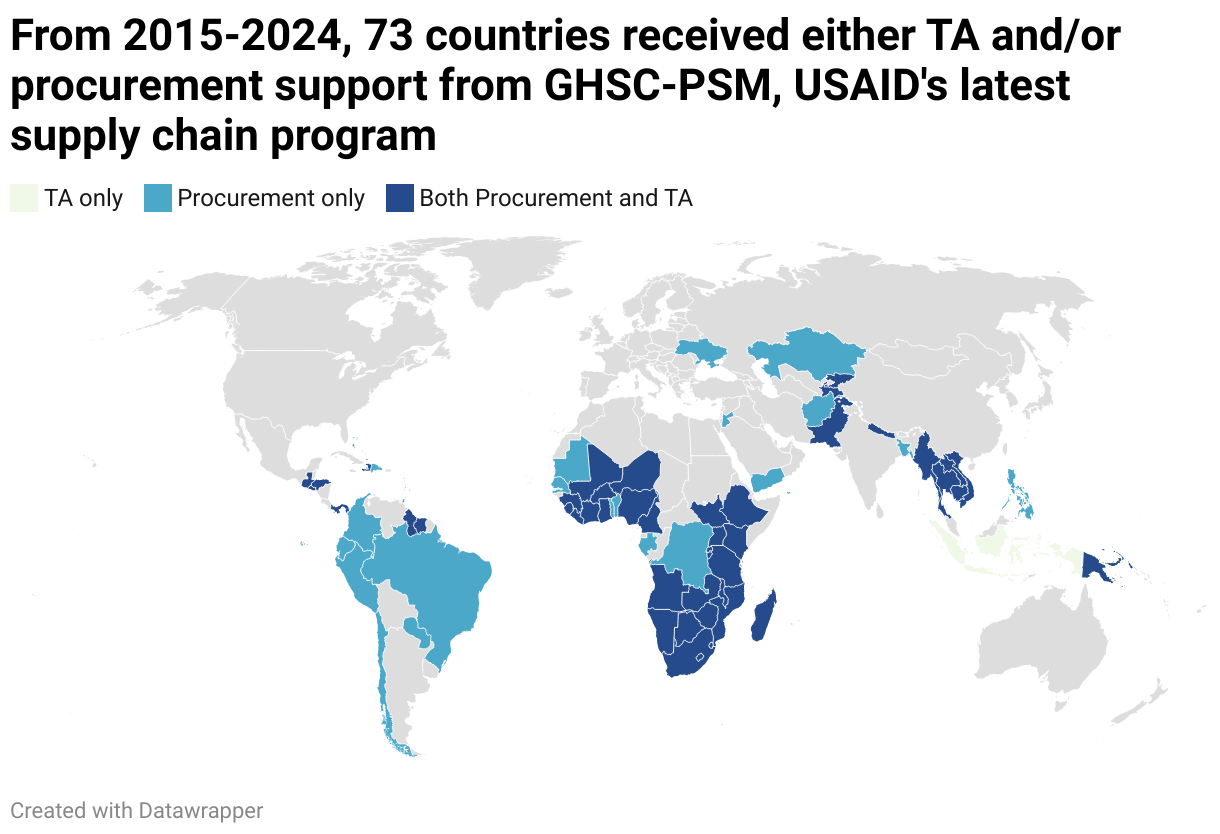
Source: FY2024 Q3 quarterly report by GHSC-PSM
USAID global health supply chain program disbursements represent a significant financial contribution to many countries. Tables 3 and 4 show the top 10 country recipients, in absolute amount and in terms of equivalent percentage of domestic government health expenditure. Nine countries received funding equivalent to more than 10 percent of their domestic government health expenditure, making this funding hard to replace with domestic resources—and eight of these countries are either low-income and/or in or at high risk of debt distress. Five are also classified as “fragile” or “conflict-afflicted.” The full breakdown by country of the averaged FY2023 disbursements and FY2024 obligations, and comparison to domestic government health expenditures, is available in an online appendix.
Table 3. Top country recipients of USAID supply chain funding (averaged FY2023 disbursement and FY2024 obligation), by total funding
| Country | USAID Supply Chain Funding (FY2023 & 2024 average, millions USD) |
|---|---|
| Nigeria | 117.4 |
| Tanzania | 96.2 |
| Zambia | 83.9 |
| Mozambique | 73.7 |
| DR Congo | 71.7 |
| Kenya | 67.0 |
| Zimbabwe | 36.2 |
| Ethiopia | 25.2 |
| Haiti | 23.7 |
| Uganda | 22.8 |
Table 4. Top country recipients of USAID supply chain funding (averaged FY2023 disbursement and FY2024 obligation), by funding as a percentage of domestic general government health expenditure (GGHE)
| Country | USAID Supply Chain Funding (FY2023 & 2024 average, millions USD) | Domestic GGHE (2022, millions USD) | USAID Supply Chain Funding as % of Domestic GGHE | World Bank Income Group (2023) | Debt Distress Risk Status | Fragile/ Conflict-Afflicted |
|---|---|---|---|---|---|---|
| Haiti | 23.7 | 64 | 37% | Lower middle income | High | Fragile |
| Burundi | 11.3 | 62 | 18% | Low income | High | Fragile |
| Malawi | 19.7 | 110 | 18% | Low income | Distress | - |
| DR Congo | 71.7 | 459 | 16% | Low income | Moderate | Conflict |
| Mozambique | 73.7 | 498 | 15% | Low income | High | Conflict |
| Tanzania | 96.2 | 728 | 13% | Lower middle income | Moderate | - |
| Liberia | 6.2 | 51 | 12% | Low income | High | - |
| Zambia | 83.9 | 731 | 11% | Lower middle income | Distress | - |
| Zimbabwe | 36.2 | 369 | 10% | Lower middle income | Distress | Fragile |
| Benin | 7.5 | 90 | 8% | Lower middle income | Moderate | - |
Detailed review of USG support by supply chain phase
USG support spanned all procurement and supply chain phases. Understanding what this support entailed, the type of USG support provided in each phase, and the degree of centralization of management of each phase in Washington can provide visibility into the specific activities that will be directly impacted by reductions in USG support.[iv]
This section therefore provides a description of USG’s contributions across the 10 main supply chain phases, from planning to procurement to delivery. For each phase, we provide a brief description of what it entailed, the source of USG support (central level in Washington, country-based project/mission staff, or hybrid), and examples. Overall, we find that the source of support (Washington, in-country, or mixed) varied by phase but the support was, by design, predominantly managed by Washington-based staff and contractors (see Figure 2). This significant reliance on aid financing, pooled purchasing, and country-based project staff for core procurement and supply chain functions will make a transition from USG support challenging.
Figure 2. USG support for HIV, malaria, family planning, and select MNCH commodities by supply chain phase
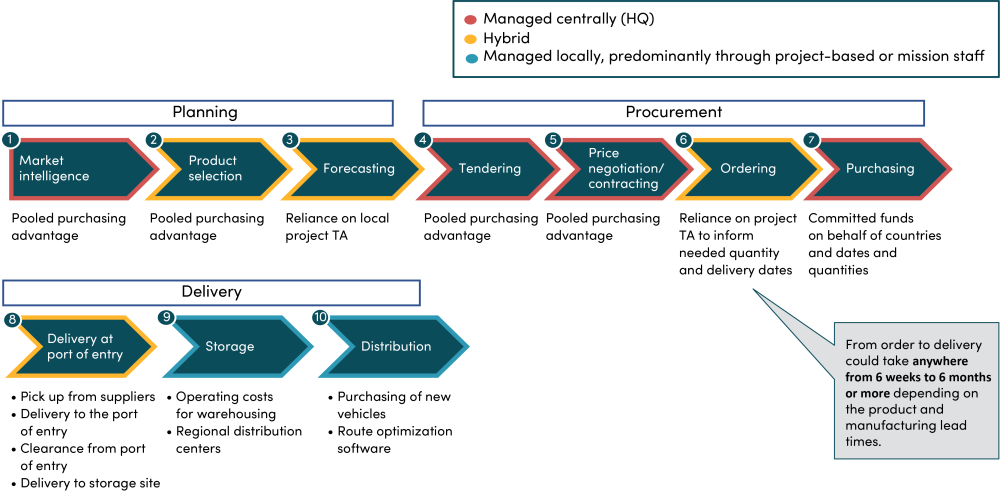
Planning includes three phases: Market intelligence → product selection → forecasting
- Market intelligence: Market insights on supply and demand trends can optimize sourcing, manage risks, and improve efficiencies in supply planning. Because USAID procured high volumes of in-kind donations on behalf of multiple countries, information on supplier quality, capacity, pricing, feasibility of serving LMICs, and implications for global markets was assessed at the central level in Washington. Washington-based project staff were responsible for assessing the market impact of USG product-choice directives (e.g., from the President’s Emergency Plan for AIDS Relief [PEPFAR] or another health area program). For example, a PEPFAR policy preference for tuberculosis prophylaxis treatment for HIV-positive patients using 3HP (treatment of latent tuberculosis with a combination of isoniazid and rifapentine) instead of isoniazid alone, given global demand, could have resulted in supply chain disruption for the production of rifamycin antibiotics. By proactively identifying and understanding the global consequences of demand and supply, the project was able to mitigate the risks by working across countries to manage product selection.
- Product selection: This phase determines which product brands the government is interested in procuring. Products procured by the USG were determined primarily through country-based policy set by clinical staff, but also influenced by the USG and the World Health Organization. The USG limits product selection to commodities with stringent regulatory approval, which has implications for policy and clinical decision making at the country level. For example, PEPFAR leadership decided to limit the procurement of the fixed-dose antiretroviral combination tenofovir disoproxil fumarate, lamivudine, and efavirenz (TLE) and replace it with tenofovir disoproxil fumarate, lamivudine, and dolutegravir (TLD), based on evidence that the latter was more effective at reducing the spread of HIV, had fewer side effects, and reduced copies of HIV in the blood quickly. That drove a decision to discontinue procurement of TLE.
- Forecasting: This process estimates demand, or serviceable obtainable market, for a particular product. Forecasting informs how much product is needed when and where, allowing supply planners to schedule shipments that maintain adequate inventory while minimizing cost and waste. Forecasting was a Ministry of Health (MoH)-led process with central support for demand planning (forecasting) and for scheduling shipments (supply planning). Country-based USAID project staff often led annual forecasting exercises and at least quarterly reviews of the supply plan, serving as the secretariat for these reviews, entering data into forecasting and supply planning software, producing reports, and then coordinating shipment plans among multiple donors to optimize investments.[i] The most recent computerized software supply planning tool used across most countries is the USG-developed Quantification Analytics Tool, with helpdesk support / software updates funded by GHSC-PSM. More than 1,000 people across 40 countries have been trained in the use of the tool.
Procurement includes four phases: Tendering → price negotiation/contracting → ordering → purchasing
- Tendering is a process that sets standards and attributes for interested suppliers, resulting in requests for proposals / requests for information and/or requests for quotations. In the USG context, procurements must abide by a set of rules that govern all federal government procurement processes to ensure transparency, competition, and accountability.[ii] Because products were procured by the USAID supply chain projects and not by countries, the vast majority of tendering was led centrally by implementing partners to meet quality standards and negotiate favorable prices with suppliers.
- Price negotiation/contracting determines which suppliers to move forward with based on negotiations regarding the scope of contractual arrangements (e.g., price, delivery terms). Central project staff are responsible, applying USAID and USG rules for competition. The project advanced two main tactics in the last 10 years: (1) using purchasing power to negotiate prices with suppliers (e.g., pooling procurement of HIV viral load testing and early infant diagnosis to drive strategic sourcing), which enabled the USG to obtain competitive prices for quality products and, by splitting orders with different suppliers, retain market health and incentivize engagement from innovator companies, and (2) active engagement with suppliers to advance strategic priorities. For example, GHSC-PSM held at least three supplier conferences from 2016 to 2024 to convene its suppliers, report on the overall performance of the project, and troubleshoot issues. GHSC-PSM also negotiated delivery terms with suppliers, encouraging them to ship products as close to countries as possible.
- Ordering and 7. Purchasing determine how suppliers will be paid, including the creation of purchase orders and payment to suppliers. Ordering and purchasing were an iterative process managed between Washington and country-based project staff to negotiate order and delivery terms, balancing what was feasible against what was desired. It could take anywhere from six weeks to six months or more between ordering and delivery. The ordering and purchasing process itself included over a dozen steps managed by the Washington project office in collaboration with country-based project and mission staff. These steps ranged from creating a requisition order in an online system, to quality assurance sample testing, to booking a third-party logistics provider to manage product collection and delivery planning.[iii]
Delivery includes three main phases that involve moving products from the manufacturing locations to service delivery points: Delivery at the port of entry → storage → distribution
In contrast to planning and procurement, the delivery phases were highly reliant on TA from the project.
- Delivery at the port of entry was managed by Washington-based project staff with support from in-country USAID mission and project staff. The central team negotiated delivery terms with the supplier and was responsible for transporting commodities directly from the manufacturer (e.g., ex works) to the port of entry, facilitating clearance processes at the port of entry, and ensuring delivery to the central storage site (e.g., the central medical store [CMS] or other warehouse). They worked closely with mission-based staff who needed to obtain duty waivers for the donations and ensure that they were accessible for clearance at the port of entry.
- Storage refers to the safe and organized holding of health commodities between distribution points and at service delivery points. While MoHs control product warehouses and generally own the infrastructure, they remain dependent on donor funding for operating costs. USG support spanned a variety of warehousing-supportive activities, depending on the quality of the public-sector infrastructure and the CMS’s capacity to manage and account for commodities under its care and custody. Support ranged from supplemental storage (e.g., renting extra warehouse space), to helping governments upgrade existing warehouses to pharmaceutical-grade conditions (e.g., roof-insulated materials, racking systems, materials handling equipment, security and climate control equipment), to procuring and installing prefabricated storage units.[iv] USAID projects also provided TA to the CMS (e.g., in Namibia), deployed secondees (e.g., in Zambia), hired extra workers for “picking and packing” orders (e.g., in Zambia), and supported reform of national storage systems. For example, in Mozambique, provincial and district-level stores were eliminated in favor of 20 warehouses run by the CMS. Finally, in some cases, the USG opted to set up a private sector–run supply chain in which subcontractors managed a warehouse and distribution system. In addition to supporting national storage, the USG centrally established several regional distribution centers that hold stock temporarily as a way to keep supplies closer to the countries served.
- Distribution refers to the process of transporting and delivering commodities between storage facilities and to the service delivery points. In many cases, MoHs operate their own fleet of vehicles. However, many are also dependent on funding from donors to maintain or replace their fleets. As with warehousing, the USG support for distribution models varied by country. Project funds were frequently used to support MoHs in outsourcing some or all of their distribution to third-party logistics providers. In Angola and Malawi, GHSC-PSM contracted warehousing and distribution through international companies with a local presence (e.g., Bollore) but over time has also awarded distribution to local vendors.
Cross-cutting areas
USAID also provided varied levels of support for cross-cutting areas such as contract performance management, logistics management information systems (LMIS), and human resources that underpinned the entire procurement and supply chain process. Figure 3 provides a visual overview; details on each phase are described below.
Figure 3. USAID’s support for cross-cutting areas
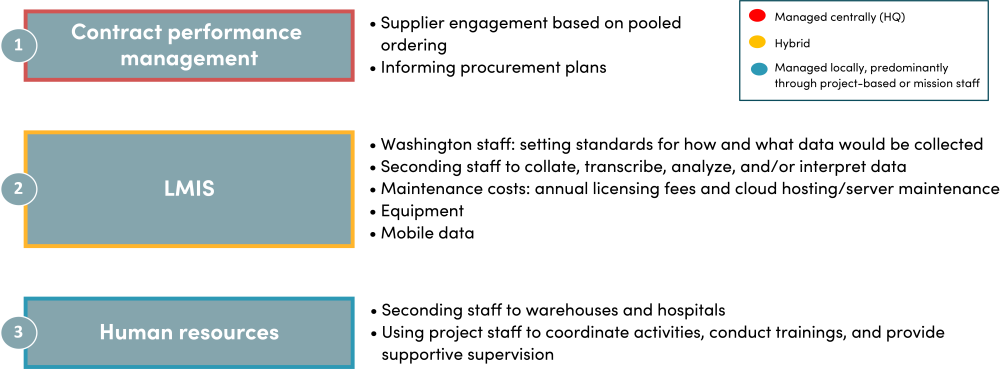
- Contract performance management ensures that suppliers deliver according to the agreed terms and enables performance monitoring based on timeliness and quality. It informs revisions for tendering and contracting. Washington project staff managed performance contracts based on the percentage of commodities with on-time delivery and on-time in-full delivery. Orders could not be more than two weeks early or one week late. GHSC-PSM worked with suppliers, governments, and vendors to exceed 80 percent on-time delivery.[ix] Project staff also managed contracts with storage and distribution vendors response for delivery to facilities (e.g., warehouses and third-party logistics providers).
LMIS are primarily used by the government for making decisions about replenishing supplies and to communicate information between storage sites (typically aligned to administrative structures) and service delivery points. USAID Washington staff set standards for how and what data should be collected. Country-based project staff adopted local LMIS based on these standards.[x] Each storage level was generally accountable for producing and collecting its supply chain data and then sharing that data periodically with the level above. Data from higher levels could be in a number of formats, ranging from Excel spreadsheets to warehouse management systems (WMS) and enterprise resource planning (ERP) tools.
There is no universal tool or protocol that is used across countries supported by USAID, since ownership of the tool and its data are in the hands of the MoH, despite attempts among donors to promote a unified LMIS package across countries.[xi] Overall, none of the existing systems (e.g., electronic LMIS, WMS, or ERP) has become a standard tool for most USAID-supported countries, and other donors have also required the use of their tools. Expenditures by USAID and other donors on WMS and ERP include fixed costs (e.g., laptops and computers) as well as operational costs such as annual licensing fees, cloud hosting, server maintenance, printing paper-based forms for service delivery points, and/or mobile data payments for community health workers. Supportive supervision visits (enabled with funder-supported per diems) would confirm that the submitted data were up-to-date and matched inventories.
Human resources refers to staff supported by the USG at the country level to operate USAID supply chain projects. USAID supply chain programs provided significant staffing support to the MoH across all supply chain activities. The number of staff in each country depended on the level of USAID support, with countries receiving PEPFAR and President’s Malaria Initiative support having more staff than those receiving support for family planning and MNCH. Although project staffing (whether TA or embedded staff) was meant to be temporary, contractor staff often filled key government roles where MoH counterparts were nonexistent or the positions were vacant. As a result, although government staff might directly supervise day-to-day activities, they heavily depended on USAID-funded staff for a range of activities as described above, including activity coordination, warehouse management, distribution planning, and training and supportive supervision aimed at verifying the quality of reordering through LMIS reports and storage conditions. Project staff worked on standard operating procedures, system design, and other interventions to streamline processes, particularly for storage and distribution to service delivery points. USAID also supported substantial per diems for MoH personnel to conduct supervision visits in addition to project staff.
Besides seconding staff or providing TA, USAID also invested in global programs that supported the professionalization of supply chain staff, such as People that Deliver and the International Association of Public Health Logisticians (IAPHL). These programs were developed in response to a realization that those working in public health supply chains are almost universally clinically trained pharmacists or nurses, as required by the MoH to oversee medicines. This means that most MoH staff tasked with managing commodities have no supply chain experience. USAID, in collaboration with Gavi and other donors, created the People that Deliver initiative in 2011 to serve as a hub for building capacity in those tasked with supply chain management. Outputs from this effort include a supply chain management theory of change, which describes the skills, resources, and motivation required for supply chains to be successful, and the professionalization framework, which provides tools to define supply chain roles, create position descriptions, and identify educational requirements. IAPHL was created by JSI in 2007 to promote the professionalization of the field of public health logistics through education and information sharing. The association supports logisticians worldwide by providing a forum for members to network, exchange ideas, and improve skills.
Discussion
Potential risks associated with significant reductions in USG support
As of April 2025, select components of the GHSC-PSM program approved with FY2024 funds have been retained. However, over 90 percent of USAID staff in Washington and across missions are scheduled to be terminated by September 2, raising concerns regarding the feasibility of delivering programs without USAID presence in-country. There are five main risks to look out for in the next six to nine months:
- Gaps in procurement, leading to stockouts. The permanent termination of procurement for family planning commodities, the 90-day pause on procurement across GHSC-PSM, and the overall USAID stop-work order has already substantially disrupted supply chains and raised the risk of stockouts. From a supply chain perspective, the long lead times for funding, procuring, manufacturing, shipping, receiving, and distributing commodities mean that the true risk of stockouts will not be noticed until it is already too late to prevent them from occurring.
- Cuts to USG and GHSC-PSM staffing and TA that may lead to supply chain failures and limited visibility into supply chain performance. Due to the high dependence on USG support across the supply chain, termination of TA programs and of country-based staff will leave a void when it comes to overseeing and troubleshooting issues related to retained supply chain programs—for example, the acquisition of duty waivers for products to clear the port, which USG officials facilitated. The second quarter is also when in-country supply planning takes place for the following fiscal year.[xii] It is not clear how these processes will be supported moving forward under the State Department. In the medium term, these cuts may lead to “procurement and supply chain brain drain,” with governments being unable to absorb skilled staff, who may then leave the sector permanently.
- Limited visibility at the country level into the true costs of USG support for supply chain programs. USG support for supply chain programs was predominantly in-kind donations and TA, and was thus “off budget” and independent of government-led procurement and supply chain activities. Consequently, many governments have limited understanding of the full costs of USG-supported programs. This limited visibility handicaps efforts to think through the financing requirements to fill potential gaps.
- Lack of private-sector readiness to step in. In public-sector facilities, when medicines are not available, patients receive prescription slips and are informed of the need to seek medicines in the open market / private sector. If companies in the private sector are not informed in advance about disruptions expected in the public sector, they will miss an opportunity to be proactive in supporting national health priorities and expanding their business.
- Loss of globally relevant insights from two decades of USG supply chain support. There are a number of practices across the GHSC-PSM portfolio that have demonstrable value that has not yet been documented, including the warehousing operational process improvements in Lesotho, Ghana’s work with LMIS, and Zambia’s use of dynamic route optimization. There have also been a range of failed initiatives with generalizable lessons. Most of this experience is not in the public domain and is at risk of being lost.
Near-term recommendations
The current moment offers an opportunity to reflect on what governments, partners (including the private sector), and funders can do to both mitigate the impact of the USG’s actions and accelerate interventions that will ultimately ensure sustainable and responsive locally managed supply chains. In the near term, we propose three immediate actions for other donors and partners that wish to step in:
- Urgently respond to country requests for TA to adapt financing, procurement, and supply chain plans. The need includes providing support to the MoH to take stock of gaps and needs across all supply chain phases, particularly ones that relied on Washington-based support. This support may include TA for the following:
- Financing: Review options for emergency allocation of domestic financing to cover gaps in supplies (e.g., Nigeria allocated $200 million), and revise national health financing policies to include consideration of donor-funded commodities. This revision may include adjusting coverage of insurance schemes, amending health benefits packages, and adding to national procurement lists. This effort may be supported by donors shifting to on-budget support and/or a “New Compact” approach to health financing.
- Priority setting and product selection: Shifting to any form of country-led financing of supply chains requires domestic capacity to set priorities and select the best products for the country’s needs. TA here could provide both short-term benefits in terms of spending emergency funding well to fill the highest-priority gaps, and also long-term benefits in building a more sustainable and higher-value-for-money health system.
- Forecasting and LMIS: These two functions are highly dependent on USG support, and this dependency must be reduced to ensure future sustainability. Bridging TA to enable MoH staff to take over these functions fully, as well as including national stakeholders who have not previously been engaged in procurement and supply management functions (e.g., Ministry of Finance, Government Procurement Board that delegates authorities across the government), would be valuable.
- Inventory management and warehousing: Because resources will be more limited, it will be necessary to revisit inventory management procedures, so countries simply hold less overall stock. The inventory control process should be revisited to encourage more frequent resupply, which, in turn, should result in less wastage due to expiry and less opportunistic diversion of products.
- Engage the private sector to respond to gaps. Private-sector providers may have capacity to respond to any gaps that emerge. For essential products commonly found in the private sector already, the public sector can harness providers’ engagement through convening consultations and discussions about the scale and scope of challenges and collaboration strategies to fill the gaps. For example, local leaders could provide private-sector entities with their demand forecasts and predicted gaps based on available resources and operational plans. This information would provide visibility into the size and locations of needs to encourage engagement and investment.
- Collect existing cross-country knowledge and practices from recent USAID implementing partners.[xiii] Best practices and costing implications for forecasting, LMIS, supervision, and warehousing and distribution should be documented and gathered to create a practical and usable body of knowledge for country policymakers and anyone looking to support supply chain strengthening interventions. Successes and challenges in transitioning from US aid should also be documented and shared. Staff that have recently departed USAID, or departed from partners such as Chemonics, Management Services for Health, JSI, and Guidehouse, would be well placed to carry this out.
In conclusion, this note finds that the risks of USG cuts to supply chain projects require immediate attention, especially for HIV, malaria, family planning, and MNCH services, and especially in countries highly dependent on aid. There is a brief window now for countries and other donors to respond to mitigate these risks. In the medium term, however, both country policymakers and donors will need to develop a more resilient and country-led model for funding supply chains.
[i] As of April 2025, it appears that some parts of the existing global health supply chain award will be retained. However, the continuing uncertainty regarding the scope of what will be retained, along with the overall planned reductions in USAID mission staff, means that the programs are likely to be curtailed. Circumstances are rapidly evolving based on an extended foreign aid review.
[ii] We are grateful to the following individuals who consented to be acknowledged for their input: John Vivalo, Dominique Zwinkels, Lindabeth Doby, and Andrew Brown. We are also grateful to Prashant Yadav for his peer review, as well as two other peer reviewers who wish to remain anonymous.
[iii] We regret that other relevant sources, including the Development Exchange Clearinghouse and USAID archives, were no longer accessible at the time of writing.
[iv] Supply Chain Management System (SCMS) (2005–2016): $2.5 billion (procurement only); GHSC-PSM (2016–2024): $5.7 billion for procurement only, as TA values were not available. While we were not able to obtain an estimate for Deliver/JSI (for family planning and malaria), we make the following assumptions: malaria and family planning commodities were likely two-thirds of the full SCMS/Deliver program, so amounting to an additional $5 billion (malaria commodities were more expensive at the time), bringing the total spend estimate to at least $13.2 billion. TA made up a smaller but still sizable amount.
[v] An additional award was made to IntelligCog as the contractor for business intelligence and analytics (GHSC-BIA) during GHSC-PSM but ended before FY2023. This award was responsible for collecting, integrating, and analyzing data from various sources with the GHSC program.
[vi] These phases have been adapted from the “key steps in medicine procurement and distribution” framework in Lyudmila Nepomnyashchiy and Prashant Yadav, “Decentralized Purchasing of Essential Medicines and Its Impact on Availability, Prices, and Quality: A Review of Current Evidence,” CGD Working Paper 605 (Center for Global Development, 2022), https://www.cgdev.org/publication/decentralized-purchasing-essential-medicines-and-its-impact-availability-prices-and.
[vii] Annual forecasting and supply planning for an 18-to-24-month duration was driven by USAID’s need to commit appropriated annual funding for commodity procurement in one tranche and by lead times from ordering to delivery.
[viii] The Federal Acquisition Regulations and Automated Directive Systems are the main sources for USG rules and policies.
[ix] Based on a GHSC-PSM training module from 2024 (unpublished).
[x] Known as “warehouse in a box”—prefabricated storage structures that could be paid for with USAID funds, in contrast to constructing warehouses, which could not be funded by the USG.
[xi] Standards set by USAID and GHSC-PSM: https://www-staging.ghsupplychain.org/news/achieving-and-maintaining-high-time-delivery-rate. Evidence of exceeding standards, for example, is provided in the GHSC-PSM FY2024 Annual Report.
[xii] OpenLMIS is one such initiative. Several other packages exist, including C-STOCK, E-ZICS, and MSUPPLY, as well as a number of mobile phone packages aimed at data collection from community-based workers and service delivery points.
[xiii] For example, Malaria Operational Plans led by the President’s Malaria Initiative and PEPFAR Country Operational Plans informed annual programmatic priorities and fiscal year budgets.
Topics
CITATION
Nepomnyashchiy, Lyudmila, Pete Baker, and Barry Chovitz. 2025. USAID’s Role in Global Health Supply Chain Programs and Implications of Aid Cuts: A Rapid Review. Center for Global Development.DISCLAIMER & PERMISSIONS
CGD's publications reflect the views of the authors, drawing on prior research and experience in their areas of expertise. CGD is a nonpartisan, independent organization and does not take institutional positions. You may use and disseminate CGD's publications under these conditions.
Thumbnail image by: USAID/ Flickr