The Millennium Challenge Corporation (MCC) has announced a proposal to terminate more than half of its programs—compacts and smaller threshold programs. The MCC board will decide in August whether to accept these proposals and whether to move forward with Liberia and Albania (also declared eligible for compacts by the board).
Such a dramatic reduction in the number of programs previously supported by the MCC board (chaired by the Secretary of State) that are now under development, signed, or being implemented has obvious consequences for whether the US is perceived as a reliable partner in promoting growth in poor countries (MCC’s core mission). But it can also be seen as a revelatory test of the US assistance review that is supposed to be guided by Secretary Rubio’s overarching principle: US foreign assistance must promote US strength, safety, and prosperity. Let’s examine the application of this principle with a look at the programs that are slated for termination.
| Program Status | Recommended for Termination (15) | Not Terminated (13) |
|---|
Implementation
(13) | Compacts (3)
Indonesia – entered 2024 (0.5% of $649m expended) Lesotho - entered 2024 (2.8% of $300m expended) Malawi - entered 2024 (2.4% of $350m expended)
Thresholds (3)
Kenya Threshold - entered 2024 (0% of $60m expended) The Gambia Threshold* – entered 2022 (10.9% of $25m expended) Togo Threshold – entered 2020 (43.22% of $35m expended) | Compacts (5)
Kosovo – entered 2024 Nepal – entered 2023 Mongolia – entered 2021 Senegal* – entered 2021 Sources say Senegal’s Power
Compact is being continued,
while the Regional Compact
is being terminated Côte d'Ivoire– entered 2019
Thresholds (2)
Kiribati Threshold – entered 2024
Solomon Islands Threshold – entered 2022
|
Signed
(7) | Compacts (2)
Zambia – signed 2024 ($458m) Timor-Leste– signed 2022 ($420m)
Threshold (1)
Mauritania Threshold – signed 2025
($27m) | Compacts (4)
Belize – signed 2024 Sierra Leone – signed 2024 Mozambique – signed 2023 Benin-Niger (Benin side) – signed 2022 |
Development
(10) | Compacts (4)
Cabo Verde Regional Senegal Regional* The Gambia* Togo*
Threshold (2)
Philippines Threshold
Tanzania Threshold | Compacts (2) Côte d’Ivoire Regional Tunisia Tunisia compact development has been paused for years |
| TBD (2): Albania and Liberia to be decided in August | | |
*The country has MCC programs in implementation and in development, but it is not clear if both programs in this country are recommended for termination.
Sources: Devex, MCC “Where We Work”
The Trump administration hasn’t yet provided an explanation or rationale for these recommendations. Recall that MCC only selects countries worth funding in the first place, based on passing—or being close to passing—the MCC Scorecard. Scorecard indicators measure a country’s progress in ruling justly, investing in people, and promoting economic freedom. And projects within programs are decided only after exhaustive analysis with the selected countries of binding constraints to growth and the investments and policies that will best address them. So why does the administration now deem some of these programs unworthy? We can pose questions that might help us assess whether the proposed terminations follow the administration’s own principle and budgetary goals.
Would these terminations advance our strategic interests in Africa and Asia?
Using Secretary Rubio’s three-part test of US interests, we can consider how terminations would help: secure or not secure critical US supply chains and economic partnerships, build or not build alliances to stop the spread of conflict, and support or not support growing markets for US goods and services.
US supply chains and economic partners
Compacts with Zambia and Indonesia are to be terminated. Zambia (along with DRC) is a critical source of copper and cobalt, key minerals for smartphones and vehicle batteries. Indonesia is the world’s largest exporter of nickel, also a key battery component. For good reason, neither compact focuses on mineral extraction. Such investments can be funded with private commercial finance and would be a wasteful use of the taxpayer-funded grants that MCC deploys.
But the compacts nevertheless serve US strategic interests because they promote broader growth and stability in countries that the US needs as long-term economic partners. The Indonesia compact finances infrastructure and SME access to finance. The Zambia compact supports agricultural development in an economy where that sector accounts for almost 85 percent of the workforce.
These are also ground zero countries in the US competition with China for economic partners. China now plays a dominant role in both countries. It is Indonesia’s top trading partner and a major actor in its infrastructure development. China is Zambia’s second-largest trading partner and a major investor in, and buyer of, Zambia’s copper.
US security
Programs in Senegal (regional), Cabo Verde (regional), The Gambia, Togo, and Mauritania are to be canceled. You might doubt that small West African countries have much to do with US national security. But these countries are in a tough neighborhood. To the east are countries in the Sahel—Niger, Mali, and Burkina Faso—which are home to some of the world’s most dangerous terrorist factions affiliated with ISIS and Al Qaeda. Threats to West Africa are growing: it is very much in the US interest to invest in coastal countries that can act as a bulwark against spreading terrorism. The commander of the US Africa Command recently warned that “one of the terrorists’ key goals now is access to the West Coast of Africa,” aiming to “diversify their revenue streams” that fund their activities.
Threshold programs in Kenya and Tanzania are to be canceled. As in the case of West Africa, the US needs long-term security partners in East Africa, where the terrorist group Al-Shabaab poses a major threat, as do spillovers from ongoing conflicts in Ethiopia, Sudan, and Somalia.
Malawi, whose compact is to be terminated, is farther from the Sahel but facing growing threats from nearer terrorist hotspots like the conflict involving ISIS-aligned terrorists in Cabo Delgado in northern Mozambique. Malawi has already been hard hit by Cyclone Freddy, a devasting drought, and deep cuts in US aid that accounted for 13 percent of the country’s budget in 2024-25. MCC’s compact would counter, not reinforce, aid dependency by focusing on one of the most binding constraints to the country’s growth—high transport costs.
Perhaps the greatest puzzle is why the Philippines threshold program is on the chopping block. The Philippines is on the front lines of the increasingly fraught and serious conflict with China over maritime territory in seas critical for global commerce. The outcome of this conflict is of direct military and economic interest to the US.
The termination recommendation is especially odd as the State Department, following a meeting between Secretary Rubio and Philippine President Ferdinand Marcos Jr., just announced a $15 million program to catalyze private sector development in the Luzon Economic Corridor. One would have thought an MCC threshold program addressing key constraints to growth would be an effective complement to that effort. (Threshold programs are relatively low-cost, averaging about $30 million.) It would be unfortunate and counterproductive if administration policy is now to ramp up State Department spending focused on economic growth at the expense of programs run by MCC, an agency with a proven model and capacity, and a 20-year track record of success.
US markets
To those who doubt the potential of African economies to serve as rapidly growing US markets, note that 12 of the 20 fastest growing economies in the world are in Africa, according to the IMF (2025 projections). Over the longer term, Africa has the most rapidly growing population and the fastest-growing middle class in the world. The middle class is projected to grow to more than 1 billion people in 2060, 42 percent of the African population. MCC programs to promote growth are a powerful tool for enabling the US to reap the gains from rising consumer incomes in Africa.
In fact, the recommendation to terminate programs does not appear to give much weight to countries’ growth performance in either Africa or Asia. Senegal, Zambia, and the Philippines are all projected by the IMF to grow by more than 6 percent in 2025.
Would there be significant budgetary cost savings from these program terminations?
It would be hard to argue that fiscal savings are a major driver of these recommendations. All together (subtracting resources that have already been expended and not including programs that are still in development), these terminations would reduce future budget spending by $2.3 billion, or roughly .03 percent of total annual federal spending.
Are these terminations driven by congressional plans for cuts in appropriations?
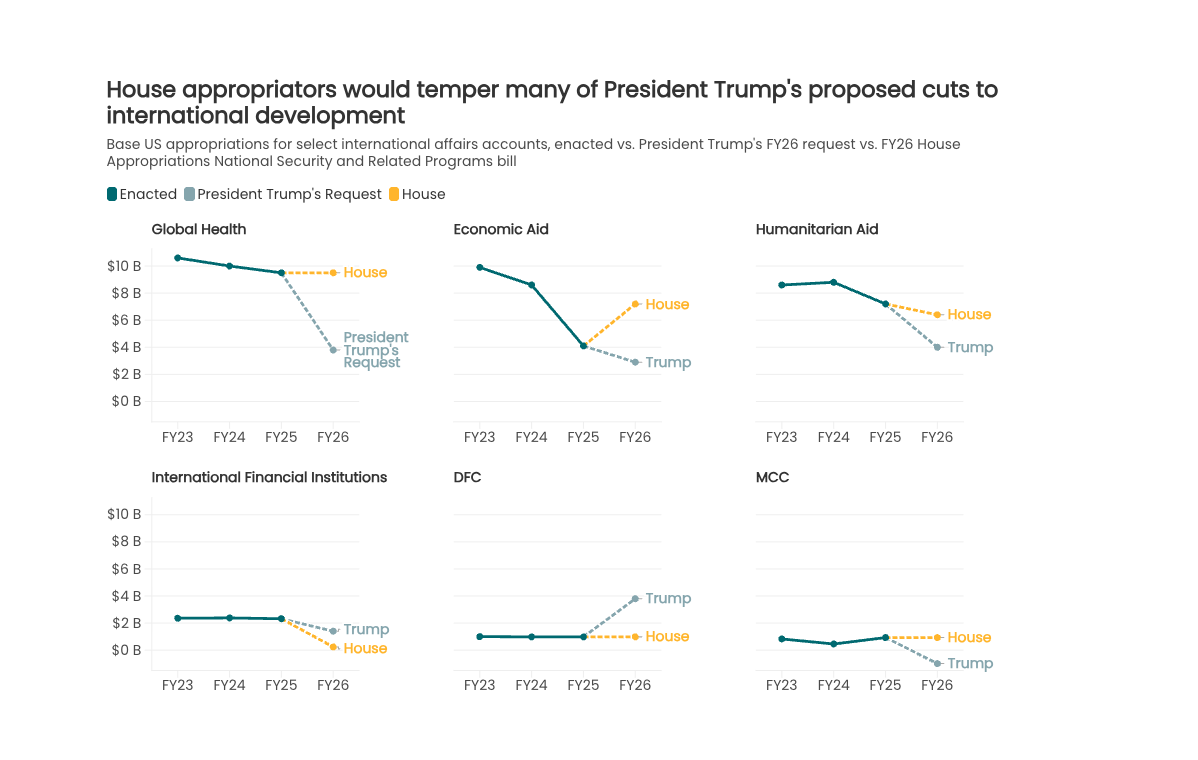
On the contrary, Congress has shown its strong support for MCC by maintaining the same appropriations level in the FY26 bill from the House Appropriations Committee as in recent years.
Does MCC have an inefficient bureaucracy that needs trimming?
MCC staffing has always been lean by design, with 300 people managing about $900 million in annual appropriations. In the wake of DOGE interventions, that staffing has gotten considerably leaner, with roughly a third of MCC’s staff having left the agency by taking retirement or deferred resignation offers.
No doubt there are reasons behind the recommended terminations. But a reasonable analysis suggests that US strategic interests, budget savings, or budget efficiency are not prominent among them. The MCC board has the final say. One hopes that it will apply these criteria more carefully and consistently.
Thanks to Justin Hurley for collecting the information shown in the table above.