Recommended




REPORT
How to Fix Global Education
As overall aid budgets shrink and allocations for direct programme funding dwindle, technical assistance (TA) is once again taking centre stage in donor strategies. TA refers to in-kind development support provided through the transfer of knowledge, skills, and expertise, typically via activities such as capacity building, advisory services, training, and institutional twinning, rather than direct financial aid. For decades, TA has been a prominent, yet sometimes controversial, feature of official development assistance (ODA). Between 2018 and 2022, an average of 13 percent of total ODA was allocated to technical cooperation. This reflects donors’ continued reliance on TA to influence domestic resource allocation and build implementation capacity in low- and middle-income countries (LMICs).
Yet policy debates and academic studies have long highlighted mixed results. Critics argue that TA often creates parallel systems such as standalone project delivery units staffed by consultants and seconded personnel, undermining institutional capacity in the long run. Others note that TA can play a crucial role where state capacity is weak, providing expertise that governments cannot yet supply internally. With major donors (including the UK and EU member states) cutting aid and looking to channel more of the remaining ODA into catalytic activities, questions about how TA is designed and delivered have become more urgent than ever.
A few years ago, we set out to examine how external experts—consultants and seconded staff—are deployed as part of TA to public institutions in African countries. Between 2019 and 2020, we surveyed more than 900 civil service officials responsible for planning, budgeting and programme monitoring across 40 ministries, departments, and agencies in the Central African Republic, Ethiopia, Ghana, and Nigeria. Below are the key findings.
1. Technical assistance is common across governments
Overall, 85 percent of organizational units reported receiving development aid in the form of TA or a mix of TA and direct funding. Departments responsible for economic sectors and infrastructure were the most likely to be covered -- 91 percent received some form of TA. Ministries and agencies focused on finance and economic management were more likely to receive support exclusively as TA rather than in combination with direct funding. This is unsurprising, as organizations such as ministries of finance or revenue authorities typically do not run development programs that would require direct funding.
Figure 1: Share of organizational units receiving various forms of development assistance by functional classification of ministry/department (N=925)
2. External experts are commonly used
Consultants and seconded personnel are among the most visible and widespread components of TA across government. In many contexts, TA effectively operates through these external experts, whether they are embedded advisors, project-based consultants, or donor-financed secondees, rather than through large training programs or direct institutional support.
In Ethiopia, one in three organizational units reported relying on external expertise for reform activities, such as policy changes, system redesigns, or programme restructuring, “always” or “most of the time,” and about one in four did so even for routine assignments. By contrast, in Nigeria, only around 15 percent reported such frequent use. Social sector ministries such as health and education were particularly heavy users of consultants and secondees, while general government services (such as defense and justice) reported the least involvement.
External experts tend to be brought in more often for reform activities than for routine administrative work. Although our survey did not distinguish between consultants and seconded staff, nor identify the donor source, the results underscore the extent to which TA often materializes as externally contracted or embedded personnel, rather than traditional capacity-building programs.
Figure 2: Involvement of external experts in routine and reform assignments
3. Officials often question the need for external experts
Nearly half of the officials we surveyed thought much of the work done by consultants and seconded staff could be handled internally. Only one in ten said none of it could be done internally. This points to a risk that external experts may crowd out in-house capacity.
Of course, these views are subjective. Some officials may not fully grasp what consultants do, or may simply want to defend their turf. Moreover, these perceptions may not necessarily imply redundancy. In many cases, officials may see tasks as technically within their remit but constrained by time, staffing, or resource limitations. In other words, “could be done internally” does not always mean “should have been done internally.”
Still, the numbers reveal a perception gap: external expertise may not be as highly valued by public officials as donors often assume, even if the support ultimately helps deliver key reforms.
Figure 3: How much of the work performed by external experts could be done internally?
4. External experts are perceived as more valuable in fragile states
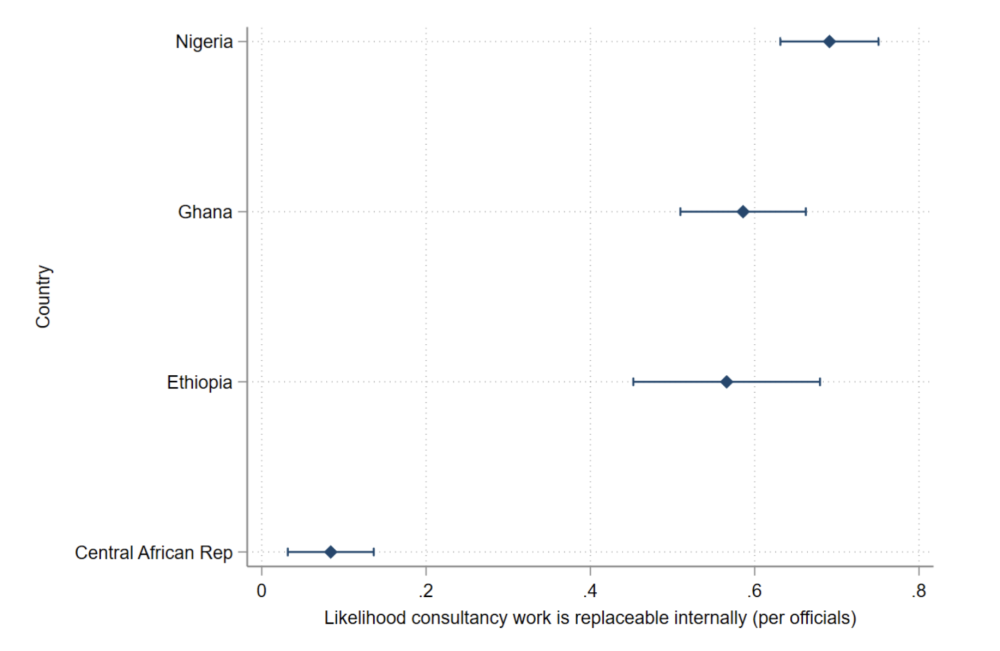
A statistical analysis of responses from 750 officials across the four countries revealed strong country differences. Nigerian officials were around eight times more likely than those in the Central African Republic (CAR) to believe that the work of external experts could be done internally. Over 50 percent of respondents in Nigeria, Ghana, and Ethiopia considered most external work substitutable, compared to less than 9 percent in CAR. This indicates that in fragile contexts such as CAR, external experts may be indispensable, whereas in more stable settings, their presence is seen as less necessary and potentially duplicative. While these findings are based on perceptions rather than objective measures of performance, they align with the broader argument that TA can be most valuable where state capacity is weakest and urgent technical expertise is required.
Figure 4: Where do most officials think consultancy work could be done in-house?
Why aid cuts could present an opportunity to rethink TA
Our findings suggest that the core issue with TA is not whether it is relevant in principle, but how it is delivered and the extent to which recipient governments have a real choice over its modalities. Heavy reliance on consultants and seconded personnel creates trade-offs: while they can provide critical expertise, especially in fragile states, they can also substitute for local skills and undermine long-term institutional capacity.
In the current context and amid significant aid budget cuts, these results point to the need for a more calibrated approach to TA, one that adapts to local capacity levels, changing priorities, and the institutional maturity of implementing agencies.
Donors, recipient governments, and technical assistance providers may need to keep a few basic principles in mind to make TA more effective amid widespread aid cuts.
- Tailor and adapt TA to context: In fragile settings, prioritize external expertise to fill urgent capacity gaps, but in stronger bureaucracies, focus on embedding advisors and supporting in-house teams. TA should also remain responsive to evolving needs, potentially shifting from delivery support to strategic advisory roles as institutions mature.
- Strengthen endogenous capacity and ownership: Design TA to complement, not substitute, domestic systems. This involves aligning technical inputs with existing institutional structures, creating opportunities for joint problem-solving, and allowing public officials to shape TA design and priorities from the outset. Ensuring government ownership throughout helps sustain reforms once external support is withdrawn.
- Plan for sustainability: Move from short-term consultancy models toward hybrid approaches that leave behind capable teams and resilient institutions once funding ends.
Aid cuts, while challenging, offer an opportunity to rethink not only how much is spent on TA, but how it is structured to balance urgent delivery needs with lasting institutional growth.
Acknowledgement: Data collection for this study was funded by the Collaborative Africa Budget Reform Initiative (CABRI) through a grant from the Gates Foundation. I gratefully acknowledge feedback from Euan Ritchie, Ian Mitchell, Lee Crawfurd and Pete Baker.
Topics
DISCLAIMER & PERMISSIONS
CGD's publications reflect the views of the authors, drawing on prior research and experience in their areas of expertise. CGD is a nonpartisan, independent organization and does not take institutional positions. You may use and disseminate CGD's publications under these conditions.