Recommended

Blog Post
Unpacking the US’s New Global Health Strategy

Blog Post
PEPFAR’s Next Chapter
Foreword
Ramona Godbole’s note makes clear the extent of an ongoing crisis of accountability in US foreign assistance. Eighty-three percent of Americans support using foreign assistance to deliver medicine and medical supplies to those who need them. The Trump administration has promised to preserve this lifesaving assistance. But since the start of the year, there has been no way to confirm if assistance is still reaching those who need it. For the two flagship US global health programs, the President's Emergency Plan for AIDS Relief and the President’s Malaria Initiative, monitoring dashboards remain dark. As Godbole notes, tracking is vital, especially in a period of upheaval and proposed reform of how assistance and services are delivered. It is past time for a return to transparency.
Charles Kenny
Senior Fellow
Center for Global Development
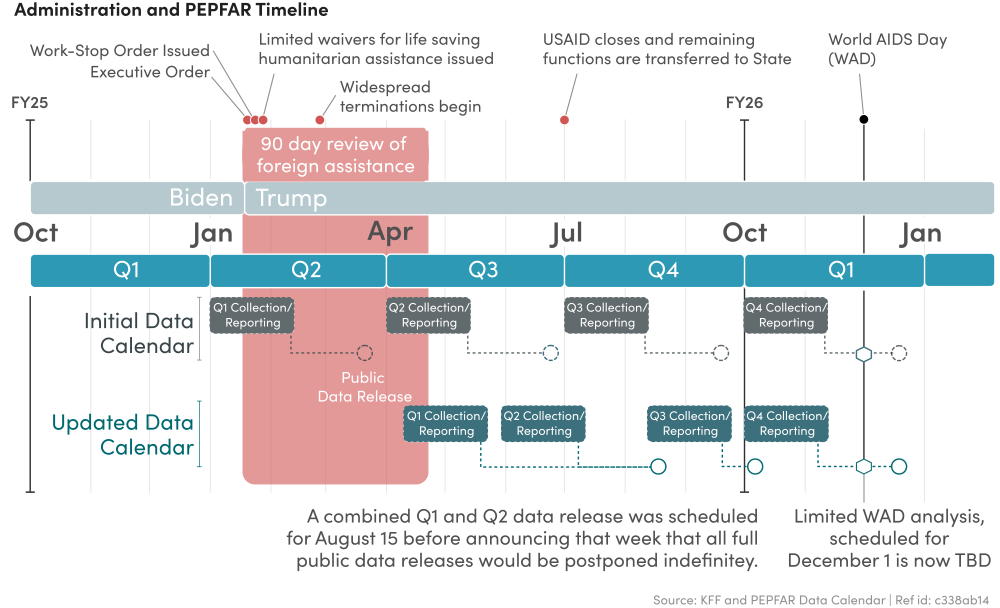
October 3rd marked another missed deadline for public release of the President's Emergency Plan for AIDS Relief’s (PEPFAR) quarterly monitoring data. If you’re not following it as closely as we are: PEPFAR has not released any new data since 2024, and since mid-August, the program's public-facing data release schedule has shifted all dates to "TBD."
We remained hopeful that PEPFAR will release a subset of high-level data for World AIDS Day on December 1st. However, as of last week, that release date has now also shifted to "TBD," leaving no scheduled data release at any level of detail. Without new FY2025 data, researchers, advocates, policymakers, donors, and partner countries will remain in the dark about the program's current status during a critical time of transition.
Imperfect data can still yield insights
The America First Global Health Strategy rightly celebrates PEPFAR for having built "one of the most robust data reporting and monitoring systems of any foreign assistance program in history1.” Even this year, PEPFAR’s commitment to data has endured, with reporting against key indicators continuing, albeit with adjustments. The biggest change has been in data transparency: no new data has been shared publicly all year. This is a drastic departure both from PEPFAR's historical practice and from the reporting requirements the program has consistently met2.
Any data from FY25 (October 1, 2024 to September 30, 2025) is, of course, going to be messy, which may explain why PEPFAR hasn't released it yet. The year unfolded as a series of escalating disruptions: Q1 ended before the flood of stop work orders to implementing partners were issued, but reporting—which typically begins immediately following the end of a quarter—was delayed until after the foreign assistance review. Q2 unfolded amid chaos, with many USAID programs at a standstill while Centers for Disease Control and Prevention (CDC) programs faced fewer restrictions. By Q3, a significant portion of USAID's PEPFAR awards had been terminated entirely. The result: we would have expected Q1, Q2, and Q3 data to be particularly unreliable, and possibly unusable.
However, Q4 data (July–September), collected after remaining USAID programs transferred to State Department management, may have provided a glimpse of what’s actually happening on the ground. While these data will certainly be imperfect3, they could provide critical insight into whether lifesaving HIV treatment was successfully transitioned from terminated USAID awards to State Department or other agency oversight.
Why tracking matters
As described in last month’s note, Analyzing USAID Program Disruptions: Implications for PEPFAR Programming and Beneficiaries, an estimated 2.3 million people on lifesaving treatment—roughly one in ten PEPFAR beneficiaries—could have been affected by this year's terminations to select USAID awards.
Take, for example, Uganda, where PEPFAR implemented a geographically "rationalized" approach, with USAID-funded partners covering general population HIV treatment programs in some districts, and CDC-funded partners covering others. Out of the 76 USAID-supported districts in the country, 70 have experienced at least one USAID award termination that we are aware of. In these affected districts, only one or zero confirmed active USAID awards remain to serve the general population, creating potential disruption for as many as 309 thousand PEPFAR-supported beneficiaries on lifesaving antiretroviral therapy across areas with some of the country's highest HIV prevalence rates. At the national level, this means that nearly one in four targeted patients may potentially be without access to PEPFAR-supported HIV treatment services. The potential risks are more pronounced in USAID-supported districts, however, where award terminations have potentially affected three in five patients receiving PEPFAR-supported treatment services.
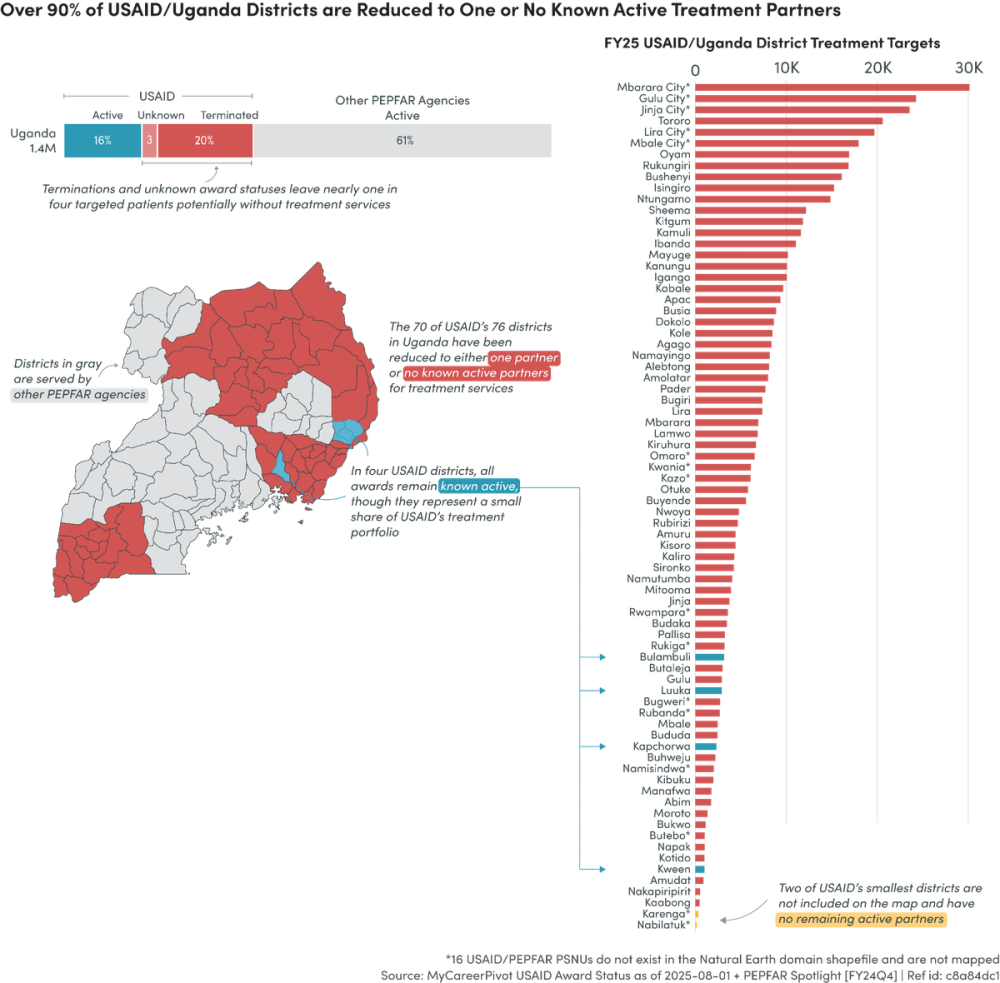
These figures represent potential risks, not confirmed realities. Given the administration's stated commitment to maintaining lifesaving treatment, we would expect and hope to see these beneficiaries served by active awards under State Department, CDC, or other PEPFAR implementing agencies. In fact, there are some early indications that other agencies and entities have begun picking up work from terminated awards, and data from usaspending.gov indicates that resources are being obligated to certain active partners. However, these signals are incomplete, inconsistent, and based on qualitative and imperfect measures. To fully understand whether or not the transition has been successful, we’ll need the kind of detailed, sub-national and award-level information that PEPFAR has historically released publicly. The administration has made clear its commitment to maintaining treatment coverage. But we need data to confirm that commitment has translated into uninterrupted care for the 2.3 million people at risk of disruption.
A baseline to plan and measure progress
We don't just need this year's data to understand what's happened; it's critical as we look to the future and implement a new direction for US global health assistance.
The America First Global Health Strategy calls for bilateral agreements with recipient countries by December 31, 2025, with implementation beginning in April 2026. These agreements are intended to be data-driven, with targets based on historical performance and current realities. Results from FY25, coupled with HIV epidemiologic data, will be essential for effective targeting and resource allocation. Negotiating credible bilateral agreements, complete with cofinancing and performance benchmarks, will necessitate that partner countries have access to the historic data, including the most recent year of implementation. Beyond planning, these baseline data will be critical for ongoing accountability; ensuring both the US government and partner countries live up to their commitments in this new model. The U.S. government has made specific commitments under the new strategy, including maintaining 100 percent of frontline investments in 270,000 healthcare workers and over $1 billion in annual health commodities, while dramatically reducing the remaining 60 percent of the budget spent on technical assistance and program management. Annual Expenditure Reporting data, which appears to be proceeding, will show how much was spent and where, establishing the starting point for measuring future change. Without public release of the data, however, there's no independent way to verify that these commitments are being met and that efficiency claims translate to genuine programmatic reform.
Partner countries need this baseline data for their own accountability, as well. If countries are to be held accountable for meeting performance benchmarks and maintaining treatment coverage, they need clear baseline data showing current service levels, costs, and outcomes. This is especially important given that, as part of each bilateral agreement, countries will need to develop performance monitoring systems to track service delivery, supply chain, epidemiologic, and co-investment data moving forward.
Enabling coordinated investment
Public release of these data—both historic and future—will be essential not only for accountability, but to coordinate country and donor investments during this period of unprecedented transition. Without public access to baseline data, recipient countries cannot align their domestic HIV budgets with remaining PEPFAR support, risking either dangerous gaps in coverage or wasteful duplication. Non-US bilateral funders, as well as the Global Fund, which co-invests billions in many of the same countries, cannot effectively target its resources to complement rather than duplicate PEPFAR programming.
Philanthropic efforts face similar challenges. Project Resource Optimization (PRO) initiative's success—raising over $110 million across nearly 80 projects to support health and humanitarian program transitions—was built, in part, on access to detailed program information that allowed the initiative to identify and fill specific gaps. As PEPFAR funding shifts rapidly, philanthropic organizations that may not have historically worked in the HIV space are considering where they might step in. These efforts, whether from existing HIV funders or new entrants, will depend on current data to identify which specific interventions need support. They also need to understand which critical infrastructure, like HIV laboratory networks and supply chain systems, retains PEPFAR support and can be leveraged for new investments. Without transparent information on what PEPFAR is or is not funding going forward, philanthropies cannot strategically direct their resources to areas of greatest need.
What’s next?
With no data release currently scheduled on PEPFAR's public calendar—including the subset of high-level indicators that had been planned for World AIDS Day—the situation has become increasingly urgent. Even that limited release would have provided some visibility into the program's current status. However, what's truly essential is release of the full dataset by the State Department, ideally with appropriate context and caveats about data quality and completeness given this year's disruptions.
These data could allow for independent analysis to understand what happened this year: whether beneficiaries were lost, whether transitions succeeded, and what the true impact of disruptions has been. More importantly, the data could establish a baseline for the future to measure the efficiency commitments, target resources effectively during the bridge period and beyond, and enable coordinated planning with countries and other donors as PEPFAR enters a new era.
PEPFAR has built its reputation on transparency during both successes and setbacks. The program's credibility has rested not on perfect performance, but on honest reporting that allowed stakeholders to hold it accountable and push for improvements. Sharing this data is further underscored by the disappearance of USAID's broader global health data: results.usaid.gov no longer exists, and comprehensive records of the agency's work have vanished from public view. Releasing FY25 data—messy as it may be—would reaffirm the US commitment to global health data transparency, even amidst significant transition.
Notes
1. For the past several years, the vast majority of PEPFAR’s data—both raw numbers and interactive dashboards—has been shared publicly on data.pepfar.gov. PEPFAR’s three key data streams are
2. There are a number of mandates and requirements that govern the collection and public release of U.S. foreign assistance generally and PEPFAR specifically, including the Foreign Aid Transparency and Accountability Act of 2016 (FATAA), the Program Management Improvement Accountability Act of 2016 (PMIAA), the Foundations for Evidence-Based Policymaking Act of 2018 (the Evidence
3. Q4 data will need to be interpreted carefully. While terminated awards should, theoretically, be required to report as part of close out; in practice this might be unrealistic. Depending on reporting rates, it will be hard to distinguish between true losses and poor data quality. In addition, many indicators of potential interest have been dropped or become optional for reporting as described in the latest PEPFAR MER guidance. Finally, for non-cumulative ("active") indicators, which capture the current status of beneficiaries at a specific point in time, year-over-year comparisons for these metrics may be extremely difficult, with Q4-to-Q4 comparisons offering the most reliable analysis.
Topics
CITATION
Godbole, Ramona. 2025. PEPFAR’s Missing Data: Why Transparency Matters More Than Ever. Center for Global Development.DISCLAIMER & PERMISSIONS
CGD's publications reflect the views of the authors, drawing on prior research and experience in their areas of expertise. CGD is a nonpartisan, independent organization and does not take institutional positions. You may use and disseminate CGD's publications under these conditions.
Thumbnail image by: Josh Estey/USAID