Recommended

Project


Blog Post
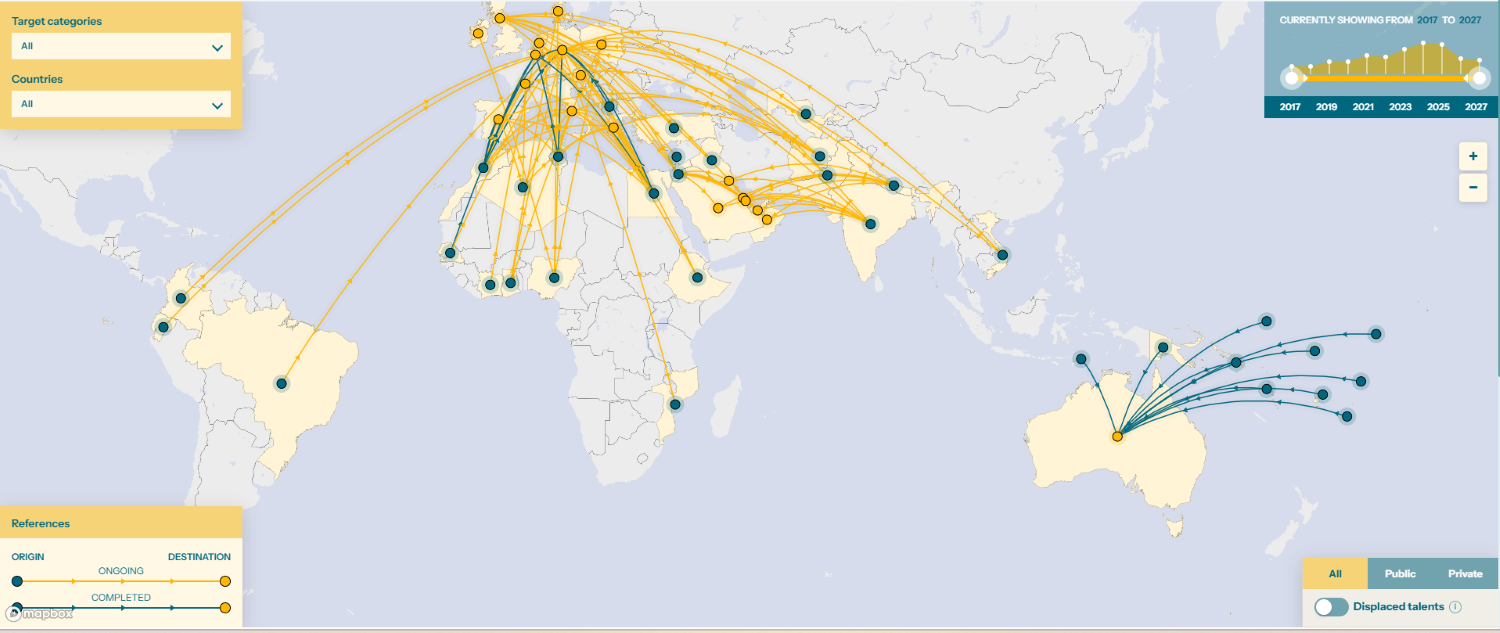
A Global Map of Green Skilled Migration Projects
Workforce gaps are a key bottleneck when it comes to reducing carbon emissions in almost every country. Even where capital, technology, and political will are available, shortages of skilled workers are slowing delivery of decarbonisation plans, delaying installations, and deterring investment. This trend will grow as the time available for cutting emissions runs down. Solving workforce shortages is thus a pressing climate policy priority.
In a new paper, we for the first time put a number on the climate impact of adding one more worker where clean energy activities are held back by worker shortages. We focus on cases where clean energy installations are delayed —or would never happen— because there are not enough workers. When one additional worker fills that gap, those projects can move ahead, cutting emissions that would otherwise continue. (We call the work enabled by this additional worker the “marginal contribution”.) Our modelling shows that, in these situations, a single worker can be linked to avoiding several thousand tonnes of CO₂. This is the case even when accounting for success in broader grid decarbonisation goals (Figure 1).
Our analysis focuses on two occupations central to near-term decarbonisation: electricians installing residential rooftop solar photovoltaic (PV) panels, and heating technicians installing residential heat pumps. We model a period of work from the start of 2024 to the end of 2032, across six countries and two occupations. We assess worker outputs, their installations, and the carbon emissions reduction impact of the installed technology’s activities net of embodied carbon in the context of grid decarbonisation in the same period.
This can also be expressed in monetary terms. Using standard social cost of carbon approaches (we use those developed by the US Environmental Protection Agency in 2023), the implied value of the emissions reductions comes to hundreds of thousands of dollars: a solar panel installer working in Italy, for example, will contribute to abatement with a social value of over US$280,000. This is also the equivalent of planting a forest of trees: more than 6,500 trees would need to grow for 50 years to sequester the equivalent amount of carbon (Figure 2).
On this basis, we argue that if domestic training pipelines are insufficient to meet workforce demand for decarbonisation within the urgent timeframes required, legal, skills-based labour migration programmes should be used to ensure that binding workforce constraints do not persist. Our chosen countries comprise three possible countries of destination facing shortages (the United Kingdom, Germany, and Italy) and three possible countries of origin interested in agreeing training and migration partnerships (India, the Philippines, and Kenya). All three countries of destination are already, to varying degrees, leaning on immigration to meet decarbonisation workforce needs. Germany, for example, has explicitly linked immigration reforms to decarbonisation-related workforce pressures, and has also established several labour migration initiatives aimed at reducing shortages.
However, migration of “green-skilled” workers can also pose a carbon risk. High-income countries typically have lower carbon emissions per kilowatt-hour of generated grid electricity than lower-income countries, and also have more ambitious grid decarbonisation plans. Moving a “green” worker—for example, an electrician installing solar PV—from a lower-income country to a higher-income country could lead to a large negative impact on net decarbonisation if their work is similarly marginal in both countries (Figure 3). A worker installing rooftop solar PV in the Philippines, where the grid carbon intensity was an estimated 675gCO2/kWh in 2025 would lead to the abatement of nearly 5,500 tonnes of CO2 during the period modelled. If they moved to the UK they would contribute nearly 700 tonnes of abatement; so if their departure left a gap in the solar installer workforce that wasn’t otherwise filled, the net effect of their emigration would be an extra 4,800 tonnes of CO2 emissions.
For this reason, we argue, countries of destination must take care when recruiting to ensure that they are not leaving a bottleneck in countries of origin, harming a global public good. Instead, they should target underemployed workers or collaborate with countries of origin to train more workers, ensuring that the global stock of skilled workers rises and that tasks crucial to decarbonisation are not left undone due to labour shortages.
Policy conclusions
Ultimately, most countries will struggle to raise domestic training capacity to the heights needed to supply all the workers required. The findings of this new paper support the use of targeted labour migration to supplement domestic supply and ensure workforce gaps do not limit reductions to carbon emissions. Across high-income countries seeking to decarbonise rapidly, the thousands of migrant workers needed to fill labour gaps are likely, on the basis of this paper’s modelling, to contribute to the abatement of millions of tonnes of CO2.
For this reason, we draw the following policy conclusions:
Where domestic labour pipelines alone cannot meet needs, international recruitment should be facilitated. From a carbon emissions reduction standpoint, labour migration is not a tool that can be set aside. This requires coherency between reliable green industrial policy, workforce development policy, and immigration policy, informed by strong labour market intelligence.
International recruitment must be conducted with care to ensure that it does not leave decarbonisation gaps in countries of origin. Because of differences in grid decarbonisation levels, a worker can often make a greater contribution at the margin in a country of origin than in a country of destination. Because the climate is a global public good, this recruitment would therefore be harmful to the country of destination’s interests.
Underemployed workers should be targeted for recruitment. Recruiting under- or unemployed workers will avoid the creation of workforce gaps, and maximise the net decarbonisation gain from workforce reallocation. Partnerships can be agreed with countries with surplus pre-trained populations. Equally, some populations, such as refugees unable to work in host countries, may have necessary skills but be unable to use them.
Harmonise curricula and qualification recognition procedures to facilitate workforce mobility. International reallocation of workers to countries with skill bottlenecks is crucial for decarbonisation. Difficulties in recognising training standards, however, frequently delay or derail mobility. Harmonisation of curricula to international standards and improvements to credential recognition should be priorities for standard-setting and recognition bodies at the international and national levels. Mutual recognition or service level agreements and overseas assessment partnerships could help at the bilateral level.
Training and migration partnerships to increase global workforce supply, rather than merely reallocating it, can mitigate risks. Partnerships that increase the total stock of workers before helping some to move to where they’re needed (e.g. Global Skill Partnerships) can benefit both destination and origin countries. For the country of destination, such a partnership can serve as a form of insurance and as a contribution to broader decarbonisation. If they do need workers, they have a known supply whose training they have ensured is to the standard required. If they do not, the workers can go where they are needed: in the green transition they are unlikely to go unemployed. This is a model being tested by Australia in partnership with India.
Given the value of a marginal skilled worker, training and migration partnerships are a good use of climate finance. Without skilled workers, decarbonisation cannot happen. An individual’s abatement contributions can run into thousands of tonnes of CO2: preventing workforce bottlenecks is a good use of climate finance. As of today, only very limited climate funds are used to address clean energy workforce shortages— a key missed opportunity.
Topics
DISCLAIMER & PERMISSIONS
CGD's publications reflect the views of the authors, drawing on prior research and experience in their areas of expertise. CGD is a nonpartisan, independent organization and does not take institutional positions. You may use and disseminate CGD's publications under these conditions.
Thumbnail image by: CGP Grey/Wikimedia