Recommended

Despite the global development system’s existential funding crunch, the World Bank is booking record profits. Last fiscal year, the World Bank reported a record $2.4 billion in profit. And in the first quarter of this fiscal year (June-September), it has already brought in $570 million in profit.
The World Bank—via its hard loan window, the International Bank for Reconstruction and Development (IBRD)—has always been a profit-making institution: it borrows from capital markets at a certain rate and then on-lends to its clients at a slightly higher rate. The difference between the two rates is used to fund the bank’s operating costs. What remains is profit (or what is termed “allocable net income” in the World Bank’s financial statements). IBRD profits have quadrupled over the past decade, largely because it is lending a lot more.
Until 2016, most of the IBRD’s “allocable net income” was transferred to the International Development Association (IDA), the World Bank’s fund for the poorest countries, to buttress funding for low-income countries. But concerns around the IBRD’s own financial position prompted a rethink of the IDA transfer. In response, in 2017, the World Bank began to implement a formula-based approach to determine the size of the IDA transfer that radically changed how the World Bank uses its profit (see Figure 1).
Figure 1. IBRD support to IDA fell after 2017
IBRD annual net income allocations (in $ million)*
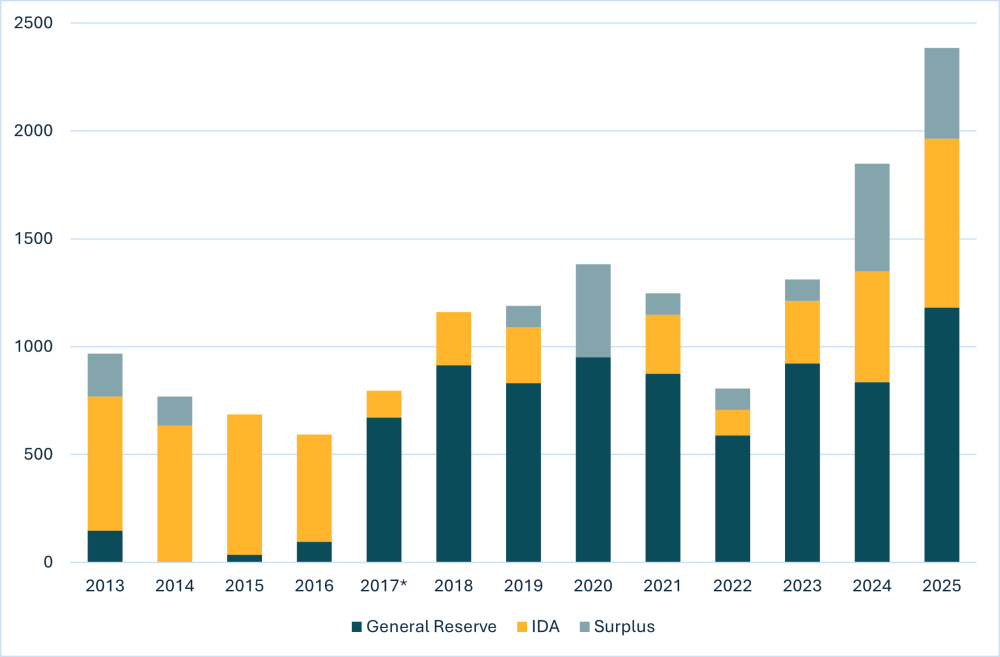
*NB: The surplus fund is used to finance non-IDA grants, most recently the Livable Planet Fund, or projects in the West Bank and Gaza. General Reserve funds are reinvested on the IBRD’s balance sheet.
The formula-based approach significantly dampened IBRD’s support to IDA. In the years leading up to the implementation of the formula, IBRD transferred a total of $1.8 billion to the IDA 17 replenishment cycle (2014-2016). The transfer decreased by over two-thirds in IDA 18 (2017-2019) to $630 million after the formula was implemented.
The formula was designed so that IBRD would retain a larger share of its profit (i.e., move them into the “general reserve”) and grow its balance sheet through capital accumulation. This was responding to a 2017 problem, namely that IBRD was capital-constrained and faced a lending cliff unless it bolstered its equity base. Shareholders were in the process of negotiating a General Capital Increase (GCI), and the United States was pushing hard on IBRD’s ability to financially self-sustain. In contrast, IDA’s financial position was growing stronger, which diminished the case for the transfer. In 2017, IDA introduced a hybrid financial model, which enabled IDA to start borrowing from that market, and it increased its program of loans and grants by almost a third. Steady donor support was not in question, and IDA could also rely on a steady stream of grant contributions each cycle. Against this backdrop, several major countries were graduating out of IDA, such as Vietnam, which reduced the claim on IDA resources.
The logic underpinning the transfer formula is at odds with today’s realities. IBRD is now in a strong financial position. Its equity-to-loan (E/L) ratio has continued to hover around 21.5 percent, despite the fact that the World Bank lowered the threshold to 18 percent in 2024, suggesting that IBRD has more than ample capital to meet client demand. The latest S&P Supranationals Edition suggests that IBRD may have significant unexploited headroom above and beyond the E/L threshold. In sharp contrast, IDA is today profoundly capital-constrained, with a majority of its client countries in or at high risk of debt distress and core donors becoming increasingly unreliable sources of funding. And several countries—including Sri Lanka and Syria—have regained IDA eligibility, putting yet more pressure on a limited resource pot.
Shareholders should take a fresh look at the rules governing the allocation of IBRD profits. My very back-of-the-envelope calculations suggest that IBRD could average as much as $2.8 billion a year over the next three years (and this may be a conservative guess since it assumes a steady state in lending with no increase related to S&P’s additional headroom numbers). Does it still make sense to reinvest profits in the IBRD’s balance sheet when it has so much unutilized lending headroom? Shouldn’t the World Bank be taking all measures possible to shore up its support to the poorest countries through IDA in this era of development crisis? Are there other important casualties of the donor retreat where these additional resources could make a difference? The World Bank board needs to have this debate.
To put my cards on the table, my preference would be for the bulk of IBRD profits to go to IDA. Let’s assume my $2.8 billion a year in allocable net income number is ballpark correct, and the World Bank transferred around two-thirds to IDA over IDA 21—that would raise total transfers from $2.7 billion to $5.6 billion. It would more than compensate for the cuts in donor contributions from IDA 20 and IDA 21. It would be an increase larger than the United Kingdom’s entire IDA pledge. And there are also interesting governance implications: it would make the IBRD the largest contributor to IDA. Since the transfer essentially represents profits from loans to middle-income countries, it could translate into a greater voice for these countries at the IDA board.
But there are also other options. One would be for IBRD to lower its loan charges to IDA blend countries (the countries that borrow both from IBRD and IDA) so IBRD could take more responsibility for financing these countries on affordable terms and alleviate some of the pressure on IDA. (We are working on a paper on this now, so more analysis is coming soon!) Another option would be for IBRD to use the profits to fund a research ventures fund, as my former colleague Scott Morris had proposed in 2019, for research and innovation. Or a bigger chunk of IBRD’s profits could capitalize the Livable Planet Fund for global public goods (which is currently receiving funding out of the surplus fund) that it launched in 2024 at a time when a lot of climate and health support is being slashed.
But the bottom line is that the status quo is incongruous with the times. In this era of scarcity, IBRD holds important and underutilized resources. And this comes at a significant cost, especially for the poorest
It’s time to reopen the debate around who gets the profits.
Topics
DISCLAIMER & PERMISSIONS
CGD's publications reflect the views of the authors, drawing on prior research and experience in their areas of expertise. CGD is a nonpartisan, independent organization and does not take institutional positions. You may use and disseminate CGD's publications under these conditions.
Thumbnail image by: Tim on Tour/ Adobe Stock