Recommended

Blog Post
How the UK Should Focus Its Aid in 2026

The UK’s development minister, Baroness Jenny Chapman, recently caused consternation within the UK development sector by raising the possibility that the Independent Commission for Aid Impact (ICAI)—the UK’s aid watchdog—could be scrapped. Colleagues have already written why they think that this is probably a bad idea: given ICAI’s tiny budget, it could quite easily pay for itself many times over if it led to even modest improvements in UK aid.
This blog examines all published Foreign, Commonwealth & Development Office (FCDO) business cases for aid projects to explore how prominently ICAI reviews have featured, and finds that ICAI reviews are often an important input for the approval process, with one in seven business cases referencing them in some way.
Many of these references show that as well as helping to weed out bad projects, ICAI has had a positive role in shaping policy. This is despite an annual cost equivalent to the monitoring and evaluation budgets for some individual programmes (or even less). It is not impossible that there are different options that could retain this function as a constructively critical friend, but the evident influence of ICAI in FCDO documentation does not provide strong rationale for getting rid of it.
How many of FCDO’s project documents reference ICAI?
FCDO publishes (nearly) all of its business cases for aid projects on its aid transparency platform Devtracker. These documents detail the nature of the intervention, and the underlying evidence for their effectiveness. The latter needs to be sufficiently strong to convince either department heads or ministers to sign off the project (depending on the size). Since ICAI was established in 2011, its reviews have often formed part of this evidence base. There are currently 2,591business cases available on Devtracker, and of these, 372 mention ICAI, just over 15 percent.
The figure is higher for larger projects that are subject to additional scrutiny. Projects seeking budgets over £40 million need to be approved by FCDO’s Quality Assurance Unit (QAU), which assesses the quality of the evidence underpinning the proposed project. Of these, over a quarter mention ICAI, and this figure has been increasing in recent years (nearly 40 percent of business cases for projects over £40 million contained an ICAI reference in 2024).
Figure 1: Percentage of business cases referencing ICAI
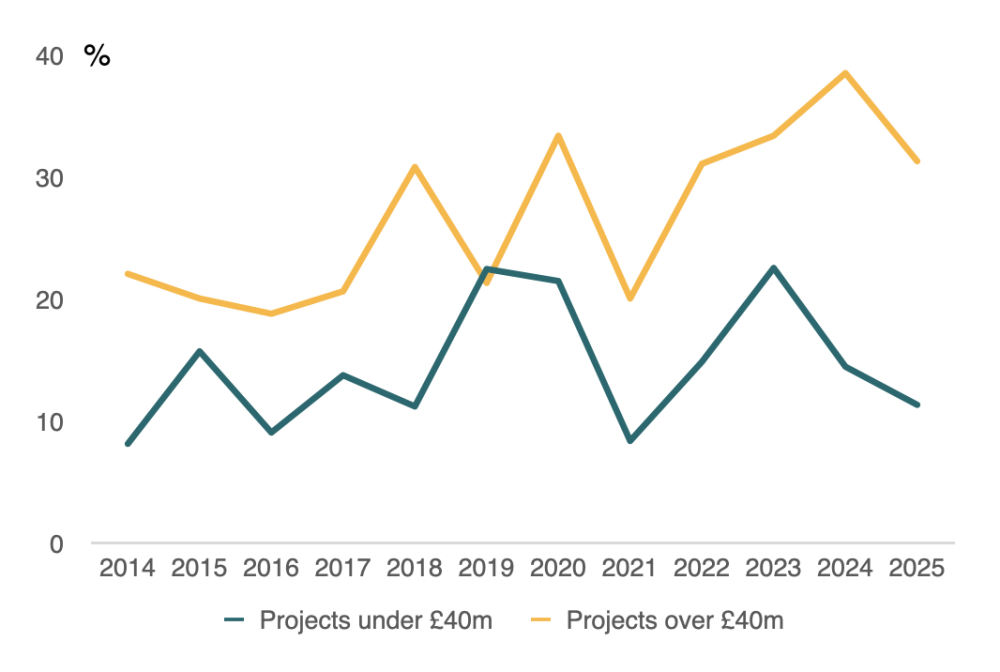
Source: FCDO business cases, accessed via the International Aid Transparency Initiative
This prominence suggests that FCDO officials are aware of ICAI reviews, and see value in citing them (whether because they trust the reviews themselves, or think they hold sway with business case adjudicators). We do not have information on rejected projects, so it is impossible to know whether citing ICAI reviews makes it more likely for projects to receive a positive QAU assessment, but the higher levels of mentions for projects facing greater scrutiny are indicative that officials think it may help their case.
ICAI reviews inform programme design and support the case for more funding
In many cases, ICAI reports are used to justify or support programmatic decisions. For example, a democracy-strengthening programme in Ethiopia bases using UNDP as a partner on the basis of an ICAI review, and support for a UN fund was redesigned in line with findings from another. One programme credits ICAI (along with other evaluations) for improvements to risk-management functions.
Similarly, ICAI is frequently mentioned in requests for cost extensions, and some of these are explicit about the influence of ICAI on the project. One programme sought a £2 million cost extension to support efforts to rebalance DFID’s programming towards ending violence against women and girls and notes that “This is in part a response to the recent ICAI report”. Others note how programmes have been adapted in response to ICAI recommendations. In requesting a cost extension of £74 million for a humanitarian programme in Somalia, the addendum states that: “this model of building flexible finance into humanitarian programmes from the outset was one of the main recommendations from the ICAI Horn of Africa... DFID Somalia began applying this approach through the Multi Year Humanitarian Programme (MYHP) and has carried it forward into SHARP.” (GB-1-205128).
Many more references hint at ICAI informing programme design. A request for more funding for the “Million commitment for the Three Millennium Development Goal (3MDG Fund)” noted that it received “the first fully green rating” from ICAI. Another cost extension seeks to support UNRWA’s reform agenda “following on from the recommendations of the September 2013 Independent Commission for Aid Impact (ICAI) report.” And a request for a cost extension for British International Investment (worth £3.5 billion) credits ICAI for BII’s inclusion of a broader range of development impact criteria in its project assessments, following a critical review that started in 2018.
So, in many cases, FCDO staff directly credit ICAI recommendations for elements of programme design. But is this impact positive? Or are FCDO officials begrudgingly making unnecessary changes in response to external pressure? There are two reasons to think that at the very least, officials believe that these changes are for the better. The first is that the government has agreed with the vast majority of ICAI recommendations, and the need to act upon them. The business case quotes are just evidence that those promises were not empty.
The second is that officials clearly do not feel compelled to follow the recommendations where they disagree: several business cases note why they are not doing so, for example in the ESSPIN programme officials respectfully note why they will not implement a change suggested by ICAI. That’s fine: ICAI is not infallible, but an outside perspective nevertheless has the potential to bring improvements. And for big, multi-year projects, even slight improvements would more than pay for ICAI’s slender budget.
ICAI as a critical friend
ICAI has two functions: a learning, and an accountability function. The latter—ensuring government honours commitments and spends aid in accordance with legislation—tends to receive more attention. ICAI has been credited with stopping ineffective aid to China, and played a major role in the closure of ineffective programmes like the Prosperity Fund. Identifying underperforming programmes is a valuable function, especially in an era of cuts. But the above analysis highlights that the learning function—informing programme design and highlighting best practice—has likely contributed to the positive impact that ICAI has had on UK aid.
The learning function adds to the substantial evaluation and learning process that takes place within FCDO, both as part of individual programmes and of overall portfolios. But this does not mean that ICAI is duplicative: internal reviews may struggle to deliver the candid, cross-cutting conclusions that an outside voice can. ICAI can also give visibility to more widely-applicable conclusions than internal reviews: its learning function is not limited to FCDO in the way that internal reviews tend to be. ICAI reviews may also be more useful for officials making the case for certain interventions, by lending their arguments additional credibility: “this is not just our argument for why we should receive this funding, it is backed up by external reviewers”.
Of course, paying for additional evaluations costs more money. But both internal and external evaluations have their place, and ICAI is not particularly expensive compared to the former. FCDO are currently funding an evaluation of its economic growth research with a budget of over £500,000—roughly double the average cost of ICAI reviews. Some individual programmes have evaluation budgets many times that. Good evaluations require expertise and that is expensive how ever it is procured.
ICAI does enough to justify its existence
It is difficult to rigorously evaluate ICAI’s impact: we cannot observe the counterfactual world in which ICAI did not exist. But there is a plethora of examples of FCDO staff claiming that it was instrumental in bringing about changes to programme design, and in justifying the extension of successful projects. This suggests that it is still performing a valuable role in the UK-aid ecosystem—easily enough to justify £4 million a year, or 0.04 percent of the new aid budget.
Topics
DISCLAIMER & PERMISSIONS
CGD's publications reflect the views of the authors, drawing on prior research and experience in their areas of expertise. CGD is a nonpartisan, independent organization and does not take institutional positions. You may use and disseminate CGD's publications under these conditions.