Recommended
Project
Key messages
This note examines the evolution of comparable health system metrics covering inputs, outputs, and outcomes across three country groupings: “legacy low-income countries (LICs),” comprising 24 countries that have remained low income since the 2000s; “transitioned” lower-middle-income countries (LMICs), comprising 32 countries that have transitioned from low- to lower-middle-income since the 2000s; and “legacy LMICs,” comprising 16 countries that have remained lower-middle-income since the 2000s.
- Despite not receiving the majority of health aid over the past two decades, legacy LICs have narrowed gaps relative to legacy and transitioned LMICs in many areas, including service coverage and health spending efficiency; even closing the gap completely in the case of HIV/AIDS.
- Despite this progress, they remain behind other groups considerably in terms of financial protection, domestic health spending, and workforce availability.
- Consequently, legacy LICs should be the top priority for donor support based on their health system needs, continuing to support the delivery of basic health services through simple, highly concessional instruments.
- Transitioned LMICs may also require external support over an extended period, which should be much more nuanced in terms of instruments, modalities, and development objectives.
- Overall, health aid needs to become much more agile, in both (re)allocation and design, to maximise impact, fairness, and value in low-resource settings.
Data and code for the analysis are available on GitHub here.
Introduction
Reductions in development assistance for health are here to stay for at least several years, and so are tough choices in global health about how and where to prioritise a smaller envelope of health aid. Focusing aid on the lowest resource settings makes sense—this is where need and potential impact are highest. Low-income countries (LICs) and lower-middle-income countries (LMICs) are typically seen as those in most need of external support.
Over the past two decades, many countries have changed classification, with some even “leapfrogging” two income groups altogether—for example, Bosnia, China, and the Republic of Moldova all moved from low- to upper-middle-income. Of 53 lower-middle-income countries in the year 2000, 22 countries were high-income in 2025 (Table 1). 25 years ago, 75 percent of the world's population lived in LICs and lower-middle-income countries; today, it is less than 50 percent.
Table 1. Income group transitions of low- and lower-middle-income countries between 2000 and 2025
| Number of countries by income group in 2000 | Number of countries by income group in 2025 | |||
|---|---|---|---|---|
| Low-income | Lower-middle | Upper-middle | High | |
| Low-income (n=63) | 24 | 32 | 7 | None |
| Lower-middle-income (n=53) | 1 | 16 | 30 | 22 |
Source: based on income group classifications from the World Bank, July 2025 release.
Note: Bosnia, China, Honduras, and Sri Lanka transitioned from low- to lower-middle-income between 1995 and 2000.
For the countries that have made the leap to higher income strata, this transition is, undoubtedly, a resounding success story for development. However, the remaining LICs have stagnated within their category for generations, and most are likely to remain within it for the foreseeable future. Meanwhile, the lower-middle-income grouping today spans both archetypes—formerly LICs having seen rapid growth, and longstanding LMICs that have stagnated.
What has the income group transition of the past 25 years brought for health systems in low- and lower-middle-income countries? How similar are these groupings today? Is there scope to prioritise external support between them, fully or partially? And what do the next 25 years look like for them?
This note examines these questions through the lens of comparable health system inputs, outputs, and outcomes based on data from the World Bank, the World Health Organization, the International Monetary Fund, and other literature sources. It examines specifically three country groupings (full list in Annex 1):
- LICs that have remained in the low-income classification since 2000s, which we call “legacy LICs” (n=24);
- formerly LICs which have transitioned to lower-middle-income status at any point since the year 2000, which we call “transitioned LMICs” (n=32); and
- LMICs that have remained in this group since the 2000s, which we call “legacy LMICs” (n=16).
Today, there is a clear GNI per capita gradient across these three groups, with transitioned LMICs distinctly between legacy LICs and legacy LMICs (Figure 1, vertical axis). Two decades ago, however, the picture wasn’t as clear cut. Nearly all LICs with high GNI per capita in 2000 transitioned to LMICs, while at lower GNI per capita some transitioned and others did not (horizontal axis).
Figure 1. Gross national income per capita by income group change, 2000 and 2023
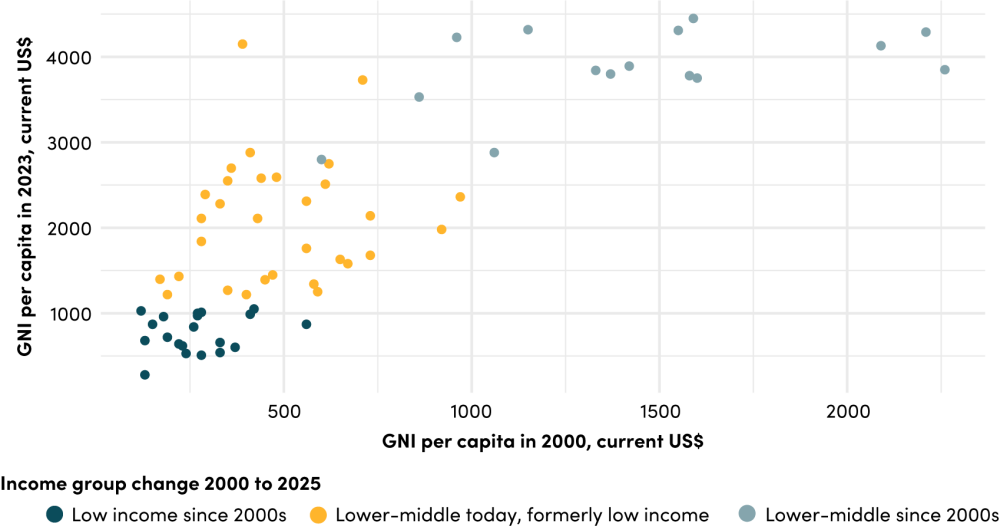
Notes: Data from the World Development Indicators, indicator NY.GNP.PCAP.CD.
Twenty-five years later: Health system changes since the 2000s
Mixed improvements in health workforce availability and domestic health financing
Health workforce availability has improved substantially in most legacy LICs, with more modest and nuanced improvements in LMICs (Figure 2). The median density of physicians, nurses, and midwives in legacy LICs has increased up to threefold. For LMICs, the improvement picture is more nuanced: the median physician density has increased by about 50 percent only for legacy LMICs, while the median nurse and midwife density has increased also by about 50 percent only for transitioned LMICs. Despite these improvements, a stark income gradient remains—the median physician density in legacy LMICs is about nine times higher than in legacy LICs; for nurses and midwives, it is three times higher.
Figure 2. Density of health professionals by income group change category, 2000 and 2025
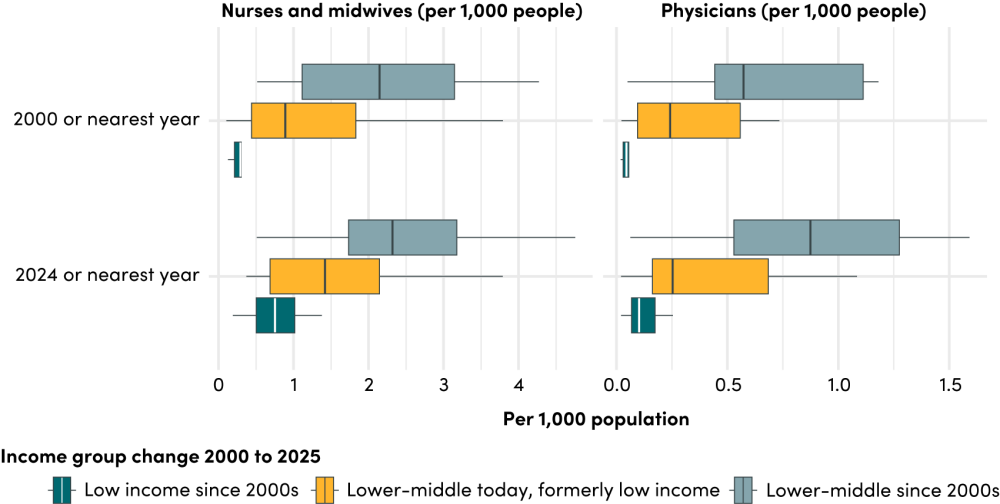
Notes: Data from World Bank HNP Statistics, indicators SH.MED.NUMW.P3 and SH.MED.PHYS.ZS. Boxplots show the median (vertical line), the interquartile range (box) and range; outliers were removed for ease of visualization.
In terms of domestic health spending, legacy LICs spend the same amount per capita, adjusted for inflation, as they did 25 years ago. LMICs—both legacy and transitioned—on the other hand spend nearly double what they used to (Figure 3, left panel). This spending increase has been driven mainly by economic growth because health has not been prioritized more than it used to as a share of government expenditure (Figure 4). In per capita terms, health aid has remained historically near double in legacy LMICs compared to legacy LICs and transitioned LMICs (Figure 3, right panel).
Figure 3. Domestic and external health spending per capita by income group change category, 2000 and 2023
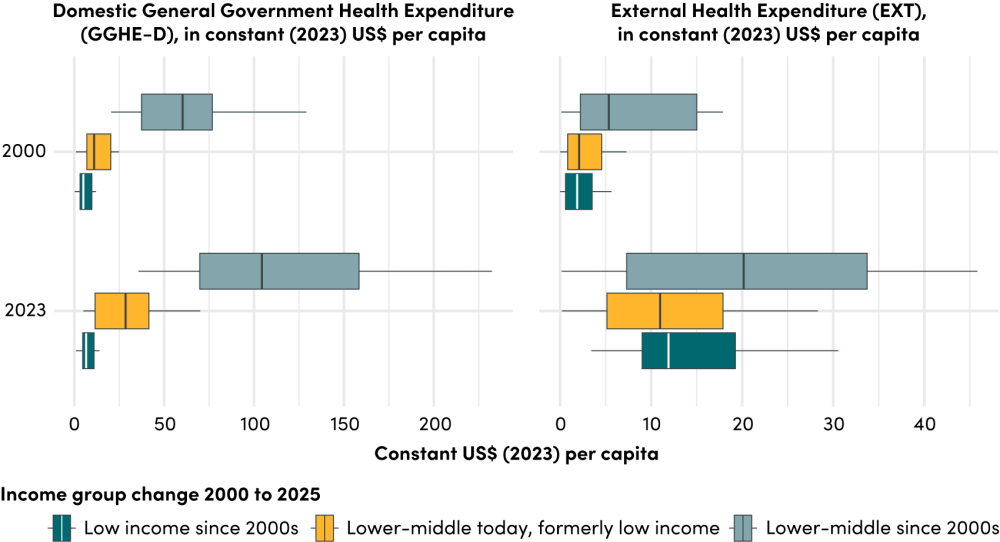
Notes: Data from the WHO Global Health Expenditure Database, December 2025 release. Boxplots show the median (vertical line), the interquartile range (box) and range; outliers were removed for ease of visualization.
Figure 4. Health prioritization in government expenditure by income group change category, 2000 and 2023
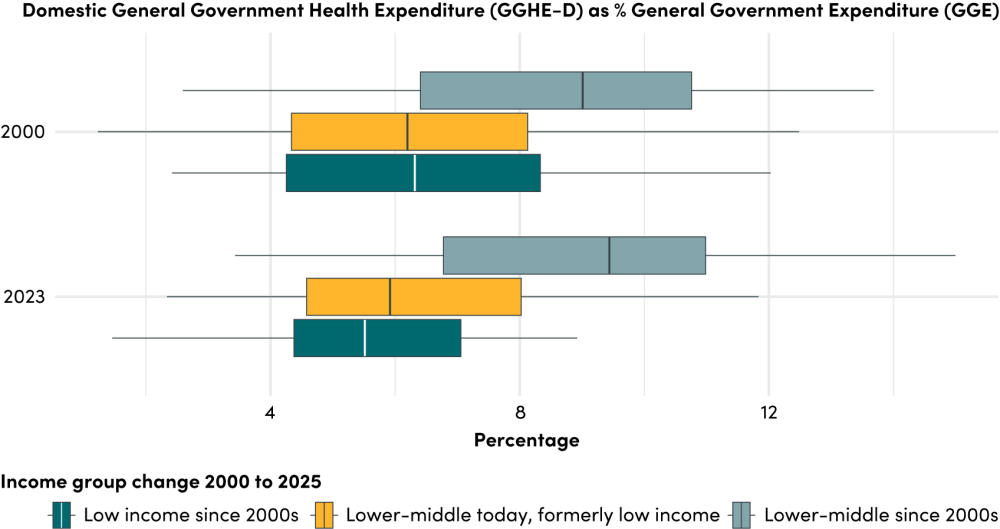
Notes: Data from the WHO Global Health Expenditure Database, December 2025 release. Boxplots show the median (vertical line), the interquartile range (box) and range; outliers were removed for ease of visualization.
Mortality rates have gone down substantially across the board, particularly for HIV/AIDS
In 2000, LICs had substantially higher mortality rates than LMICs for HIV/AIDS, malaria, maternal health, neonatal health, and tuberculosis. A typical LIC had HIV/AIDS and tuberculosis mortality rates nearly 50 times higher than a typical LMIC, and much higher in some cases. For maternal and neonatal conditions, it was three times higher.
Today, legacy LICs have much lower mortality rates than in the past. However, only for HIV/AIDS has the gap been closed almost completely relative to LMICs—in part due to the attention that HIV/AIDS has received from major donors (Figure 5). For all other major mortality causes, the mortality burden in legacy LICs remains higher than in transitioned LMICs, which in turn is higher than in legacy LMICs.[1]
Figure 5. Mortality rates from major causes by income group change category, 2000 and 2023
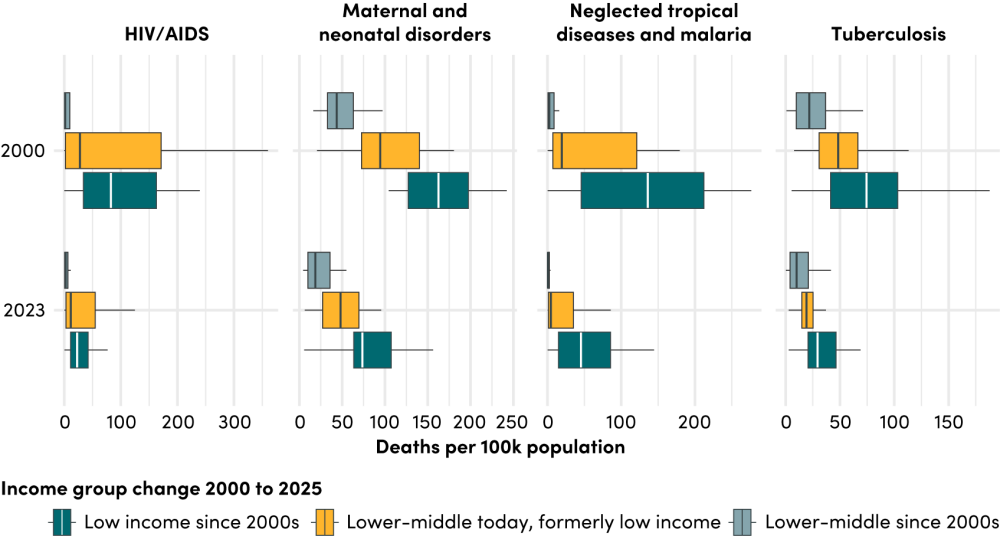
Notes: Data from the IHME Global Burden of Disease Study 2023. Boxplots show the median (vertical line), the interquartile range (box) and range; outliers were removed for ease of visualization.
Coverage with antiretroviral therapy (ART) has increased substantially, but improvements in immunization coverage are more nuanced
ART coverage is one of the biggest success stories in development, particularly for LICs—which have gone from near-zero in the 2000s to leading the field today (Figure 6). This is one of the few areas where there is no gap between LICs and LMICs, today. Immunization coverage levels have also improved, particularly for legacy LICs.
Figure 6. Coverage with selected health services by income group change category, 2000 and 2024
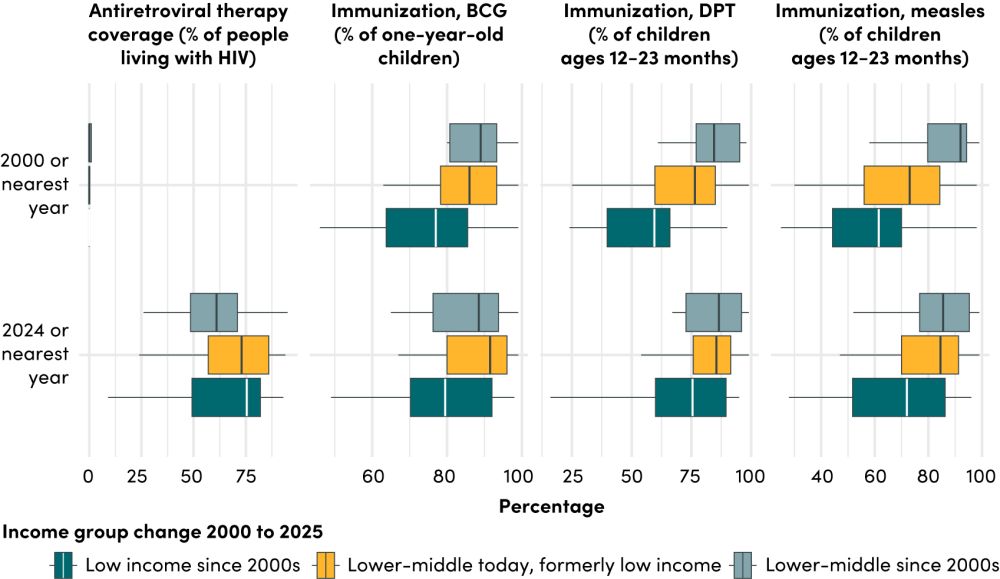
Notes: Data from the World Bank HNP Statistics. Boxplots show the median (vertical line), the interquartile range (box) and range; outliers were removed for ease of visualization.
Health spending in low-income countries is more efficient than it used to be
Longitudinal data on health system (in)efficiency are sparse and must be viewed with caution due to the methodological assumptions they make. Lastuka et al. (2025) estimated the best possible health-adjusted life expectancy (HALE)—a measure of population health—for every level of health spending based on epidemiological and health financing data from 201 countries between 1995 and 2022, then calculated country-year inefficiency scores as the distance between a country's HALE and the frontier at that country's level of spending.
Based on these scores, health spending in LICs used to be more inefficient than in LMICs, but not anymore. Notwithstanding within-group variation, health spending efficiency today is comparable between the two groups, largely because health spending efficiency in LICs has improved considerably (Figure 7).
Figure 7. Health spending inefficiency by income group change category, 1995 and 2022
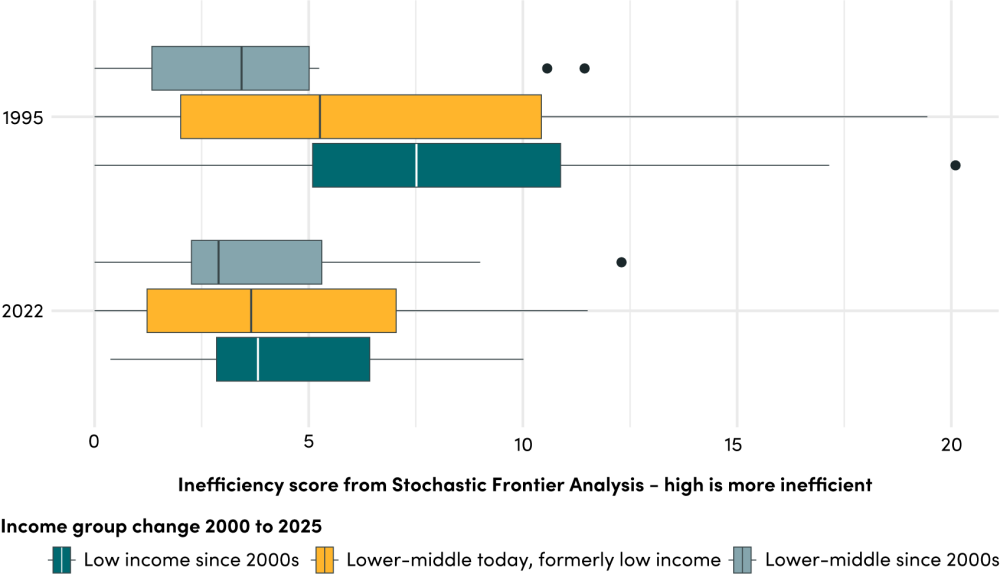
Notes: Data from the stochastic frontier analysis by Lastuka et al., 2025.
Financial protection has improved for most legacy LICs and transitioned LMICs
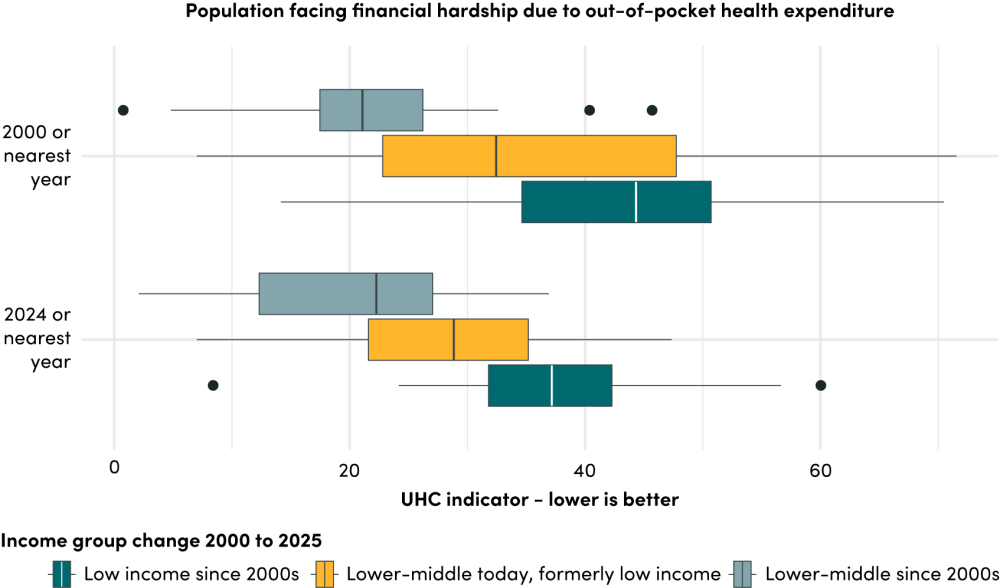
In legacy LICs and transitioned LMICs, financial hardship due to out-of-pocket health expenditure has improved somewhat since the 2000s (Figure 8). LICs as a group are more alike and remain distinct from LMICs. Legacy LMICs, on the other hand, remain broadly where they were in the 2000s, with some having slipped behind since.
Figure 8. Financial hardship due to health expenditure by income group change category, 2000 and 2024
Notes: Data from the Universal Health Coverage Global Progress Report 2025.
The next 25 years: The road to 2050
Over the past 25 years, legacy LICs have narrowed the gap relative to transitioned and legacy LMICs in many health system output and outcome areas; and for HIV/AIDS, the service coverage and mortality gaps have all but been closed altogether. However, they remain significantly behind LMICs, particularly legacy LMICs, in terms of financial protection, health workforce availability, and domestic health spending.
The income group transition of the 2000s has shifted health system heterogeneity from the LIC to the LMIC group. LICs today are, as a group, much more homogeneous than they used to be, while LMICs are much more heterogeneous. Transitioned LMICs share characteristics with both legacy LICs and with legacy LMICs but appear in most areas like a distinct group themselves. On the one hand, this confirms the discriminatory power of GNI per capita; on the other hand, it highlights that the current GNI-based classification into income groups masks important differences in health system capacity and functioning, particularly for LMICs.
The future looks complicated for LICs and transitioned LMICs (Table 2). The World Bank estimated that only a few are likely to transition to middle-income status by 2050. Their economic growth prospects are solid, particularly for LICs. For many of them, government health spending per capita is set to increase somewhat by 2030 in real terms by just under 3 percent annually, which is markedly lower than the 22.7 percent required for LICs (and 10.7 percent for LMICs) to achieve a minimum level of per capita spending for universal health coverage. Their total population is also set to increase considerably by 2050, adding further strain to their health systems. While there is a demographic dividend to be reaped in the long run, this requires investment which looks uncertain currently—not in the least because of debt servicing pressures.
Table 2. Economic growth, population, and debt servicing prospects by income group change category
| Indicator | Legacy low-income (n=24) | Transitioned lower-middle-income (n=32) | Legacy lower-middle-income (n=16) |
|---|---|---|---|
| Outlook for annual real GDP growth in 2031, group median (%) | 5.0 | 4.6 | 3.0 |
| Projected change in total population between 2025 and 2050, group median (%) | 66.2 | 45.5 | 31.5 |
| Outlook for increase in real government health spending per capita between 2025 and 2030, group median (%) | 14.4 | 14.5 | 4.5 |
| Number of countries by debt servicing risk category | |||
| Insolvent with no market access | 2 | 1 | 1 |
| Insolvent with market access | 0 | 4 | 0 |
| Illiquid with no market access | 4 | 5 | 3 |
| Illiquid with market access | 0 | 7 | 1 |
| Lower risk | 11 | 14 | 5 |
| No data | 7 | 1 | 6 |
Notes: GDP growth data from the International Monetary Fund, April 2026 issue of World Economic Outlook data. Population growth data from the United Nations Population Division, World Population Prospects 2024, medium projection. Projections of government health spending per capita from the World Bank Government Resources And Projections For Health (GRPH) 2025 dataset, indicator ‘ghetotpc’. Debt servicing data from Annex 1 in Diwan et al. 2026. 'Insolvent' refers to countries facing an insolvency breach in 2024; 'illiquid' refers to countries not insolvent that are forecast to face a liquidity breach between 2024–2030; lower risk are those defined neither as insolvent or illiquid. ‘Market access’ refers to countries that issued foreign currency bonds in international markets in 2024/25; ‘no market access’ refers to countries that were unable or unwilling to do so.
The implications for ongoing discussions on reimagining the global health architecture are that:
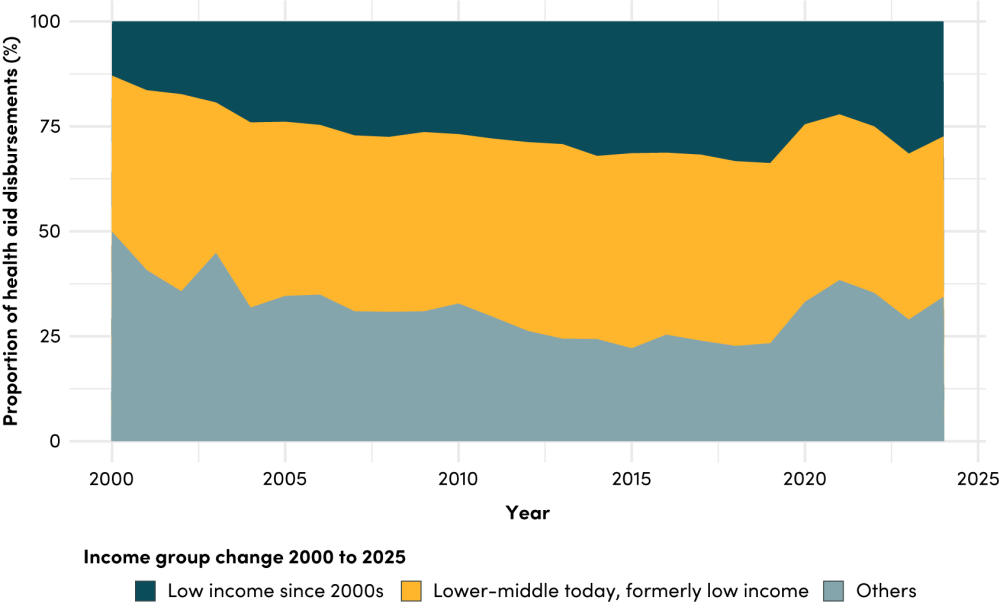
- Remaining health aid needs to refocus quickly and predominantly towards legacy LICs and transitioned LMICs. This is where constraints in health system capacity remain the highest despite progress to date, where health spending delivers high value, where economic growth prospects are strong, and where substantial gains made over the past two decades could be most easily lost without continued funding. Most health aid still goes towards transitioned LMICs, where needs are high but, arguably, not as high as in legacy LICs. Historically, less than 75 percent of health aid has focused on legacy LICs and transitioned LMICs (Figure 9). If anything, legacy LICs have been slightly de-prioritised since Covid-19.
Figure 9. Health aid disbursements by income group change category, 2000 to 2024
Notes: Data from the OECD CRS DAC for sector codes starting with 12 and 13.
- Most legacy LICs will require external support in the long run considering their needs and fragility. Straightforward instruments with simple goals are likely to work best here—for example, grants or highly concessional loans to support the basic service delivery of high-value services.
- Transitioned LMICs also require continued support, but they are a much more diverse group that lends itself to a more nuanced approach to external support. A case-by-case approach would probably go further in the form of bespoke combinations of grants, loans, technical assistance and more complex partnerships targeting both service delivery and health system strengthening.
- Health aid needs to be more agile. For LICs and transitioned LMICs, the margins of objective “need” have become much narrower and the multiple vulnerabilities they face compound one another—be it climate, conflict, or debt. While per capita wealth remains a useful allocation principle for health aid, measures of health system capacity, domestic political will, and vulnerability should also be accounted for routinely in both (re)allocation and design to maximise impact, fairness, and value.
Annex 1. Country categorisation by income classification change since 2000
| Legacy low-income (n=24) | Transitioned lower-middle income (n=32) | Legacy lower-middle income (n=16) |
|---|---|---|
Afghanistan Burkina Faso Burundi Central African Republic Chad Democratic Republic of the Congo Eritrea Ethiopia The Gambia Guinea-Bissau Democratic Republic of Korea Liberia Madagascar Malawi Mali Mozambique Niger Rwanda Sierra Leone Somalia Sudan Togo Uganda Yemen | Angola Bangladesh Benin Bhutan Cambodia Cameroon Comoros Congo Republic Cote d'Ivoire Ghana Guinea Haiti India Kenya Kyrgyz Republic Lao PDR Lesotho Mauritania Myanmar Nepal Nicaragua Nigeria Pakistan Sao Tome and Principe Senegal Solomon Islands Tajikistan Tanzania Uzbekistan Viet Nam Zambia Zimbabwe | Bolivia Djibouti Egypt Eswatini Honduras Jordan Kiribati Micronesia Morocco Namibia Papua New Guinea Philippines Sri Lanka Tunisia Vanuatu West Bank and Gaza |
Source: The author based on World Bank data.
Note: Bosnia, China, Honduras, and Sri Lanka transitioned from low- to lower-middle income between 1995 and 2000.
I am grateful to Rachel Bonnifield, Pete Baker, Tom Drake, and Kalipso Chalkidou for their insightful comments on an earlier draft.
[1] The same progress pattern applies when representing burden as disability adjusted life years (DALYs) – data not shown.
Topics
CITATION
Gheorghe, Adrian. 2026. 25 Years Later: Income Transition and Health System Progress in Low-Resource Settings . Center for Global Development.DISCLAIMER & PERMISSIONS
CGD's publications reflect the views of the authors, drawing on prior research and experience in their areas of expertise. CGD is a nonpartisan, independent organization and does not take institutional positions. You may use and disseminate CGD's publications under these conditions.
Thumbnail image by: World Bank / Vincent Tremeau