Recommended
Event
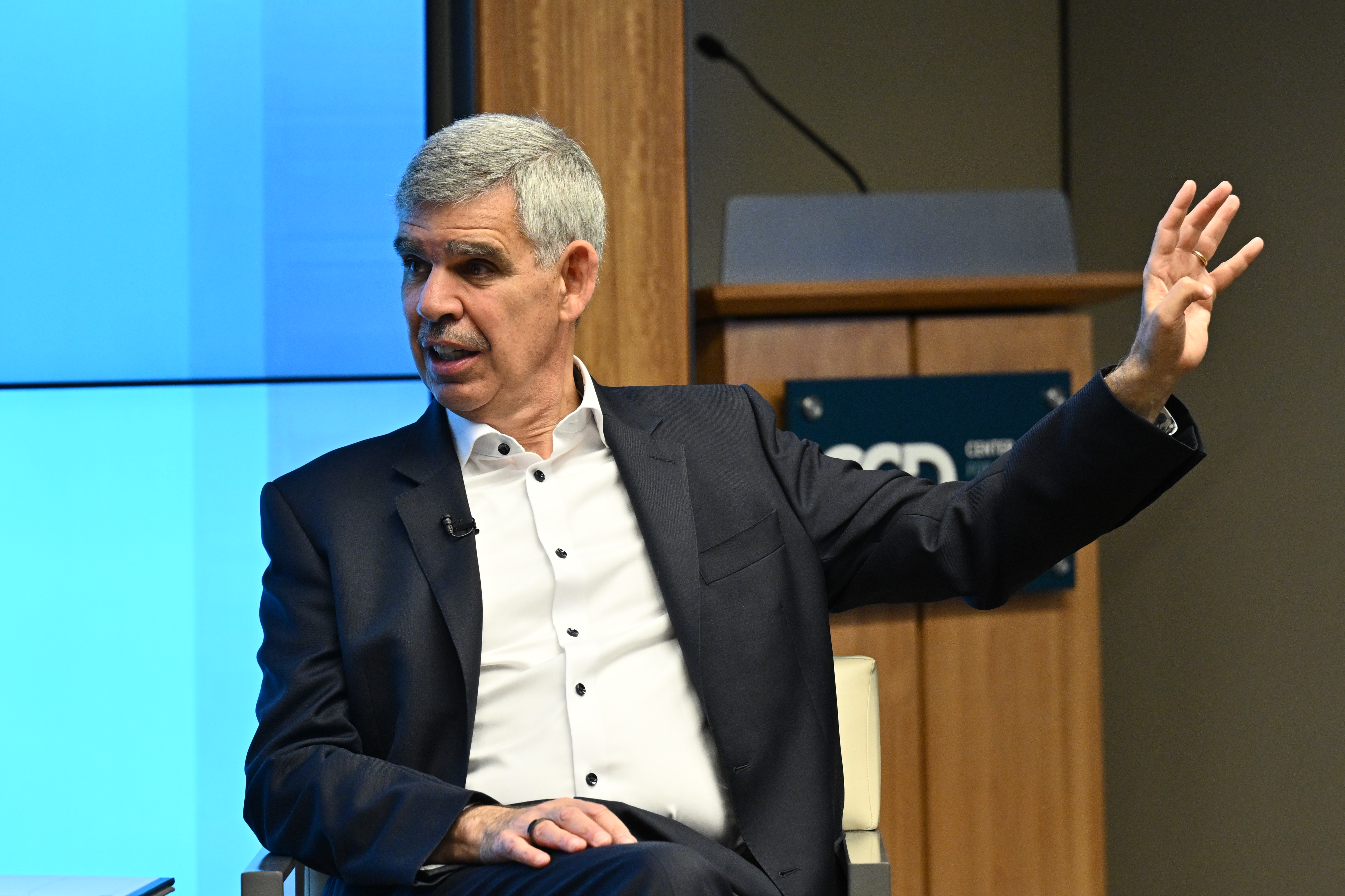
A Fireside Chat with Mohamed A. El-Erian
HYBRID
June 18, 2026 9:30—10:30 AM ET | 2:30—3:30 PM BSTRachel Glennerster: Hello and welcome to the Center for Global Development Podcast. I'm Rachel Glennerster, president of the Center for Global Development. Today we're going to have a little bit of a different format. We're going to bring you a conversation between Mohamed El-Erian, our incoming board chair at CGD, and Judy Woodruff from PBS.
Now, Mohamed El-Erian is a very well-known commentator on financial market issues and emerging market economies. He was CEO of PIMCO, one of the largest investors in emerging markets, and also President of Queens' College, Cambridge. He is currently the Chief Economic Adviser at Allianz, which includes PIMCO. You will hear him a lot on CNN and other places discussing international finance issues, so we're extremely excited to welcome him as CGD board chair.
To kick off his tenure, we asked Judy Woodruff, another member of our board who is a longtime journalist on the News Hour at PBS, to interview him. Something that she has done many times in the past on PBS, and they're going to talk about the Iran war, its impacts on Low- and Middle-Income Countries, on the global economy, why markets and economists differ in some ways on what they think the impacts are going to be and what reforms are needed, et cetera. I will pass over to the discussion that was held at CGD today when I'm recording this.
[applause]
Judy Woodruff: Thank you, Rachel. Delighted to be here this morning to have this conversation with our new board chair, Mohamed El-Erian. Mohamed, I want to ask you about something that's in the news right now. What appears to be a deal, a memorandum of understanding between the United States and Iran, bringing to a close a war that's gone on longer, I think, than most people expected that it would. What effect do you see it having on the world, the world economic picture, assuming it holds, but at this point, what does it look like to you?
Mohamed A. El-Erian: I think we should welcome something that has the potential, and I stress has the potential, to end a war that has hurt lives and livelihoods, not only in the region, but around the world. It's far from a done deal. If you look at the four major challenges. The first one: "Transforming a memorandum of understanding of 14 points into something that's comprehensive and implementable," that requires a lot of negotiations.
The second is the parties involved go beyond the two parties that have signed this agreement. There's a question of: Will other parties also abide by commitments that are made on their behalf in the agreement?
Third, there's this notion that restoring oil production, shipping of fertilizers, oils, like putting on a switch, you turn it on and off. That's not reality. It takes time.
Then the final issue is what I call the economic scarring. There are longer-term effects, including some that haven't been felt yet. They're still in the pipeline, and we've got to manage that. It's wonderful that we have a deal, but I think we should be focused on how to make this deal more meaningful to stop a war that has undermined lives and livelihoods. If you look at developing countries, if you look at the last six years, this is the third major shock. Lots of minor shocks, but the third major shock. The first one was COVID. The second one was what happened to wheat prices and energy prices following Russia's invasion of Ukraine. Then there's a trade issue.
What typically happens when you have a shock is everybody focuses on what happens in advanced countries. The good news is we haven't had a systemic crisis in the developing world. The bad news is we've run down whatever element of resilience was left that has been used up for every one of the shocks. I'm talking about financial resilience. I'm talking about human resilience. This shock is going to have long-lasting effects at a time when most countries are already squeezed, especially investing in the social sectors: health, education, and most countries have to invest in new technologies so that they don't get left behind. It's a very serious setback for development, and it's one, unfortunately, that if we're not careful, it's going to play out over the next months, quarters, and years.
Judy Woodruff: What are you going to be watching for in the near term to see whether the damage that's been done over these last weeks and months is being alleviated in any way?
Mohamed A. El-Erian: The big issue is: do you get more normal flow of goods through the Strait of Hormuz? With that, do you start reducing some of the pressures that come from lack of energy, lack of fertilizers? The longer-term issue is going to be country by country. There are some countries that bought time, literally bought time; used valuable reserves, subsidized energy consumption, and have to restore whatever buffers they had.
There are other countries that have been pushed further towards debt problems and now have to come back. Then there's another set of countries that have had to, once again, cut on investments, on spending on health and education, because that's the easiest thing to cut, unfortunately, but it has the worst effects longer term. It will be country by country as to how they restore the resilience that they have run down.
Judy Woodruff: This is an organization focused on those Low- and Middle-Income Countries. As you focus on them, as opposed to the world overall, are you literally watching for some of these countries to go into a deep crisis mode? What could happen?
Mohamed A. El-Erian: If you think of where we are in the development process, we have three now really big challenges. Whatever headwinds to development we had before—debt, climate, governance—have been made worse by the external effects of the war. The external spillovers have made existing challenges much worse.
Second element, this is happening at a time when aid flows are being cut. When private finance hasn't stepped up yet to the opportunity. There's too many market failures that stop that from happening. Therefore, countries are also dealing with lower funding. Then the third element is the world has changed. The typical development paradigm that people thought was the North Star, if you like, it's not clear if that still is applicable. We haven't got an alternative development paradigm. This is a really important time for the development process and for CGD that can help the thinking on this, can have an impact on policymaking. It's a really challenging time that the war has made more challenging.
Judy Woodruff: When do you think it will be that oil prices will return to levels that they were before the war?
Mohamed A. El-Erian: I'm surprised how fast oil prices have come down. In the last week, we're down 20%, and there's been a massive reaction. This morning when I came in, WTI was trading around 75, 74. We were at 100 not so long ago, and we were in the 60s before the war. We've come back quite a bit.
Judy Woodruff: Does that hold?
Mohamed A. El-Erian: I should ask you. Do you think the memorandum of understanding gets translated into something that is lasting or not?
Judy Woodruff: There's no way I'm going to answer that question.
Mohamed A. El-Erian: Because it's uncertain or--
Judy Woodruff: It's uncertain.
Mohamed A. El-Erian: Yes. That's the answer.
Judy Woodruff: Who knows what will happen? So many different pieces of the puzzle. What's your take on that?
Mohamed A. El-Erian: I'm like you; it's uncertain. It's fascinating, too. The markets have declared mission accomplished, finished, et cetera. The economists are much more guarded.
Judy Woodruff: I want to ask you about that. Why the divergence between what the smart folks, the economists, are saying and thinking, and what the markets are doing?
Mohamed A. El-Erian: I'll give you an incredible example. SpaceX was a private company this time last week. The fifth most valued company in the US, more valued than Amazon. Almost equal to Microsoft. That is market hype, enthusiasm, whatever you want to call it. This then pulls everything else up. You've had the following factors play out in the marketplace.
One, an enormous love affair with the potential of AI. People have brought forward the productivity gains that AI promises, and they've monetized it. The second is behavioral. Because of the policy response function, investors have been conditioned over and over again to buy every dip. It doesn't matter why it is that the markets are going down; it's a profitable opportunity, and it has been a profitable opportunity. Whenever there's a bit of a dip, you immediately get more investors in.
The third is, as much as there are things with the US, if you look at private capital, the US is the cleanest dirty shirt. It's not pristine, but it's a lot more attractive than markets elsewhere. The US also attracts a lot of foreign capital, especially on the back of the AI promise. That momentum builds such a strong tailwind to the market that the market will overshoot on the way up, just like it's overshot on the way down.
Judy Woodruff: The risks to that are?
Mohamed A. El-Erian: It depends how it unfolds. Finance normally is the tail, and you think the fundamentals—that's what really matters—but we learn every once in a while if the imbalance in the financial sector is so bad that the tail wags the body of the dog. We saw that in 2008 during the global financial crisis. I don't think we're looking at something systemic, but we could well have a correction at some stage. It's going to take a major setback to change the behavioral elements of the market right now.
Judy Woodruff: Are there particular effects on the Low- and Middle-Income Countries as a result of the markets potentially overshooting?
Mohamed A. El-Erian: It's the old problem that whatever happens outside can impact you more than where it happens, so yes, it could disrupt normal financing as people become more risk-averse. There's also a bit of a loss of trust. I travel a lot around the world, and there's a lot of questioning of the construct. The construct is the US is in the core of the system. The US produces a lot of public goods to reserve currency. The US provides the deepest financial markets. The US has a strong voice, if not a veto voice in some cases, in multilateral institutions. The US is viewed as a natural leader of the G7, the G20, et cetera.
The implicit contract is the US benefits from every single one of these things. The reserve currency: you issue pieces of paper, and people give the goods and services. That's a great deal. Being the financial center of the world, you get much more capital. Therefore, your borrowing costs are much cheaper than they would be otherwise. You have enormous opportunity to influence, if not impose, outcomes on other countries through the multilateral system. Against that, there was the expectation, implicit contract is the system will be run responsibly.
Then people look and say, "Wait a minute. The 2008 global financial crisis that originated in the US, the first trade war that originated in the US. The US's behavior during COVID in terms of sharing vaccines was not what we expected. Now we have other things coming from the US." There's a lot of people that question this implicit contract. That's why you're seeing efforts to build little pipes. No one can replace the US at the center of the system, but you're seeing lots of little pipes being built around the US to try and increase the resilience of the system. That's increasingly the view from the rest of the world: we cannot replace the US, but we have to reduce our sensitivity to the US.
Judy Woodruff: You're saying that's something that started not just in the last couple of years.
Mohamed A. El-Erian: No, it's been going on for a while.
Judy Woodruff: It's been going on. I want to read the Center's mission to reduce global poverty, to improve lives through innovative economic research that drives better policy and practice by the world's top decision makers. You touched on this a minute ago. Talk about the opportunities that you see at this moment. You mentioned some of the challenges, and clearly, they're there. How do you see opportunities at the same time we're facing the challenges that you're talking about?
Mohamed A. El-Erian: The greater the challenges, the more the opportunities, typically, if you're able to respond to the challenges. This is what this institution has: is the ability to respond to the challenges. You need people. If you look at the work that's come out of here, you have got the people. You need the platform.CGD is respected in really important decision-making places. Then the third thing is you need sustainability. You need to be able to be around, and CGD has that sustainability.
If you look at who can respond to opportunities in a sector that right now is under tremendous pressure, which is development, and that's development economics, development finance, development policy, you can add whatever work you want after development; it's being challenged. The Center for Global Development is uniquely placed, in my opinion. Look at the work that's being done on AI, something that I believe is absolutely transformational but is not automatic at all. In fact, if we leave it to the invisible hand, developing countries are likely to be left behind. You need work to be done in that area to help the development of AI that can be applied in a way that is transforming developing countries.
Look at the debt issues that are facing us. Look at the development finance issues. Look at the role that the private sector should play. I was at a meeting in South Africa last week, and the complaint you hear, which is a very genuine complaint: "Private capital isn't coming to opportunities." Then I said, "Okay, so where's the market or institutional failure? Tell me why it is." They have no view of that; they're just concerned that it's not happening. You need people to be able to research these issues in a policy-oriented way in order—and to use the word that Rachel likes so much—to have impact. The potential for impact is huge when the challenges are so high.
Judy Woodruff: When you talk about the harm that's been done to the development sector, clearly some of that has happened just in the last year and a half. Dismantling the Agency for International Development, other education programs, health programs around the world. Can you quantify how much effect these decisions that have been made just over the last 18 months have had in the development sector?
Mohamed A. El-Erian: This is why we have great people; that's their job. I can tell you, don't focus too much on the US; this is happening elsewhere. Look at what's happened to the aid budget in the UK. It has been radically reduced, not only overall but because some of it has been diverted to domestic product purposes and no longer flows. It's not just the US; this is becoming a more general process, and it's because fiscal constraints are starting to hit. Growing up, it would have been unthinkable that the markets, the bond vigilantes, would attack three of the seven G7 countries. In the last four years, the UK had a market crisis, Japan, and France. The constraint on fiscal is becoming more and more real around the world. Unfortunately, an easy response is to cut your development budget. It's not just the US, we're seeing it elsewhere.
I was at the IMF for 15 years. The easiest thing to cut is spending on social sectors, but that has a really bad, immediate, and longer-term effect. Governments find it easier than to cut spending on military. As the budget constraints amplify, it's much broader than the US. That's why I go back to development is being fundamentally challenged by changes in what we thought were parameters that have become variables.
Judy Woodruff: Let's come back to AI. How do you see it affecting the approach that Low- and Middle-Income Countries can take, and how do you see it affecting them and the different ways they can accommodate or not?
Mohamed A. El-Erian: Let me answer this question in three parts. The financial side, the economic side, and what does it mean for Low- and Middle-Income Countries. The financial side is what I call a rational bubble. The bubble element of it is, at the end of the day, we're going to look back and see a lot of investments prove to be worth very, very little. Why is it rational? Because it's a venture capital approach, the payoff to whoever dominates the AI race is huge, absolutely huge.
It's very hard for people to figure out which of the actors will dominate. If you want to invest in that world, you have a venture capital approach where you spread your capital across a lot of players on the hope that if one or two pay off, it will more than compensate for the losses on the others. Now that is usually played at a small scale. The AI requirements are absolutely huge. The amount of capital being bet that's now going to different platforms is absolutely enormous. At the end of the day, unless we have a situation where there are many winners and most people don't think that this is the likely outcome, a lot of money invested will be worth very little.
Add to that that the incentive of the large platforms is exactly what Ronald Reagan did with the Soviet Union, which is engage in a spending war and then an arms race. You can see the amount of money that will be pulled into that sector relative to what it's likely to pay off is going to be very concentrated. For me, it's a rational financial bubble. For the economy, that's great. This is why we praise US capital markets, because they're willing to fund all sorts of risk they can.
Go to the UK; they have a massive problem with scale-up capital. There isn't enough capital willing to take these sorts of risks. If you believe, like I do, that AI has an enormous productivity potential—it has risks, but it has an enormous positive productivity potential—it's wonderful that you get a marketplace that's willing to allocate so much money for people to innovate.
Then comes the developing country aspect. Here I'm going to quote Marcus and Hans, and they are the experts, so I'm going to quote them. It is not like you can simply drop the technology because the development of technology will not take into account local conditions. You need the ecosystem to be able to benefit from these technologies. We can have massive gains on what the World Bank calls "small AI": health, farming, education. Big AI, that really moves the needle on productivity, needs a lot more supportive initiatives.
Again, this is where CGD comes in. There's work being done on this, both how do you try to inform the platforms of the importance of looking at different country conditions, and also, what are the necessary conditions that you would need for this technology to fulfill what I think is a tremendous promise.
Judy Woodruff: It's time for questions from all of you right here, second row. Tell us your name, please.
David Evans: I'm David Evans here at the Center for Global Development. You sound pretty bullish on the productivity potential gains from artificial intelligence. I agree, I hear you on the ecosystem point about how it's likely to affect Low- and Middle-Income Countries, but I'm curious which sectors you see globally where we see big potential for gains and whether those are sectors that low and middle-income countries are currently active in, and so there's an opportunity that doesn't have to be created out of whole cloth for productivity gains in the developing world as well?
Mohamed A. El-Erian: The sectors right now that are benefiting the most in the advanced countries are finance, tech, and health. That's because they're ready applications that can be done. It's starting to spread slowly through other sectors, but it's proving much more challenging because turning necessary into sufficient is really hard in the AI world. There's this notion that you can just bring in someone, and they'll do it for you, but that's not how it works. You have to fundamentally change your system.
One of the hardest questions is, go to a CEO and ask, "If you grew up native AI, what would your company look like?" Most CEOs cannot yet answer that question. Until you know what your North Star is, it's going to be really hard.
Why do I believe in this promise? The CEO of Microsoft says the following to you: When we first heard about AI, it was ChatGPT. It was about four-and-a-half years ago. It was about: "Ask a question and it answers." A year later, it became: "Give it a task and it will perform." "Summarize this article for me. Write me an email."
It evolved from answering a question to performing a task. Increasingly today, it's your intellectual partner. If you know how to prompt it, and if you check its work and everything, it becomes literally your intellectual partner 24 hours. That's a massive change in four years. Which leads to the second person I love quoting, James Manyika, who's done work with the UN on AI. He was on President Obama's Global Development Council. He says, "We think of AI as a general-purpose technology, like electricity. It takes time for it to change the world, but it fundamentally changes the world, and you end up doing things completely different when you have electricity. It takes a long time for you to understand electricity, but it's a general-purpose technology." It's beyond that. AI is developing so fast that it is also the inventor of inventions. That's the whole quest for artificial general intelligence: the invention of inventions. He summarizes, "Imagine you get the Industrial Revolution and enlightenment happening at the same time. How excited would you be about that?" That's the promise.
The major challenge we all have is that our society is totally in love right now with those working on AI. Is Claude better than Gemini? Is ChatGPT going to come back? We are fascinated by those working on AI. We're spending too little time on the issue of working with AI. The productivity impact doesn't come from the people working on AI exclusively; it comes from working with AI. That's why thinking about it from a developing country perspective is so important. If we froze innovation at where it is right now on AI, the productivity promise is huge if we know how to implement it, but it's really hard stuff.
Judy Woodruff: Let's go to Rachel Glennerster, our CEO.
Rachel Glennerster: Thank you very much. I wanted to come back to the impacts of the Iran war and something that's puzzled me. A few weeks ago, people were saying, "Once you open up the straits, it'll take a long time for the oil to get to places. In the next couple of weeks, we're going to hit these physical shortages of oil." I haven't been hearing much about that. Was it "That didn't happen?" That we're not hearing about it? Or is it that alternative routes and other places were able to expand? Maybe it's because there's enough rationing in Low- and Middle-Income Countries that it hasn't affected prices, but it's unclear to me how that circle is squared.
Mohamed A. El-Erian: Let's start with the rough numbers. The world lost 10 million barrels a day. A bit more, but there was a lot that was rerouted. Net is 10 million; demand destruction was 3 million of that 10 million, so the drawdown in inventory was 7 million. The biggest demand destruction came from China. It included a 20% drop in their oil imports. The question became, "When do we hit critical level at 7 million?" The view was that we would hit it within the next few weeks, and that's, in fact, one argument why we are where we are on the momentum of understanding.
The second issue was that inventory wasn't evenly distributed around the world. The US had absolutely no concern about supply shortages. India had massive concerns about supply shortages. What we found out is that the market is very efficient, much more efficient than most people thought, when it comes to redistributing refined products. You see this in the US numbers of the exports of refined products to the rest of the world. A combination of demand destruction, with China playing a major role in this, plus a much more efficient market has meant a longer runway, if you like.
The other surprise now is how quickly countries are saying they can resume production. The biggest surprise was: Qatar had announced earlier they would take it up to two years to restore LNG production. They said they can restore half now within two months. Today, Kuwait said they can restore oil production much faster than was anticipated. I suspect that is having a huge impact also on oil prices, but it is a puzzle.
Judy Woodruff: Just to follow on Rachel's question, was it hype at the beginning that this was going to do so much damage?
Mohamed A. El-Erian: I don't think people were deliberately hyping. I think people underestimated the demand destruction that would happen.
Judy Woodruff: That people can survive with less?
Mohamed A. El-Erian: Yes. There's four stages to a shock like this. The first stage is very concentrated. Energy prices shoot up. That's the first shock. Phase 2, which we're dealing with, is the energy shock starts becoming a broader price shock. Higher oil prices mean higher diesel prices, higher diesel prices mean higher cost of transportation for food, means food prices go up, so you start seeing the energy shock proliferate through the price shock.
The third element that some countries entered, not the US, is demand destruction. That prices start destroying demand or physical shortages start destroying demand. Then the fourth shock, that we didn't get to, is when that turns into a financial problem, because countries fall into recession, credit risk goes up, the markets become much more hesitant to provide financing, so you get a tightening of liquidity conditions. The speed with which you go down is a balance between your buffers and their use. I think people underestimated first, how much use would come down, especially in China, and then underestimated how the buffers available would be distributed in the system.
Judy Woodruff: On that note, thank you, Mohamed El-Erian, thank you very much, and thank you for your question.
Mohamed A. El-Erian: Thank you.
[applause]
Rachel Glennerster: I hope you enjoyed that discussion between Mohamed El-Erian, our new Board Chair, and Judy Woodruff. For me, some of the key takeaways were, I finally understood the reasons for why markets are maybe more bullish on oil prices than I had expected. Literally some of the math about how we're not in as bad a shortage as we thought we might be a month ago, but still very sobering about the long-term scarring that this could do for the world economy. Also, I thought, a really good encapsulation of the importance and benefits that the US gets from being a key leader of a more globalized, integrated world and what it potentially gives up.
For the rest of the world, its loss from the US not taking that central leadership position or not being trusted to use that central leadership position in a fair way, and how much we're losing as countries try and work around the fact that they can no longer rely on the US to be more of an impartial leader of that economic global cooperation. Not that I'm saying it was always impartial, but more impartial than it was. Sobering, fascinating, but also inspiring about the possible positive impacts of AI if we can get it right.
If you would like to hear more of the discussion, please go to cgdev.org/events. That's cgdev.org/events, and you can watch the whole conversation, including some really good back-and-forth questions from the audience, including from some of our CGD fellows who are grilling Mohamed on some of his thoughts on AI and the Iran war. Thank you very much.
Topics
DISCLAIMER & PERMISSIONS
CGD's publications reflect the views of the authors, drawing on prior research and experience in their areas of expertise. CGD is a nonpartisan, independent organization and does not take institutional positions. You may use and disseminate CGD's publications under these conditions.