Recommended
Blog Post
What Has UK Aid Achieved in Malawi?
Event
Will Burnham's Reform Agenda Come to International Development?
HYBRID
September 15, 2026 4:00—5:00 PM BST | 11:00—12:00 PM EDT
Scotland plays a small but distinct role on international development through its longstanding relationship with Malawi, which has been the central focus of Scotland's international development programme since 2005.
In 2025, First Minister John Swinney argued that it remained "necessary and right" for Scotland to play its part in addressing global challenges despite fiscal pressures, while the Scottish National Party's (SNP) 2026 manifesto pledged to increase the International Development Fund by at least 25 percent.
Malawi remains one of the poorest countries in the world and it faces some of the deepest and most fundamental challenges of any country. Despite this, the UK has effectively ended its support for Malawi, alongside devastating US cuts nearly equivalent to 1 percent of Malawi’s economy.
In this blog, we look at Scotland’s unique role on international development. We show that to meet the UN target for aid as an independent Scotland would cost just under an additional £1 billion per year and ask whether it can find £50m to turn its development role from incremental to meaningful in Malawi. Our new analysis of UK aid in Malawi illustrates the kinds of impact this sort of budget can make. The Scottish government has previously been willing to take its own position on international issues. Doing so again now could help save lives in Malawi, Scotland's longest-standing development partner, and demonstrate a clear departure from the approach taken by the Starmer and Trump governments.
What role does Scotland play on international development?
The Scottish government, led by the Scottish National Party (SNP), does not have formal responsibility for international policy, but at times it has taken one nonetheless. As part of the United Kingdom, foreign policy and international development are reserved rather than devolved matters. However, the Scottish government undertakes international development activities under arrangements that allow it to act “in assistance of a Minister of the Crown”. This provides the legal basis for Scotland's international development programme, but does not give it independent authority in this area.
Under this arrangement, Scotland has chosen to allocate part of its own budget to international development activities. This spending is distinct from—and additional to—the UK's official development assistance (ODA) budget.
This spending is recorded in the UK’s statistics on international development. The Scottish government’s spending was broadly stable at £10–14 million a year until 2020 and rose steadily to £24 million in 2025 (with a spike to £26 million in 2021 driven by in-kind COVID donations).
Over half of spending is channelled through its International Development Fund; but it also provides smaller amounts to a Climate Justice Fund and Humanitarian Emergency Fund. Typically, over a quarter of funding (£5.3m dedicated funding in 2024-25) is directed towards Malawi with Ukraine, Zambia, Rwanda and Pakistan each receiving less than half that share.
Scotland also made a statement contribution to climate loss-and-damage finance as host of COP26 in Glasgow. It became the first Global North government to commit dedicated funding for loss and damage, initially pledging £2 million in 2021. Subsequent commitments increased this to £10 million to date and these contributions are demonstrably additional to its existing support levels.
Alongside its spending, Scotland's international engagement with Malawi is also characterised by a broader civic partnership. This relationship is said to go back to the work of Dr David Livingstone over 150 years ago and now spans several areas, including education, skills, visa support, trade and investment links.
What could Scotland’s aid budget be if it was independent?
The SNP's 2024 UK General Election manifesto supported restoring aid spending to the UN target of 0.7 percent of Gross National Income (GNI). The Scottish government's 2024 independence paper additionally commits an independent Scotland to enshrining that commitment in law. Scotland’s GNI is not calculated annually but has typically (across 2008-2021) been 92.5 percent of its GDP, so perhaps £214 billion in 2025. So, if they were to fulfil the target, their spending would equate to £1.5 billion ($2 billion).
Relative to income, that would make Scotland the 5th in the OECD’s Development Assistance Committee (DAC) and the 18th largest provider in absolute terms, above Austria, Poland and Finland and just behind Ireland, Belgium and Australia.
The UK government provided 0.43 percent of GNI in 2025 and plans a spend of 0.3 percent in 2027. Applying those shares to Scotland’s current GNI suggests its economy effectively contributes £0.92 billion and £0.64 billion respectively. An independent Scotland would therefore need to find around £0.9 billion per year from 2027 to lift ODA to the UN target.
What is happening to Malawi?
The scale of the cuts facing Malawi are over twenty times Scotland’s contribution (which averaged £4.3m across 2021-23). Last year, our colleagues estimated the US reduced its support by $116m (£86m) and the UK has confirmed it will slash support from around £50m in 2025 to £5m by 2028. This comes against a backdrop where our analysis showed that, even before the UK’s cuts, Malawi was already one of the most under-aided countries in the world.
Fig 1. FCDO aid to Malawi (£000) FY2020-2028
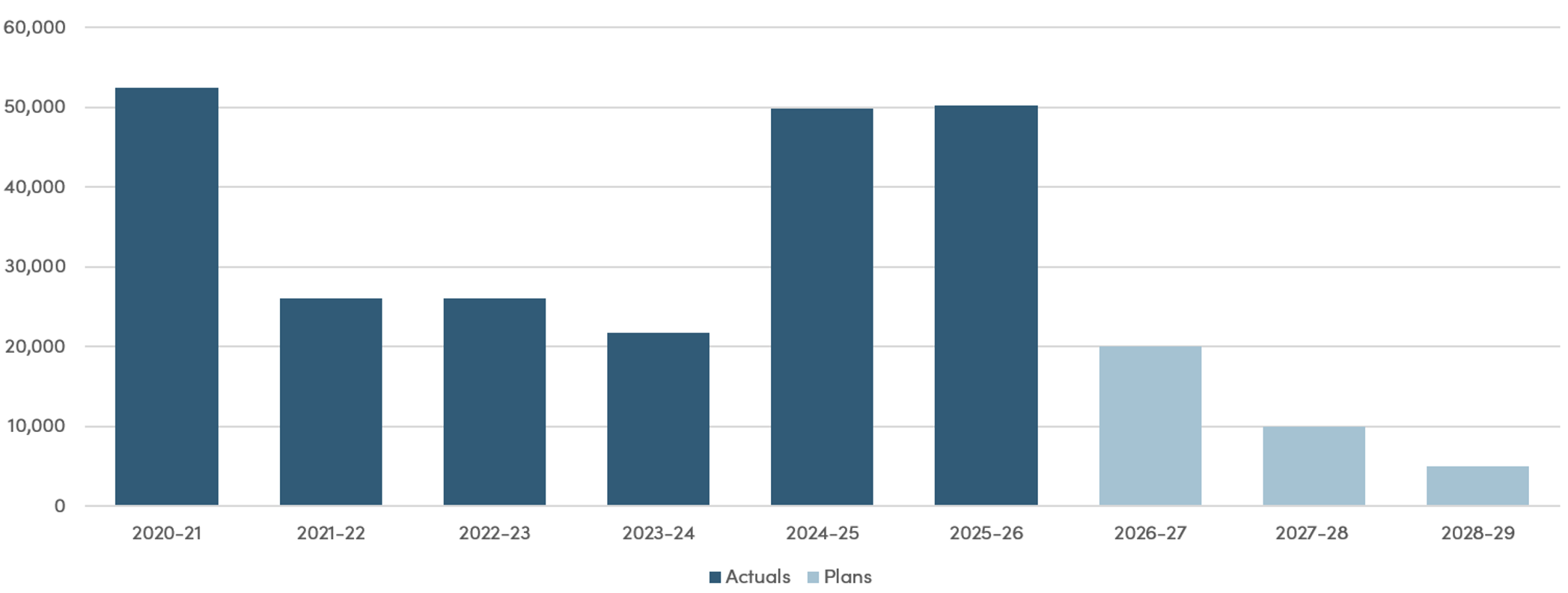
Source: Authors’ analysis, FCDO annual reports
In this context, the promised 25 percent increase is less than £1m, leaving the Scottish contribution to Malawi at best very modest and at worst irrelevant.
What could the SNP Government do?
The UK government has responsibility for policy on international development. But the Scottish government could contribute more internationally and the dilemma it faces is almost identical to that of the UK—that is, any sustainable additional spending must come from diverting resources, or increasing taxes. This is the situation the SNP government faces now, and would also be the implication of meeting the UN target as an independent country. There is no free money.
But there is also an opportunity here for Scotland. Many voters remain supportive of international development and there is potential political credit in the UK for taking a distinct path to that of the Trump administration who are destroying the idea of aid to tackle extreme poverty.
If Scotland increased its support for Malawi to 1 percent of its budget (£50m per year), it could rescue the very best aid programmes, become Malawi’s biggest European partner and deliver incredible benefits to Malawians.
A new review of UK aid over the past 20 years in Malawi shows what results this level of funding can achieve. UK support helped save the lives of more than 7,000 mothers—roughly equivalent to every woman in St Andrews or Larkhall—and more than 8,000 children under five, more than the number of babies born in Glasgow in 2024.
There’s no hiding that the additional £50m would need to come from reduced spending or increased taxes in Scotland, but if the Scottish government could find the political courage, it would not just save lives, it could fulfill its pledge to be a “good global citizen” and show that a different direction is possible.
Topics
DISCLAIMER & PERMISSIONS
CGD's publications reflect the views of the authors, drawing on prior research and experience in their areas of expertise. CGD is a nonpartisan, independent organization and does not take institutional positions. You may use and disseminate CGD's publications under these conditions.
Thumbnail image by: Adobe Stock Images