Recommended
Blog Post
Three Issues to Watch at WHA79
Blog Post
A Lean World Health Organization: Four Responses to Our Proposal
The election of the World Health Organization’s (WHO) next Director-General comes at a pivotal moment for the organization. Mounting geopolitical tensions, the exit of the United States, and global aid cuts are all placing increasing pressure on the organization’s influence and finances. A new vision for WHO is needed from the candidates, one that can bring Member States behind it and ensure funding continues to flow.
The temptation for the six prospective candidates is to offer all things to all people. WHO has 194 Member States, all with different priorities and expectations, and candidates who explicitly propose reducing particular programs or activities risk alienating parts of the electorate. Individual Member States have a clear incentive to vote to protect the specific services they receive directly, while the responsibility for protecting functions that benefit all countries is more diffuse. The Director-General election is therefore one of the few moments when an individual can inspire a better collective decision, seeking to avoid the tragedy of the commons, and instead mobilize countries behind a new vision for the WHO for the greater global good.
In this blog, we lay out three tests that WHO Member States should be asking of the candidates: 1) Does the candidate have a clear vision? 2) Are they willing to say what the WHO should stop doing to achieve this? 3) Does the vision drive us towards a WHO for the Global Good?
Test 1: What is your vision for the WHO?
The first test is whether a candidate has a clear vision for what WHO’s role should be. This means articulating their understanding of the organization’s mission, its comparative advantages relative to other organizations, and therefore where its priorities should lie. This should primarily be in terms of functions. What does the candidate think the WHO should do for Member States? Is its role to provide technical assistance to countries? Stamp out outbreaks? Enable collective decision-making? And should this differ by region or country? All future decisions flow from this.
Candidates who focus on specific themes such as climate change are missing the chance to reform the WHO to be better at tackling those themes. Those who focus on specific country goals such as universal health coverage rather than WHO’s institutional functions are distracting the electorate from where the WHO actually has power. And those who suggest the WHO should do all things for all countries are not being straight with Member States about the organization’s very limited resources.
Test 2: What should the WHO stop doing?
The real test for any leader is whether they are willing to say what an organization should do less of, stop doing, or leave primarily to others. With such tight budgets, the only way to make any serious progress on achieving a new vision is to protect areas that matter, and strategically cut areas that are low priority.
WHO’s 2025 cost-cutting exercise illustrates why this is so important. In the face of a major funding shortfall, the organization decided to reduce all regional budgets by 14 to 15 percent. As we argued at the time, this was clear evidence of stakeholder management, rather than strategic prioritization. A candidate proposing a new vision should therefore be able to explain which areas of WHO’s work could be scaled back, and where those resources could be redirected. This should include how they see the WHO’s role relative to the World Bank, the Global Fund, Gavi, and other UN agencies: where the WHO should lead, where it should set norms and provide guidance, and where others are better placed to finance or deliver.
Candidates do not need to enter the campaign with a detailed plan for restructuring the organization. They should, however, be able to point to specific functions or programs where they think WHO is doing too much, or where its role could be more limited, and explain whether those responsibilities could be shifted elsewhere. Promises to improve efficiency, reduce duplication, or make better use of limited resources should be viewed skeptically. New initiatives, envoys, or flagship programs announced without corresponding reductions elsewhere would raise the same concern.
Member States should therefore press candidates on what they would protect and expand, as well as what they would expect the WHO to scale back as Director-General.
Test 3: Will you support a WHO for the Global Good?
Member States should apply the first two tests regardless of their view on the future of the WHO. The third test is based on our view that the world needs a WHO for the Global Good.
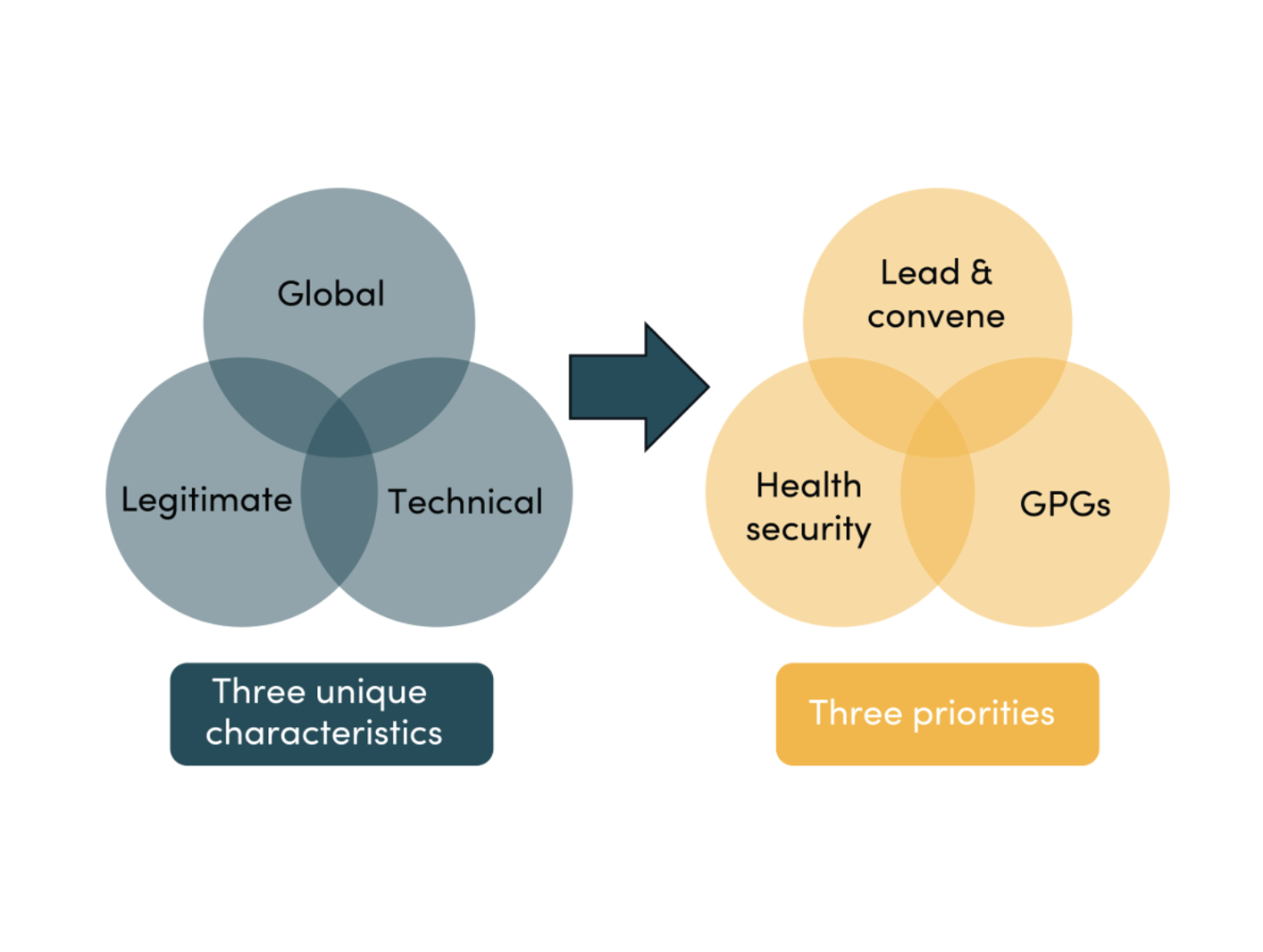
WHO’s comparative advantage rests on three characteristics: it is uniquely global, uniquely legitimate, and uniquely technical. We contend that these characteristics translate into three areas where WHO has particular value: global leadership and convening, global health security, and the production of global public goods.
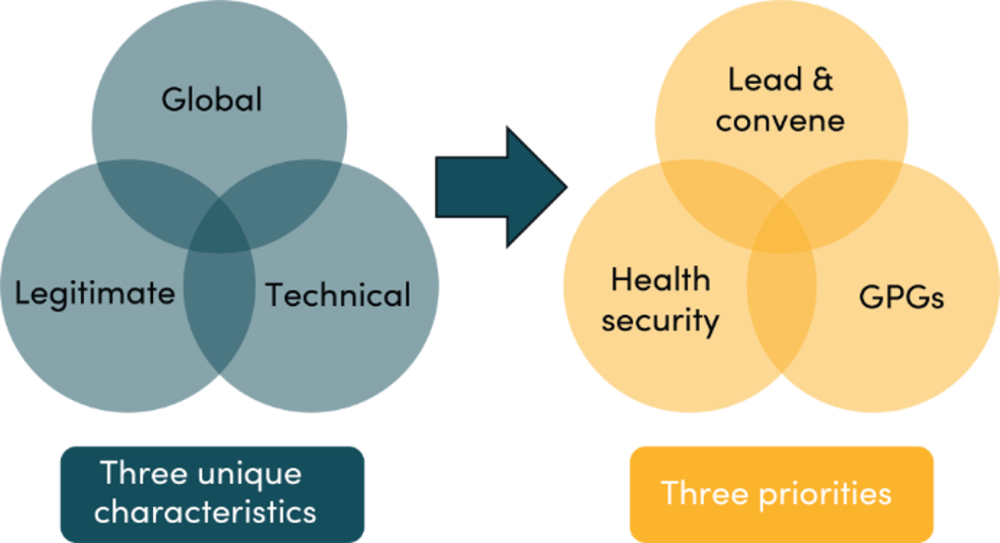
These functions include convening governments and shaping the global health agenda, setting international norms and standards, developing technical guidance, coordinating surveillance across countries, assessing and prequalifying health products, and helping the international community prepare for and respond to cross-border health threats.
This is a vision with very clear implications for prioritization and for what the WHO should stop doing. Because these functions are primarily global, the balance of WHO resources should shift toward its global functions and away from direct country-level technical assistance and service delivery. The boldest statement of this would be a commitment to reduce resources spent at the country level to be able to deliver on global functions, while protecting outbreak response and the countries that depend most on the WHO.
A stronger focus on WHO’s global functions also does not necessarily mean concentrating those functions in Geneva. Some may be better carried out through regional offices. The point is not where the work sits, but whether WHO is concentrating its limited resources on global functions that other actors would struggle to replace.
What Member States should do now
Over the coming months, there will be many opportunities for candidates to establish their priorities in more detail. Member States and those moderating candidate discussions should use these opportunities to put these three tests to the candidates.
A candidate that is serious about reform must pass tests 1 and 2. One that is serious about a WHO for the Global Good would need to pass all three tests. They would need a compelling vision which articulates that the role of the WHO is to deliver a healthier world, that the comparative advantage of the WHO is global, and that the functions the WHO must deliver to Member States are primarily global in nature. The candidate must then show how this vision prioritizes resources for the global good and be willing to reduce resources for country-level work, while protecting those that depend most on the WHO.
The most likely outcome, however, is a candidate that promises everything, and by doing so, does not truly secure a mandate for a WHO for the Global Good. This would be a missed opportunity, and Member States must interrogate it.
Topics
DISCLAIMER & PERMISSIONS
CGD's publications reflect the views of the authors, drawing on prior research and experience in their areas of expertise. CGD is a nonpartisan, independent organization and does not take institutional positions. You may use and disseminate CGD's publications under these conditions.
Thumbnail image by: scorcom/ Adobe Stock