Recommended
WORKING PAPER
School Meals in Crisis Settings
Blog Post
Global School Meals at the Next Frontier
Blog Post
What Does It Cost to Feed a Child?
School meals can play a role in keeping children in school during crises, but they can also consume a large share of already stretched education budgets in emergency situations. With international funding for education in emergencies facing historic cuts, how efficiently programmes spend will be as important as how much they receive. This blog highlights three findings from a new CGD working paper analysing 65 grants funded by two of the leading organisations supporting education in emergencies, Education Cannot Wait (ECW) and the Global Partnership for Education (GPE), from 2018 to 2024.
- School feeding absorbs a disproportionate share of grant budgets, accounting for about 31 percent of the aggregate budget while reaching 7 percent of total beneficiaries. This points to a potentially important budget–coverage trade-off, even though our analysis does not establish relative value for money.
- Per-child costs vary enormously, from $4 to over $200, and are highest in settings where needs might be greatest: drought zones and complex, multidimensional crises. While there is some evidence of economies of scale, it can be difficult to achieve in more complex contexts.
- On-site hot meals dominate delivery modalities, while the evidence base on potentially more cost-effective alternatives remains thin.
The funding context: Why trade-offs and cost efficiency are more critical now
There is sound evidence that school meals in emergency settings improve education continuity. Across the programmes examined in the working paper, attendance, retention, and re-enrolment were the most commonly cited objectives, and case study evidence from nine programmes suggests that feeding is valued precisely because it provides an immediate and tangible incentive for families to send children to school even in the midst of crisis.
But these programmes are overwhelmingly funded by international aid, and the current environment for development and humanitarian finance is the most constrained in years. ECW estimates that 234 million crisis-affected children need urgent education support. At the same time, OECD preliminary figures show that official development assistance (ODA) from Development Assistance Committee (DAC) countries fell by 23.1 percent between 2024 and 2025, while UNESCO warns that aid to education could fall by more than 25 percent by 2027.
The squeeze on education in emergencies (EiE) is especially severe. The Global Education Cluster’s analysis of the 2025 humanitarian reset found that education funding requirements were cut by 33 percent and target numbers by 43 percent, with some country contexts seeing reductions of up to 90 percent. Education ranked only ninth of 13 sectors in Central Emergency Response Fund (CERF) anticipatory action funding as it continues to be treated as more deferrable than other humanitarian needs.
In this context, programming decisions about school meals need to grapple more directly with three questions: What are the real trade-offs when school meals are funded from a constrained emergency education budget? How cost-efficient are these programmes, and where do costs become prohibitive? And can better coordination across sectors relieve the pressure on the education pot?
The trade-off: What is the opportunity cost of including school meals in an education grant?
In the programmes reviewed in our data, school feeding was never delivered as a standalone intervention. It was invariably embedded in broader education-in-emergencies packages that included a range of other interventions such as learning materials, teacher training, water, sanitation, and hygiene (WASH) infrastructure, psychosocial support, or school rehabilitation. But its share of the budget within those packages is often disproportionately large.
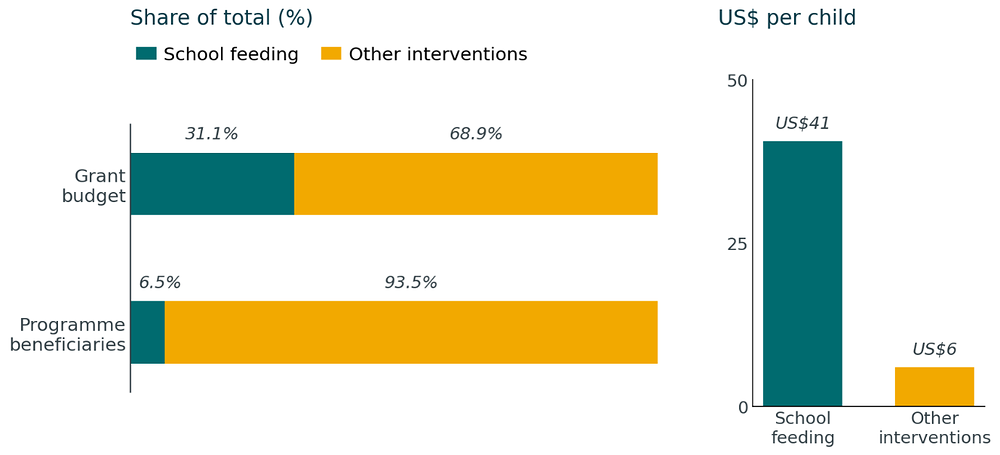
Among 19 grants for which budget and beneficiary breakdowns are available, school meals absorb 31 percent of the total grant budget but reach only 7 percent of total beneficiaries (Figure 1). The aggregate per-child allocation for school meals is $41, compared to $6 for non-feeding components. School feeding’s budget intensity—the ratio of its budget share to its beneficiary share—is 4.8. This means its budget share is nearly five times its beneficiary share across the portfolio.
Figure 1. School meals are often among the most resource-intensive components of EiE packages
Source: Authors’ calculations from ECW and GPE grant-level data. N=19 grants with complete budget and beneficiary data.
This does not mean school feeding is a poor investment in most cases. A meal addresses an essential human need in a way that conventional education interventions cannot, and the attendance effects of meals may amplify the impact of other educational inputs that would otherwise be lost if children are absent or hungry. Moreover, the non-feeding remainder of each grant is a heterogeneous mix of interventions, and beneficiary counts do not capture the value or effectiveness of what each child receives. These limitations mean the figures should not be interpreted as comparison of value for money. They do, however, highlight an important resource allocation question: school feeding is resource-intensive and may reduce the scale of other interventions within a fixed grant envelope, so grant design should make this trade-off explicit.
Cost efficiency: Context, scale, and modality
Costs vary dramatically by emergency type
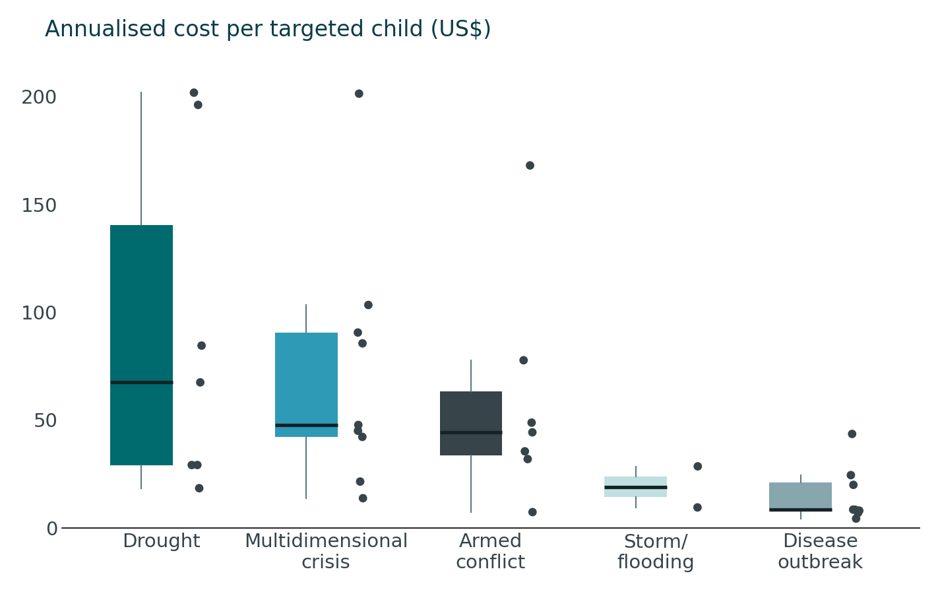
The paper finds wide variation in the annualised cost per child across grants, ranging from $4 to over $200, with a median of $35 and a mean of $56 (Figure 2). A sizeable portion of this variation can be explained by the type of emergency.
Figure 2. Costs tend to be higher in drought and complex emergencies
Note: Per-child costs adjusted for school-year programme duration. N=33 grants. Each dot represents a programme grant.
Drought-affected programmes are the most expensive, averaging $90 per child. This is consistent with the likelihood that drought raises domestic food prices or forces reliance on imported supplies. In multidimensional crises—where conflict, food insecurity, displacement, and epidemics can compound one another—the average programme costs around $72. By contrast, disease-outbreak programmes (predominantly COVID-19 responses) cost just $16 per child. While schools were closed, the surrounding food system—including households, markets, roads, and supply chains—remained largely intact.
Scale advantages exist but are limited in complex emergencies
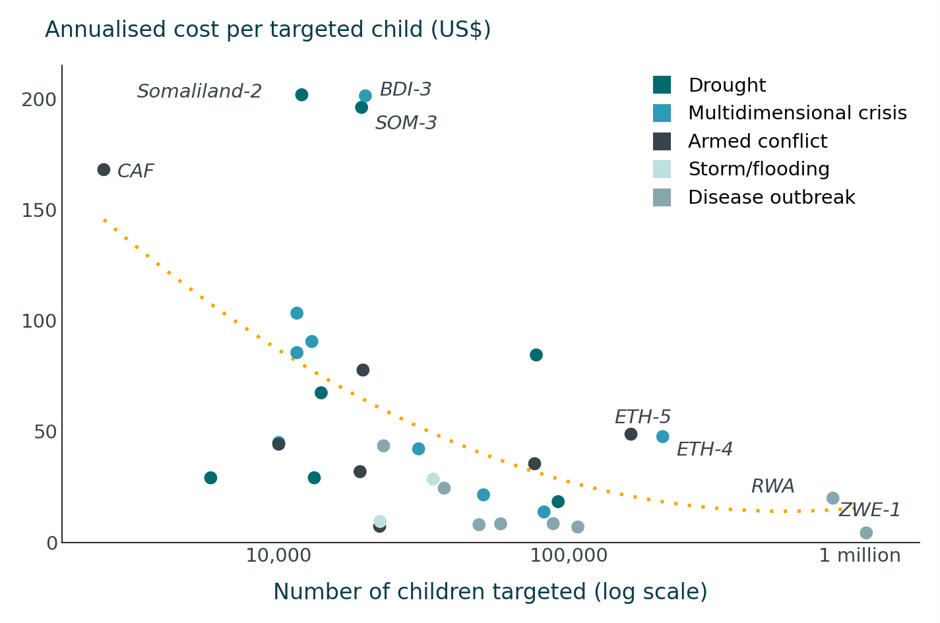
Across the full sample of grants with cost and beneficiary data, there is a clear inverse relationship between programme scale and unit cost (Figure 3). The two largest programmes—a UNICEF intervention in Zimbabwe targeting over one million children ($4 per child) and a World Bank programme in Rwanda targeting 808,000 children ($20 per child)—record some of the lowest costs. In contrast, the smallest programme, in the Central African Republic (2,500 children), costs $168 per child.
Figure 3. Economies of scale are possible, but harder to achieve in emergencies with supply-side constraints
Note: Annualised cost per child against programme scale (log), by emergency type. Fitted line shows the overall cost-scale relationship. Each dot represents a programme.
The fitted cost-scale relationship flattens considerably when disease-outbreak programmes are excluded. This suggests that economies of scale can be harder to attain in complex emergencies including armed conflict and multidimensional crises, likely because access constraints and volatile food prices limit the extent to which scale translates into lower unit costs in such environments. This has important implications for programming: planners may not always be able to assume that expanding coverage will reduce unit costs.
Scale can be achieved by expanding coverage within schools or adding more schools across a geography. Within schools, coverage tends to be near-universal—as our case studies show,there is little ethical or economic basis for means-testing within schools in the context of emergencies. Where budgets are tight, programmes prioritise younger grades or groups already identified as vulnerable by local or school administrations. Across schools, selective targeting is cheaper than the alternative but may create its own problems through negative spillovers, such as children transferring from non-feeding to feeding schools, straining resources and distorting enrolment. Geographic saturation, where feasible, may therefore be preferable to selective school-level targeting. Saturation requires budgets that may be unrealistic in the current funding environment, however.
Modality: The dominance of hot meals and the absence of evidence on alternatives
Delivery modality is near uniform. On-site hot meals dominate: 37 of 42 grants reporting modality used them. Only two grants (both in Ethiopia) used high-energy biscuits, and take-home rations appeared in a small minority of cases, typically as temporary substitutes during COVID-related school closures.
This likely reflects path-dependence, as implementers and host governments default to cooked meals based on past experience and presumed best practices. There are also genuine nutritional arguments for hot meals, which can offer a more diverse and calorically adequate ration than biscuits—particularly important in protracted crises where children face dietary deficits. Although several programmes providing on-site meals did so at relatively low cost per child, the efficiency and equity implications of using emergency education grants to pursue nutrition objectives—rather than relying on broader food security measures such as cash transfers—deserve careful scrutiny. This matters particularly because nutrition outcomes were rarely prioritised in monitoring frameworks or measured systematically for reporting. Testing alternatives such as take-home rations will require building up of the evidence base deliberately, rather than defaulting to these modalities as adaptations.
Financing and coordination: How to stretch scarce budgets
School feeding sits at the intersection of education, nutrition, social protection, and food security, yet it is typically funded from the education budget alone—through ECW, GPE, or bilateral education aid. A broader humanitarian-development-peace (HDP) nexus approach may be especially important in the current environment. Better coordination in planning and targeting could help address both the nutrition needs of schoolchildren and education continuity more efficiently and equitably, without placing excessive pressure on constrained EiE budgets.
One explanation for lower unit costs in the case studies was the use of existing national platforms. In Mozambique and Haiti, for example, the centralised procurement of a standard basket of goods by the World Food Programme (WFP) enabled expansion despite insecurity and infrastructure damage. This suggests that in less acute or protracted settings, engaging established systems can be a driver of cost efficiency. Using national targeting mechanisms and government supply chains can potentially reduce the coordination and transaction costs that push up unit costs in bespoke humanitarian delivery models. Community participation can also stretch budgets.
Given that the existing EiE system is institutionally crowded but financially constrained, the marginal return from investing in strengthening systems—such as delivery platforms and anticipatory mechanisms—might be high. Community cost-sharing, where it can be designed with equity trade-offs in mind, could be a complementary household-level lever.
Policy implications
Five practical messages follow for donors and implementing agencies.
- Make the trade-off explicit. School feeding absorbs a large share of emergency education budgets relative to the number of children it reaches. Grant proposals should show what this means for the scale and scope of other education interventions that could be included in the same grant package.
- Calibrate costs to context. School meal interventions in droughts and complex crises tend to have higher per-child costs. Programme appraisal should use context-specific cost bands to allow well-informed and realistic assessment of interventions.
- Test alternatives to on-site hot meals. The dominance of cooked meals appears to reflect institutional path-dependence rather than strong comparative evidence. Where hot meals are prohibitively expensive, donors should compare high-energy snacks, take-home rations, cash, or vouchers against education continuity objectives.
- Take geographic saturation seriously in programme appraisal. The implementation of school feeding across a partial set of schools in a given cluster can create spillovers, as children shift from non-feeding to feeding schools, straining resources and distorting enrolment. Saturating a catchment area can reduce this, but the minimum effective scale may exceed the budget. Where saturation is unaffordable, appraisal should consider alternative targeting units or delivery models that reduce incentives for school switching.
- Coordinate more deliberately across EiE funding instruments. In a constrained environment, the gains from stronger coordination among the remaining major funders—notably GPE and ECW—are greater than ever. Better alignment in system-strengthening investments, resource mobilisation, and funding strategies could help stretch scarce resources further.
As budgets tighten, the key question is no longer whether school meals matter in crises, but when and how they can be delivered cost-effectively.
Topics
DISCLAIMER & PERMISSIONS
CGD's publications reflect the views of the authors, drawing on prior research and experience in their areas of expertise. CGD is a nonpartisan, independent organization and does not take institutional positions. You may use and disseminate CGD's publications under these conditions.
Thumbnail image by: GPE/Mrutu (Trans.Lieu)